
Yugoslav Dinar
The Yugoslav dinar is the ultimate monument to hyperinflation, defined by the 1993–1994 collapse and the legendary 500,000,000,000 dinar banknote.
Quick Facts
Country: Yugoslavia
Code: YUD
Symbol: дин
System: Decimal (1 Dinar = 100 Para)
Status: Withdrawn
Issuer: National Bank of Yugoslavia
The Story of the Yugoslav Dinar
The Yugoslav dinar (YUD) evolved from a symbol of socialist industrial ambition into one of the most extreme cases of hyperinflation ever recorded. During the terminal phase of 1993–1994, prices were doubling in a matter of hours, and entire banknote series lost relevance almost immediately after release. Issued by the National Bank of Yugoslavia, the currency underwent repeated redenominations, stripping zeros only for them to reappear within weeks. The result was a monetary environment where denominations escalated into the billions and beyond, culminating in the now-iconic 500,000,000,000 dinar note—an object that redefined the visual limits of value itself.
Design & Symbolism
Banknotes of the late Yugoslav series represent a rare fusion of economic chaos and technical discipline. Produced by the state’s ZIN facility in Belgrade, with strong European technological influence, these notes retained high-quality intaglio printing, detailed guilloché structures and multi-tone watermarks even at the peak of collapse. The visual narrative shifted from structured socialist imagery toward simplified layouts dominated by enormous numerals. In a striking cultural contrast, the 500 billion dinar note features the poet Jovan Jovanović Zmaj—an intellectual figure placed on one of the most economically meaningless denominations ever issued, creating one of the most powerful ironies in banknote history.
For collectors
For collectors, Yugoslavia stands as the definitive field for “Hyperinflationary Sequences” and “Zero-Expansion” collecting. UNC specimens are particularly significant as many notes from the 1993–1994 emissions never fully entered circulation before being replaced, effectively preserving them as untouched time capsules. The appeal lies in constructing full denomination progressions—from thousands to billions—visually documenting the acceleration of monetary collapse. At WorldBanknotes.eu, our Yugoslav selection is curated for sharp paper structure, intact edges and strong ink definition, allowing collectors to experience the raw intensity of one of the most dramatic financial breakdowns in modern history.
The Yugoslav dinar was officially replaced in 1994 by the Novi Dinar, pegged to the German Mark in an effort to halt hyperinflation and restore monetary stability.
Explore the Yugoslav Dinar Banknotes Collection
-

Yugoslavia 100 Dinara 1965, P-80c, UNC
2,49 € -

Yugoslavia 10 Dinara 1968, P-82c, UNC
2,49 € -

Yugoslavia 50 Dinara 1968, P-83c, UNC
1,49 € -

Yugoslavia 20 Dinara 1974, P-85(2), UNC
1,49 € -

Yugoslavia 10 Dinara 1978, P-87a, UNC
1,49 € -

Yugoslavia 10 Dinara 1981, P-87b, UNC
1,49 € -

Yugoslavia 20 Dinara 1978, P-88a, UNC
1,49 € -

Yugoslavia 50 Dinara 1981, P-89b, UNC
1,49 € -

Yugoslavia 100 Dinara 1986, P-90c, UNC
2,49 € -

Yugoslavia 500 Dinara 1981, P-91br, UNC
2,49 € -

Yugoslavia 1000 Dinara 1981, P-92d, UNC
1,49 € -

Yugoslavia 5000 Dinara 1985, P-93a, UNC
2,99 € -

Yugoslavia 10 Dinara 1990, P-103, UNC
2,49 € -

Yugoslavia 50 Dinara 1990, P-104, UNC
1,49 € -
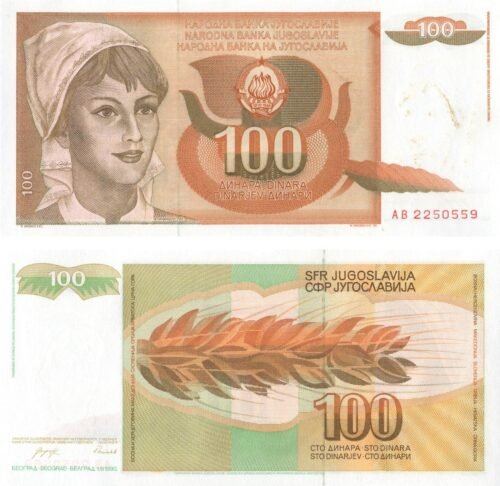
Yugoslavia 100 Dinara 1990, P-105, UNC
2,99 € -

Yugoslavia 500 Dinara 1990, P-106, UNC
2,99 € -
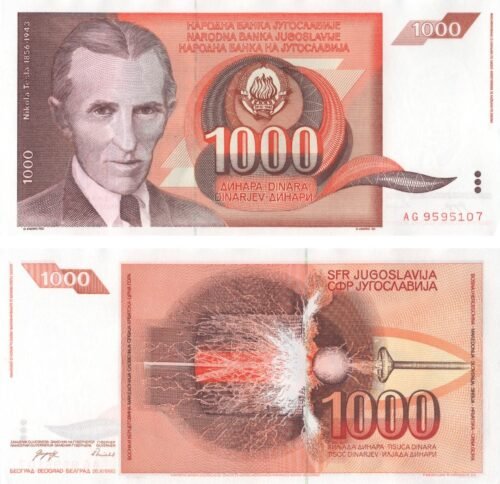
Yugoslavia 1000 Dinara 1990, P-107, UNC
2,49 € -
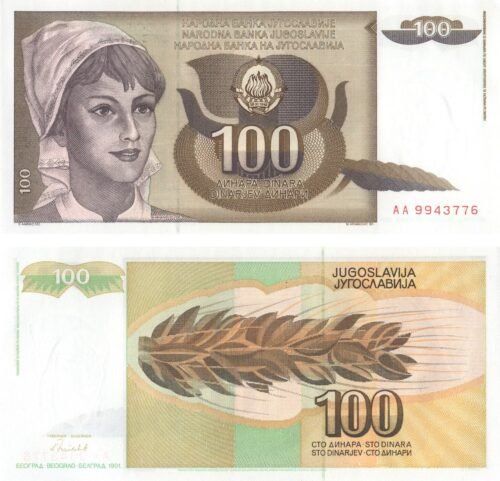
Yugoslavia 100 Dinara 1991, P-108, UNC
2,49 € -

Yugoslavia 500 Dinara 1991, P-109, UNC
2,49 € -

Yugoslavia 1000 Dinara 1991, P-110, UNC
3,99 € -
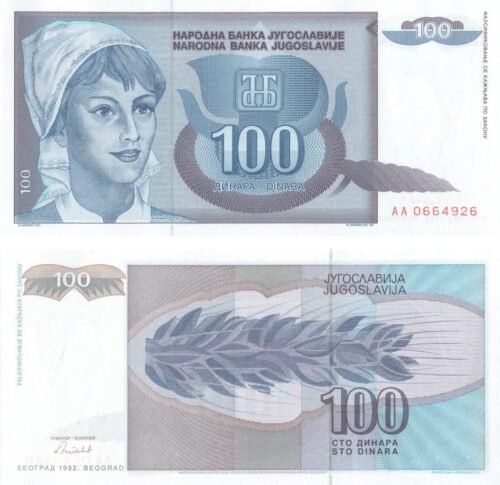
Yugoslavia 100 Dinara 1992, P-112, UNC
1,49 € -

Yugoslavia 500 Dinara 1992, P-113, UNC
2,99 € -

Yugoslavia 1000 Dinara 1992, P-114, UNC
3,99 € -

Yugoslavia 10000 Dinara 1992, P-116a, UNC
1,49 €