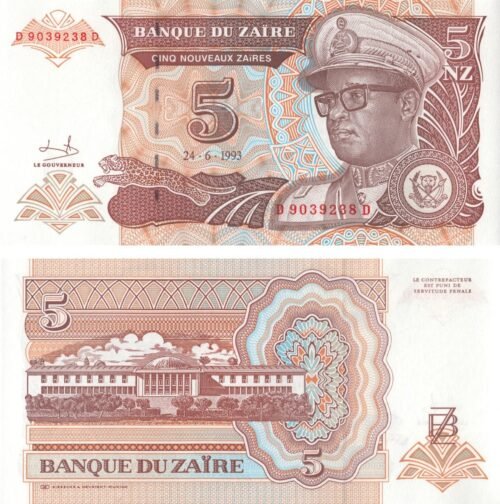
Zairean Nouveau Zaire
The Zairean nouveau zaïre was the 1993–1998 reform currency created during hyperinflation at one new zaïre to three million old zaïres and later replaced by the Congolese franc at 100,000 to one.
Quick Facts
Country: Zaire
Code: ZRN
Symbol: ZRN
System: Decimal (1 Nouveau Zaïre = 100 Makuta)
Status: Withdrawn
Issuer: Bank of Zaire
The Story of the Zairean Nouveau Zaire
The Banque du Zaïre introduced the nouveau zaïre on 1 October 1993 as a drastic redenomination during hyperinflation. One nouveau zaïre equalled three million old zaïres, creating a new accounting unit while the underlying monetary instability continued.
The first family was dated 24 June 1993 and included fractional denominations in nouveaux makuta before moving through 1, 5, 10, 20, 50, 100 and 200 nouveaux zaïres. The sequence quickly expanded as inflation eroded purchasing power, making the reform itself only a temporary reset.
Production history is unusually complex. Giesecke+Devrient printed a large part of the early family, while several 1993–1994 denominations are catalogued as Ciccone Calcográfica printings from Argentina despite carrying a Hôtel des Monnaies-ZAÏRE imprint. The Banknote Book records that these Ciccone notes entered circulation without official authorization or knowledge of the Banque du Zaïre.
The currency survived into the late 1990s but was ultimately replaced by the Congolese franc in July 1998 at one franc to 100,000 nouveaux zaïres. Taken together with the 1993 conversion, the two ratios show the scale of monetary compression experienced within a single five-year currency period.
Design & Symbolism
Mobutu Sésé Seko is the dominant figure of the nouveau-zaïre series. His military portrait, a leopard and the national coat of arms recur across most obverses, giving the banknotes a highly centralized political identity despite frequent denomination changes.
The reverses are much more varied. Early fractional notes show the Kamanyola battle monument, elephant tusks, industrial imagery and fishing scenes, while higher values feature the Banque du Zaïre building, Palais de la Nation, Palais du Peuple, Inga I hydroelectric dam and the Pont Maréchal at Matadi.
The series also records sharp production differences. Giesecke+Devrient issues commonly use windowed or solid security threads and carefully controlled layouts, while several Ciccone-associated denominations differ in size, thread treatment and print method even when the official imprint suggests domestic production.
Repeated portraiture makes technical details essential. Date, governor signature, printer, prefix/suffix structure, thread type, watermark and whether a note is intaglio or lithographed can be more decisive than the central design when separating catalogue varieties.
For collectors
The nouveau zaïre should be separated from the pre-1993 Zairean zaïre and from the Congolese franc introduced in 1998. The 3,000,000-to-one and 100,000-to-one conversions provide unambiguous boundaries for the currency period.
The fractional opening denominations are a useful starting point because they preserve the makuta structure of the new system while introducing the reformed unit. P-47 through P-51 also show the contrast between Giesecke+Devrient production and the Ciccone-associated notes.
Printer attribution deserves special attention. A Hôtel des Monnaies-ZAÏRE imprint does not always identify the physical printer, so specialist cataloguing should retain the documented printer attribution alongside the wording actually printed on the banknote.
Later high denominations track the renewed inflation that followed the reform. A complete study is best organized by denomination, date, signature, printer and prefix rather than as a single Mobutu portrait type, because those production changes define much of the series’ real catalogue depth.
Introduced on 1 October 1993 at ZRN 1 = ZRZ 3,000,000; replaced in July 1998 at CDF 1 = ZRN 100,000.