
Zambian Kwacha (ZMK)
Zambian Kwacha (ZMK) identifies Zambia’s pre-2013 kwacha standard, a long-running banknote system that culminated in denominations up to K50,000 before a 1,000-to-one rebasing created the modern ZMW kwacha.
Quick Facts
Country: Zambia
Code: ZMK
Symbol: K
System: Decimal (1 Kwacha = 100 Ngwee)
Status: Withdrawn
Issuer: Bank of Zambia
The Story of the Zambian Kwacha (ZMK)
The Zambian kwacha entered circulation on 16 January 1968, replacing the Zambian pound under the Currency Act of 1967 and decimalising the national currency system. One pound became two kwacha, one kwacha corresponded to ten shillings, and the new unit was divided into 100 ngwee. This established the ZMK monetary standard that remained in use until the 2013 rebasing.
During the 1980s and early 1990s, Zambia’s banknotes moved from the Kenneth Kaunda portrait series toward a design system centred on the African fish eagle, national architecture, agriculture, wildlife and economic activity. Inflation gradually pushed the denomination structure from low-value notes into the hundreds and then thousands of kwacha.
By the 2000s the family extended to K50,000. Security development included windowed threads, electrotype watermarks, holographic fish-eagle patches and later LEAD devices. The K500 and K1,000 denominations also moved to polymer in 2003, creating a short but technically important substrate branch within the old-kwacha system.
On 1 January 2013 Zambia rebased the kwacha by removing three zeros: K1,000 in the ZMK system became K1 in the new ZMW system. The reform changed the ISO code from ZMK to ZMW while retaining the familiar K currency symbol, making the two kwacha standards related but distinct catalogue entities.
Design & Symbolism
Earlier ZMK issues prominently feature President Kenneth Kaunda together with the Zambian coat of arms and the African fish eagle. Reverses depict subjects such as education, hydroelectric power, the Bank of Zambia building and other scenes tied to national development.
The later design family made the fish eagle the principal recurring obverse motif and paired each denomination with a specific tree. Reverse designs combine native wildlife with productive activity and the Freedom Statue in Lusaka, creating a consistent structure across changing values.
High denominations developed a recognizable security vocabulary. The K10,000, K20,000 and K50,000 notes use holographic elements, windowed security threads and denomination electrotypes, while reverse subjects include rice harvesting, mining, the Bank of Zambia building, porcupine, black lechwe and leopard imagery.
The 2003 K500 and K1,000 polymer notes form an important exception to the paper series. The earliest release was quickly withdrawn because serial numbers could rub off; modified notes were reissued with the same date, and later printings introduced further production and printer changes.
For collectors
The essential distinction is code and scale: ZMK belongs to the pre-2013 currency and ZMW to the rebased system. Banknotes should not be merged simply because both use the name kwacha and the symbol K.
Pre-1992 material can be organized by portrait, governor signature and prefix, while the later fish-eagle family is best studied through denomination, date, printer and security-feature changes. This prevents visually similar continuations from being treated as identical issues.
The 2003 polymer K500 and K1,000 notes require particular care. Early serial-ink and later corrected printings are genuine catalogue distinctions, and subsequent issues were produced by different printers. Substrate, serial behaviour and prefix therefore matter alongside date.
The final high-denomination ZMK notes provide the clearest transition into the rebasing era. Recording the K10,000, K20,000 and K50,000 types together with their signatures, threads, holographic devices and 2012-dated printings gives a precise endpoint before the 1 January 2013 conversion.
Rebased on 1 January 2013 at ZMK 1,000 = ZMW 1; the ISO code changed from ZMK to ZMW while the symbol K was retained.
Explore the Zambian Kwacha (ZMK) Banknotes Collection
-

Zambia 2 Kwacha 1986-1987, P-24c(1), UNC
1,49 € -

Zambia 5 Kwacha 1986-1987, P-25d, UNC
0,99 € -

Zambia 10 Kwacha 1984-1986, P-26d, UNC
0,99 € -

Zambia 10 Kwacha 1986-1988, P-26e, UNC
1,49 € -

Zambia 20 Kwacha 1986-1988, P-27e, UNC
1,49 € -

Zambia 50 Kwacha 1986, P-28, UNC
1,49 € -
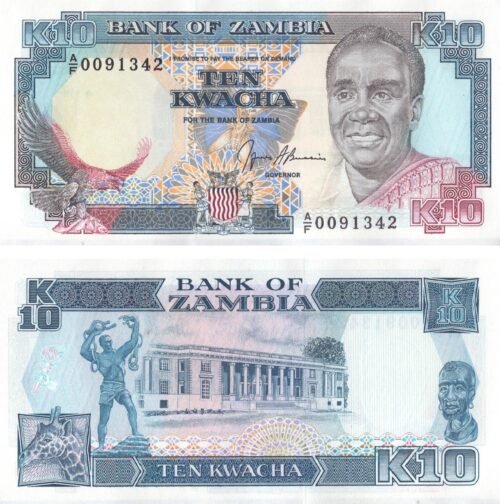
Zambia 10 Kwacha 1990-1991, P-31b, UNC
2,49 € -
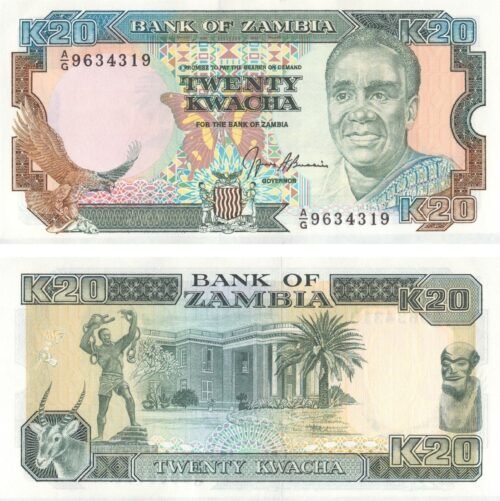
Zambia 20 Kwacha 1990-1991, P-32b, UNC
1,49 € -

Zambia 100 Kwacha 1991, P-34, UNC
2,49 € -

Zambia 20 Kwacha 1992, P-36a, UNC
1,49 € -
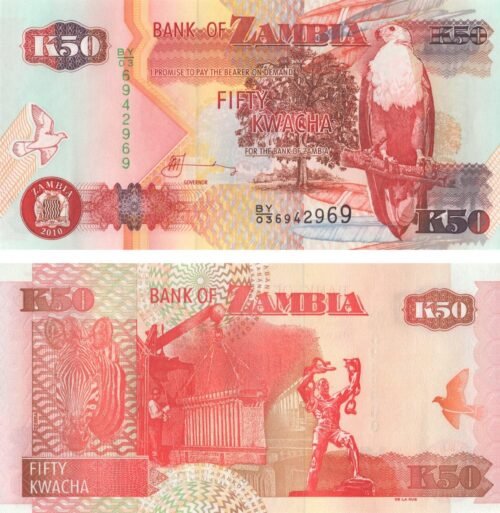
Zambia 50 Kwacha 2010, P-37i, UNC
1,49 € -
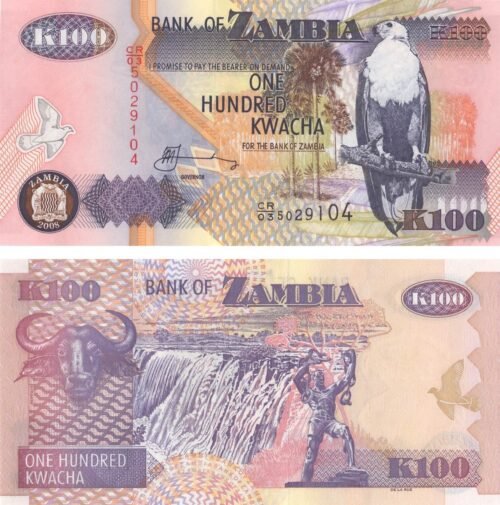
Zambia 100 Kwacha 2008, P-38g, UNC
1,49 € -

Zambia 100 Kwacha 2011, P-38j, UNC
1,49 € -
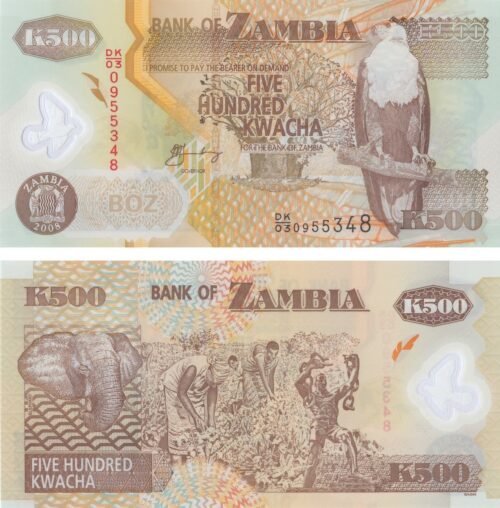
Zambia 500 Kwacha 2008, P-43f, UNC
2,99 €