
Scrip
Scrip is a substitute for official money that is issued for use within a limited system, locality, organisation or period rather than as general national currency. In paper-money collecting, the term usually refers to note-like certificates carrying a stated value or entitlement.
Scrip can be issued by companies, municipalities, banks, communities, institutions or other organisations. Its acceptance depends on the terms of the issue, and it is not automatically legal tender simply because it is denominated like money.
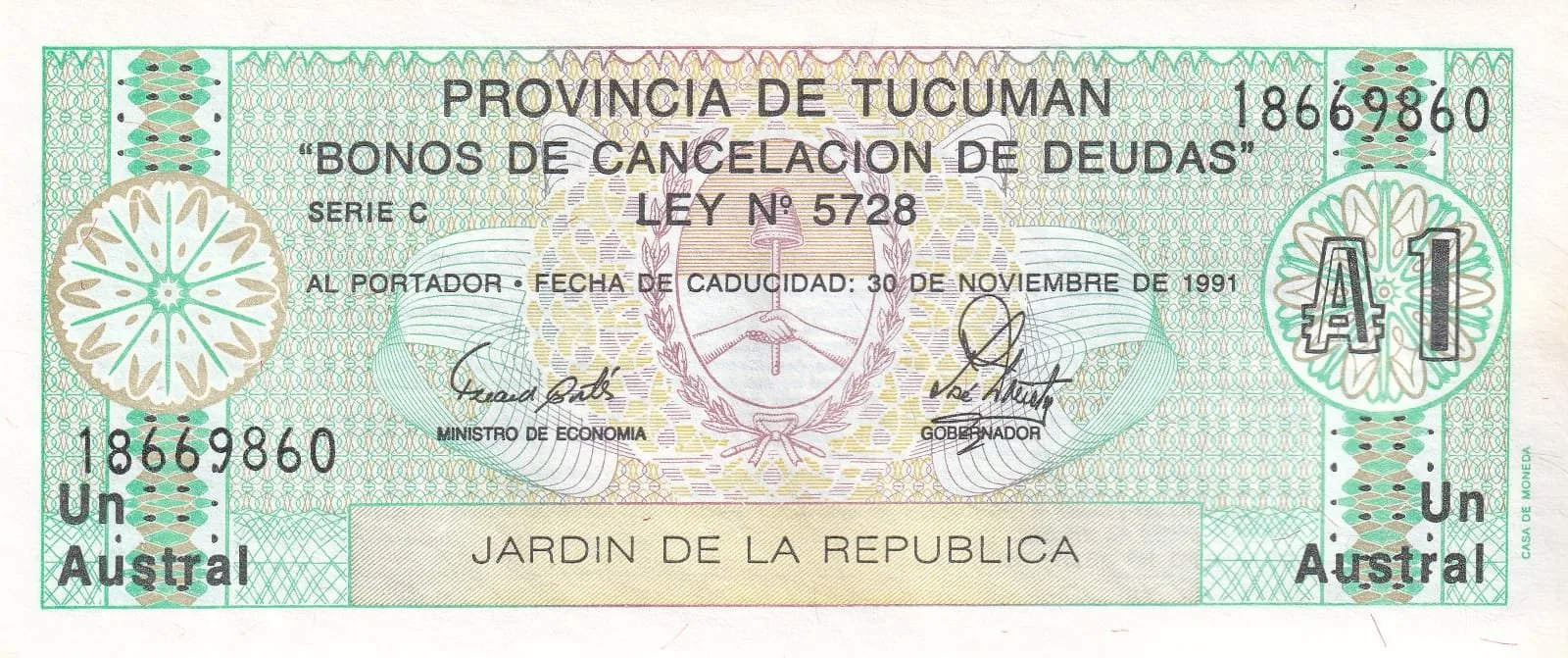
Tucumán · 1 austral · provincial bond
The printed conditions on the back

The issuer and the instrument
Redemption in legal currency
How It Appears
Scrip often resembles a small banknote or voucher. It may show an issuer name, denomination, serial number, signature and printed conditions stating where, when or for what it can be used.
The wording is especially important. Phrases such as “good for,” “redeemable in,” “payable at” or restrictions to a particular store, company, town or period can reveal that the instrument belongs to a limited monetary system.
Not every voucher or coupon is scrip. The term is most useful when the instrument functions as a substitute or local medium of exchange, credit or payment within a defined network rather than merely offering a discount or promotional benefit.
Some scrip is visually close to paper money, while other forms are much simpler. Classification should be based on issuer, function and redemption terms rather than appearance alone.
Functional Role
Scrip has been used when ordinary currency was scarce, inconvenient or unavailable, but emergency shortage is only one reason for its existence. It has also been used for company wages, local trade, institutional accounting and restricted payment systems.
Its usefulness comes from agreed acceptance. A community or organisation can circulate scrip because participants recognise the issuer’s promise or rules, even though the instrument does not have the same legal status or geographic acceptance as national currency.
This is why legal tender and scrip are separate concepts. A scrip note may have worked effectively as money in its own setting without being legally compulsory for the settlement of debts outside that setting.
Redemption can take different forms. Some scrip was exchangeable for official currency, goods or services; other issues circulated only for a limited time or within a closed system. The printed conditions and historical context determine what the promise actually meant.
A concrete example comes from the United States during the Great Depression. In November 1931, the New Martinsville Glass Manufacturing Company in West Virginia issued one-dollar promissory notes redeemable sixty days after issue, commonly described as Depression scrip; similar local issues appeared when bank closures and cash shortages disrupted ordinary payments.
Why It Matters to Collectors
Scrip documents monetary life below or outside the national issuing system. It can connect a collector directly to a local business, town, bank, industrial community, crisis or temporary monetary arrangement that may not appear in standard national banknote series.
Attribution therefore depends heavily on the issuer and place of use. Two pieces with the same denomination can have entirely different significance if they were issued by different companies, municipalities or emergency committees.
Scrip also overlaps with established banknote-collecting categories. Some issues belong naturally beside emergency money, while military or institutional scrip may sit closer to military issues or specialised local-currency collections.
Collector value is separate from the amount printed on the piece. Historical importance, issuer, rarity, condition and demand can matter far more than the original denomination or redemption value.
Scrip vs Emergency Money
Scrip describes a restricted substitute-money instrument or system.
Emergency money describes money created specifically in response to a shortage, crisis or disruption.
A simple distinction:
Scrip describes what the instrument is and how narrowly it circulates.
Emergency money describes why it was issued.
The categories can overlap strongly. During banking crises or currency shortages, communities have issued scrip as emergency money, but not all scrip was created during an emergency and not all emergency money is best classified as scrip.
Related Terms
- Emergency Money (Notgeld)
- Legal Tender
- Issuing Authority
- Denomination
- Paper Money
- Military Issue
Frequently Asked Questions
What is scrip money?
Scrip is a substitute for official money that circulates within a limited system, locality, organisation or period. In paper-money collecting it often takes the form of a denominated certificate or note-like instrument.
Is scrip legal tender?
Not automatically. Scrip can function as money within an agreed network without having the legal status of national legal tender. The exact status depends on the issue and jurisdiction.
Who issued scrip?
Historically, scrip has been issued by many kinds of organisations, including companies, municipalities, banks, communities and institutions. The issuer and redemption terms are central to attribution.
Is scrip the same as emergency money?
Not always. Scrip can be issued during an emergency and often was, but it has also been used for company wages, local trade and other restricted payment systems outside crisis periods.
Is old scrip collectible?
Yes. Scrip is collected for its issuer, location, historical context, design, scarcity and condition. Its collector value is separate from the amount originally printed on it.