Albanian State Bank
The Albanian State Bank issued Albania’s socialist-era paper money under the name Banka e Shtetit Shqiptar. Its notes connect post-war monetary reorganisation with the familiar 1964 and 1976 designs, where agricultural work, industry and national landmarks appear beside state emblems.
Quick Facts
Institutional Identity
Albanian State Bank is the catalogue name for Banka e Shtetit Shqiptar, also rendered in English as State Bank of Albania. Established under the organic law of 13 January 1945, it replaced the National Bank of Albania within the post-war nationalisation of the country’s banking system.
Its responsibilities extended beyond currency issue. The bank administered lending to state enterprises and agricultural cooperatives, handled government financial operations and held foreign-exchange reserves. This concentration of issue, credit and settlement functions distinguishes the socialist state bank from the modern Bank of Albania, whose central-bank framework dates from 1992.
Historical Evolution
Early 1945 issues included older notes validated with a new stamp, followed by banknotes naming the state bank. The monetary decree of 7 July 1947 then established the lek as the national unit and removed the golden frang from circulation.
Redenomination in 1965 exchanged ten old lek for one new lek. The replacement notes carried the date 1964. Related designs reappeared in 1976, so their shared imagery should not obscure the distinction between the first dated issue and its later reissue.
In the early 1990s, banking reform separated central-bank responsibilities from commercial operations. The law of 22 April 1992 established the modern Bank of Albania’s framework, marking the transition from the socialist banking system to a separate central-bank structure.
Design Philosophy
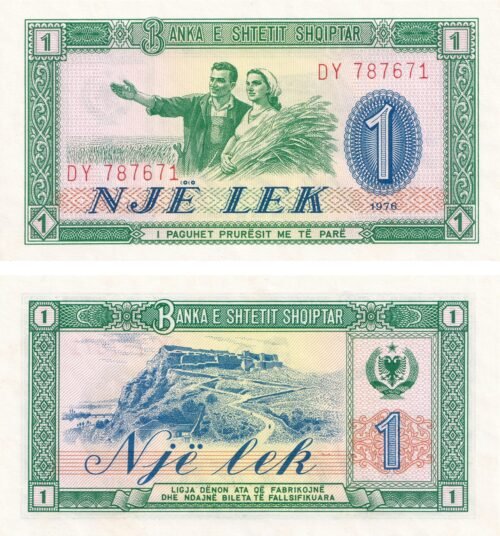
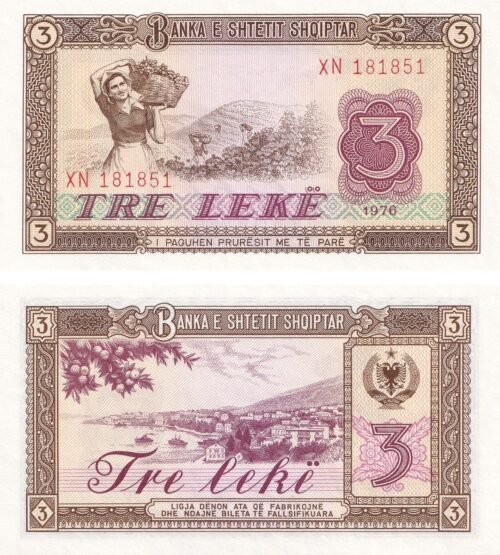
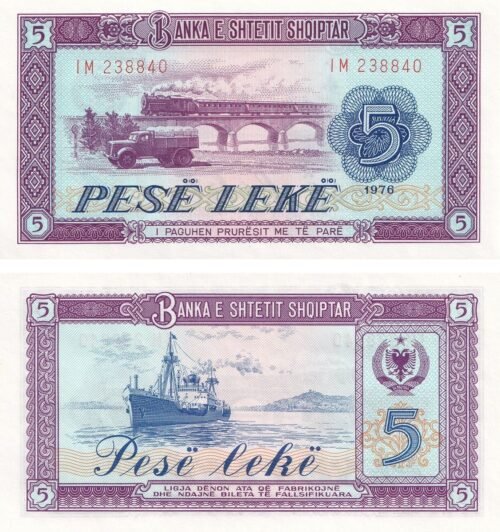
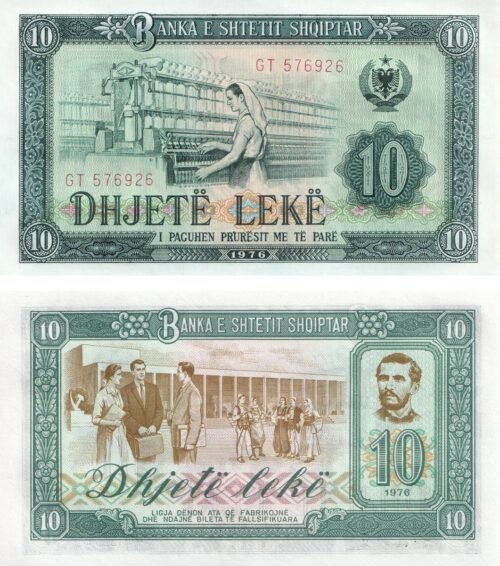
The 1964 and 1976 families place working figures at the centre of their layouts. A peasant couple appears on one lek, a vineyard worker on three and a textile worker on ten. Railway, road and shipping scenes extend this focus on production across the five-lek design.
On the reverse, Rozafa Castle at Shkodër, Sarandë and Tirana’s Palace of Culture supply recognisable locations. The ten-lek note also includes writer Naim Frashëri. The bank’s numismatic catalogue credits Hysen Devolli with these designs. State arms and decorated value panels give the varied subjects a consistent frame across the denominations.
For collectors
For collectors, the 1964 and 1976 families reward direct comparison. Start with the printed date, denomination and complete bank name rather than scenery alone. The one-lek Rozafa Castle scene and three-lek Sarandë view recur across both dated families, making an apparently matching picture insufficient for assigning the issue.
Format provides another check: the 1976 one-lek note measures 105 x 55.5 mm, while ten lek measures 135 x 75 mm. Keep these circulation notes separate from the 1965 buona lekë vouchers. The latter were issued by the Ministry of Finance, despite carrying state-bank wording, so a familiar inscription does not settle their institutional attribution.