Bank of Angola
Banco de Angola issued Angola’s angolar and later escudo banknotes during the Portuguese colonial period. Established in 1926, it preceded Banco Nacional de Angola, whose kwanza issues belong to the monetary system introduced after independence.
Quick Facts
Institutional Identity
The Bank of Angola, named Banco de Angola on its banknotes, was created on 14 August 1926 with headquarters in Lisbon. It took over Banco Nacional Ultramarino’s note-issuing role and banking agencies in Angola. Its catalogue identity is therefore distinct from earlier BNU issues, even where the territory remains the same.
Banco de Angola is also separate from Banco Nacional de Angola, the national bank created in 1976. This distinction matters when identifying escudo notes: the colonial issuer’s name appears in Portuguese, while the later institution issued the first kwanza series. Bank of Angola refers here specifically to the 1926 bank.
Historical Evolution
Banco de Angola emerged from the 1926 reorganisation of note issue in the territory. Its early banknotes were denominated in angolares; the 1927-dated series was introduced in 1928 when the angolar replaced the earlier escudo.
Angolar notes were followed by a new escudo series dated 15 August 1956, which entered circulation in 1958. Subsequent issues bear dates through 1973. Changes of portrait and signature combinations distinguish these successive issues.
Following independence in 1975, the banking system was reorganised. Law 69/76 created Banco Nacional de Angola in November 1976. That institution issued the kwanza notes introduced on 8 January 1977, marking the transition away from Banco de Angola’s escudo issues.
Design Philosophy
The bank’s notes combine Portuguese historical figures with scenes from Angola. Early angolar issues feature Salvador Correia de Sá e Benevides; later series show King John II, Portuguese explorers and President Américo Tomás. The portrait provides an immediate series identifier, while the reverse often supplies a specifically Angolan subject.
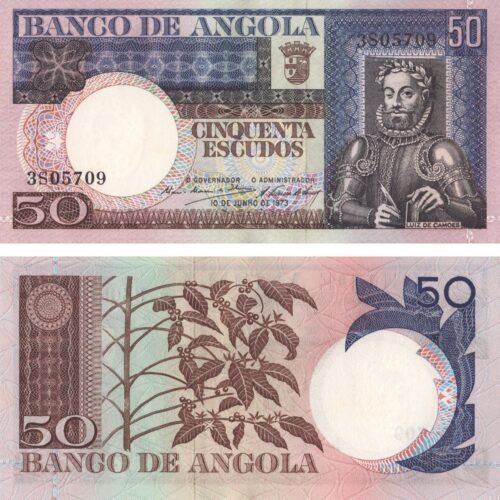
On the 1972 and 1973 series, reverses retain the same denomination-specific subjects while the obverse changes from Óscar Carmona to Luís de Camões. Cotton, coffee, oil palm, Pedras Negras and waterfalls appear across the five values. Comparing both sides reveals the continuity between these differently portrayed issues.
For collectors
For collectors, Banco de Angola offers two currency families rather than a single uninterrupted escudo sequence. Keep angolar and escudo entries separate, then record the full printed date and signature combination. An issuer match alone is not enough to establish a catalogue variety.
The 1973 Camões group includes circulating notes, specimens and remainders. On the 500 escudos, letter-only and fractional serial prefixes distinguish catalogued variants. Undated, unsigned remainders of the 20 and 50 escudos also lack serial numbers; these are separate from the finished, numbered notes.