Bank of China
Bank of China’s Republic-era notes trace its changing role from central banking to authorised commercial note issue. Portraits of Sun Yat-sen, place names and architectural scenes distinguish these historical yuan issues from modern renminbi and the bank’s later Macau currency.
Quick Facts
Institutional Identity
Bank of China was established in Shanghai on 5 February 1912, following approval to reorganise the Bank of Great Qing. Between 1912 and 1928 it performed central-bank functions for the Republican government, including managing treasury funds and issuing currency. That early role explains its place among China’s national paper-money issuers.
Under the statute of 26 October 1928, it became a government-authorised international exchange bank while retaining note-issuing rights. It was therefore distinct from the separately established Central Bank of China. Its Republic-era yuan notes must also be kept apart from renminbi issued by the People’s Bank of China.
Historical Evolution
In 1916, the Shanghai branch resisted a government order suspending banknote redemption and cash payments on deposits. The order applied to Bank of China and Bank of Communications and was ultimately withdrawn after opposition in Shanghai.
The 1928 statute changed its institutional position without ending currency issue. Bank of China became an authorised international exchange bank, while a separate Central Bank took over the government’s central-bank role. Overseas business expanded alongside domestic note circulation.
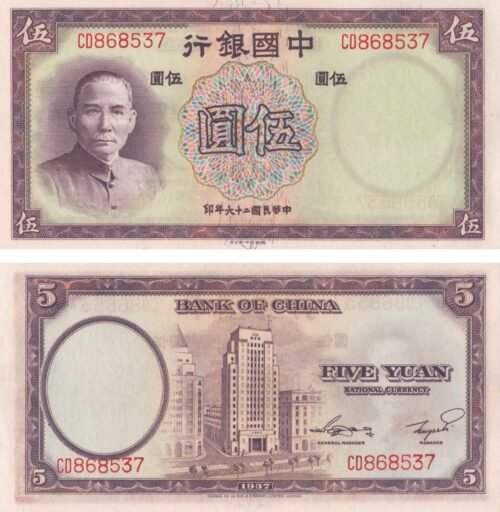
The 1935 fabi reform made notes of Bank of China, the Central Bank and Bank of Communications legal tender from 4 November. Bank of China’s Sun Yat-sen legal-tender designs followed in 1936 and 1937, including the familiar five-yuan note dated 1937.
Design Philosophy
Architecture and portraiture change across the issues rather than forming a single fixed style. The 1918 Shanghai national-currency series uses Beijing’s Zhengyang Gate, while the 1935 one-yuan design shows the Hall of Prayer for Good Harvests at the Temple of Heaven. Place names remain important parts of the printed identity.
The 1937 family places Sun Yat-sen on the front and the bank’s Shanghai building on the reverse. Blue, purple and green distinguish one, five and ten yuan. The earlier 1935 five-yuan note combines Sun with Beijing’s White Pagoda, so a shared portrait does not mean an identical design.
For collectors
For collectors, start with the issuing-bank inscription and monetary period. Bank of China’s Republican issues belong apart from Central Bank of China notes, later People’s Bank of China renminbi and Macau patacas. Provincial or city names, where present, provide additional divisions within the historical material rather than identifying a different modern currency.
Read both sides for the date. The purple 1937 five-yuan note gives Republican year 26 on the front and 1937 on the reverse: two forms of the same year. Compare its Shanghai-building reverse with the larger, differently coloured 1935 five-yuan design before assigning a catalogue reference.