
Bank of Mongolia
The Bank of Mongolia (Монгол Улсын Төв банк) operates as the central monetary authority overseeing a system shaped by political transition, with both Sükhbaatar and Chinggis Khaan represented in the banknote family introduced in 1993.
Quick Facts
Institutional Identity
The bank operates as Mongolia’s central monetary authority, evolving from a Soviet-style monobank system into an independent institution managing currency issuance, monetary policy and financial stability within a resource-driven economy.
Historical Evolution
Established in 1924, the Bank introduced the tögrög in 1925. In the 1993 banknote family, Sükhbaatar remained on the 5–100 tögrög denominations in a new portrait, while Chinggis Khaan appeared on the new 500 and 1,000 tögrög denominations.
Design Philosophy
Mongolian banknotes are anchored by the sacred Soyombo national symbol and intricate “must” ornamentation, combined with portraits of Chinggis Khaan, nomadic scenes, paiza tablets and architectural motifs; high-denomination 20,000 tögrög notes are produced by Giesecke+Devrient with advanced colour-shifting elements and precise engraving.
For collectors
For collectors, the Bank of Mongolia offers scarce socialist Sükhbaatar issues alongside later notes featuring both Sükhbaatar and Chinggis Khaan, where the presence of the Soyombo symbol, nomadic iconography and high-denomination G+D printings creates strong visual and historical distinction.
Explore Banknotes Issued by Bank of Mongolia
-

Mongolia 50 Togrog 2019, P-72, UNC
0,99 € -
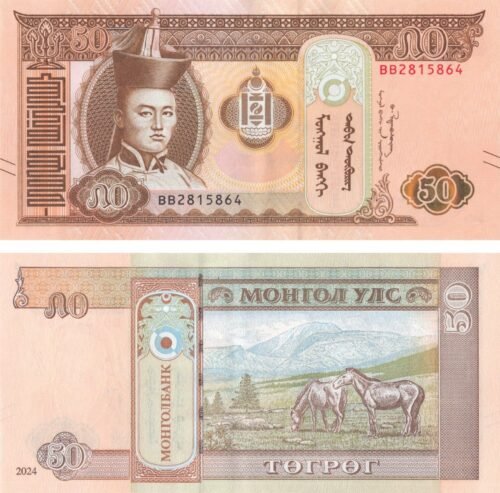
Mongolia 50 Togrog 2024, P-72, UNC
0,99 € -

Mongolia 100 Togrog 2020, P-73, UNC
0,99 € -
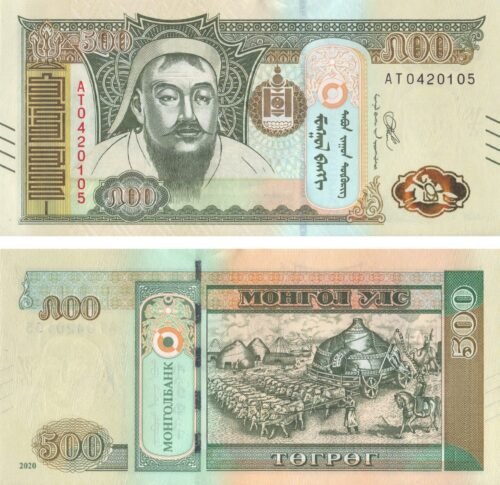
Mongolia 500 Togrog 2020, P-74, UNC
1,49 € -

Mongolia 1000 Togrog 2020, P-75, UNC
2,49 € -

Mongolia 10000 Togrog 2021, P-77, UNC
9,99 € -
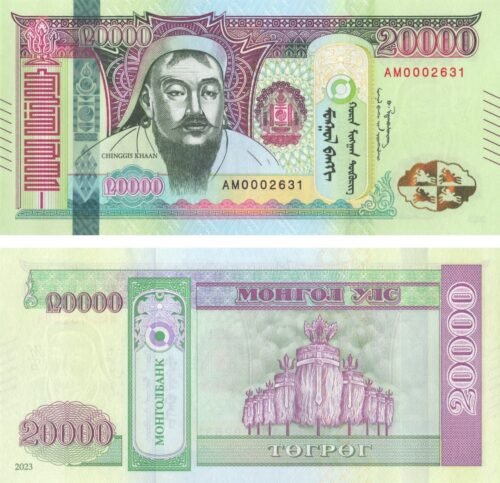
Mongolia 20000 Togrog 2023, P-78, UNC
17,99 € -

Mongolia 10000 Togrog 2021, P-79, UNC
13,99 € -

Mongolia 5000 Togrog 2024, P-80, UNC
5,99 €