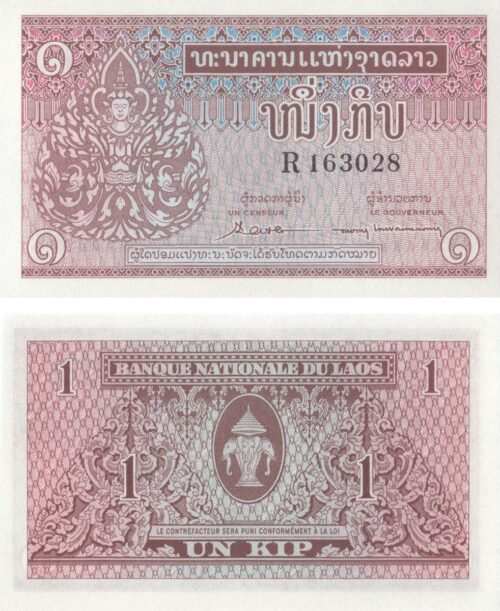
Banque Nationale du Laos
Banque Nationale du Laos was the national banknote authority of the Kingdom of Laos during the formative kip era. It replaced the Indochinese piastre with the Lao kip in 1955 and is associated with the 1957–1962, 1962–1963 and 1974–1975 note families, whose designs combine royal imagery, Buddhist landmarks, agriculture and French–Lao bilingual presentation.
Quick Facts
Institutional Identity
Banque Nationale du Laos, translated as the National Bank of Laos, was the monetary authority responsible for the Royal Lao kip system after independence. The Banknote Book records that on 5 May 1955 it replaced the Indochinese piastre with the Lao kip at a rate of one kip for ten piastres. The currency was also known as the Vientiane kip, after the capital.
The Banknote Book groups three major catalogue periods under this authority: 1957–1962, 1962–1963 and 1974–1975 issues. These span a politically unstable period in which different zones of Laos used competing monetary arrangements, so the printed issuing authority and exact issue family are more reliable identifiers than the generic word kip alone.
The Banque Nationale du Laos belongs to the royal-era monetary system and must be distinguished from both the Pathet Lao Government’s 1968 issue and the later Bank of the Lao P.D.R. The issuer boundary is especially important because some note types and design traditions overlap across the wider Lao monetary transition.
Historical Evolution
The new Lao kip followed the end of the Indochinese piastre system. Early lower denominations were initially printed by Security Banknote Company in the United States and used coloured planchettes embedded in the paper. The larger denominations drew on established international security printers including Banque de France and Thomas De La Rue.
The 1962–1963 issues appeared amid the Lao Civil War and included the Royal Khangkhai kip associated with the government of Prince Souvanna Phouma. During the same conflict, Pathet Lao-controlled production also created later printings of some earlier low-denomination designs, distinguishable by paper and serial characteristics. These production varieties require care because similar artwork does not always imply the same printing origin.
A final royal-era group followed in 1974–1975, including higher denominations with King Savang Vatthana and national landmarks. The monarchy ended after the Pathet Lao takeover in 1975, closing the Banque Nationale du Laos banknote period and leading toward the Liberation kip and, later, the Lao People’s Democratic Republic’s post-1979 monetary system.
Design Philosophy
Banque Nationale du Laos banknotes combine state identity with a broad visual survey of Lao culture. Royal portraits, the Erawan three-headed-elephant arms, nāga dragons, Buddhist temples and ceremonial motifs appear alongside agricultural work, weaving, elephants and village life.
The notes often divide language by side: Lao text dominates the front while French appears on the reverse. This bilingual structure reflects the administrative and monetary environment of the period and is a useful visual marker for distinguishing royal-era notes from later Pathet Lao issues, which use Lao text on both sides.
Printing technology varies considerably across the catalogue. Planchettes, security fibres, different serial-number fonts, watermarks and multiple international printers create important physical distinctions beneath otherwise related designs. For this issuer, production characteristics are therefore part of the design history as well as security features.
For collectors
For collectors, Banque Nationale du Laos is the key issuer for the Royal Lao kip before the Pathet Lao monetary system became dominant. The same denomination can appear in multiple printings or signature states, so issuer, issue family and production characteristics should be checked together.
Low-denomination varieties may differ by planchettes, security fibres and serial-number fonts, while larger notes can be separated by signature combination, series or prefix, watermark and printer. The 1962–1963 Royal Khangkhai issues form another distinct collecting group within the broader Banque Nationale du Laos catalogue.
The most important boundary is historical as well as visual: royal Banque Nationale du Laos issues, Pathet Lao Government notes and later Bank of the Lao P.D.R. issues all use the kip name but represent different monetary authorities. Keeping those issuer identities separate prevents the turbulent 1950s–1970s transition from being flattened into a single series.