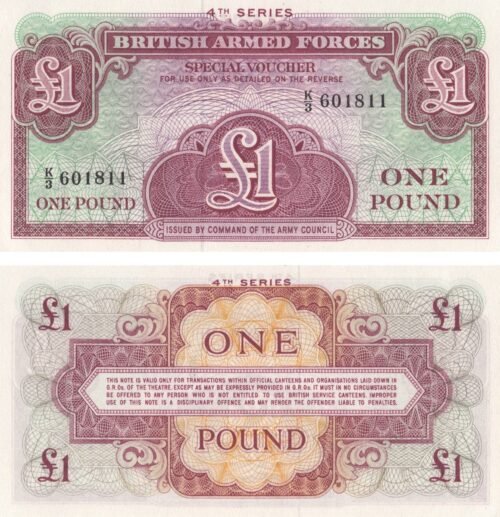
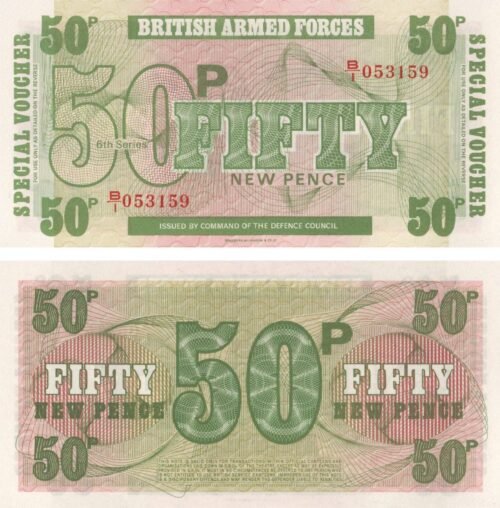
British Armed Forces
British Armed Forces special vouchers were controlled military payment instruments used by British personnel overseas after the Second World War. Issued in successive series between 1946 and 1972, they were designed to protect local economies and restrict unauthorised currency trading.
Quick Facts
Country: Great Britain
Currency: British Pound
Institutional Identity
The British Armed Forces were not a central bank, yet the military administration issued paper vouchers that functioned as money inside designated service environments. Their acceptance was limited to authorised establishments and personnel rather than the general British economy.
The vouchers were denominated in the British pound system. Earlier issues used pounds, shillings and pence; later series reflected decimalisation. Their legal and operational setting makes them military currency rather than ordinary Bank of England notes.
Historical Evolution
The first post-war series appeared in 1946 as British forces remained stationed across Europe and other overseas territories. New series could be introduced quickly and older ones withdrawn, a control mechanism intended to frustrate black-market holdings and limit leakage into local circulation.
Special vouchers were used in several theatres, with Germany becoming the best-known collecting context. Production continued through the decades of Britain’s large overseas military presence, and the final series was withdrawn in 1972.
Design Philosophy
The notes favour authority, legibility and controlled use. Formal borders, prominent denominations and military or heraldic references establish an official identity without copying the portrait-led appearance of contemporary Bank of England currency.
Changes in colour, format and denomination help distinguish successive series. The absence of a conventional national issuer portrait is itself meaningful: these were service instruments built for a closed payment system.
For collectors
For collectors, series identification is essential because notes with similar denominations served different issue periods. The printed series, denomination system and any control markings should be recorded before assigning a catalogue reference.
Uncirculated examples often survive, but replacement notes, serial varieties and complete denomination runs add specialist depth. They are best catalogued as British military money, not as circulating issues of a particular host country.