Brunei Currency Board
The Brunei Currency Board introduced the country's own notes in 1967, beginning a succession of designs shaped by royal portraiture, mosques and local landscapes. Its issues span the early paper families and Brunei's first polymer notes, before later monetary institutions assumed its responsibilities.
Quick Facts
Institutional Identity
The Brunei Currency Board was the historical authority responsible for issuing and managing Brunei's notes and coins under the Currency Act of 1967. Its Malay name was Lembaga Matawang Brunei. The currency was the Brunei dollar, divided into one hundred cents, rather than a separate currency named after the Board.
The arrangement with Singapore allowed the two countries' currencies to be exchanged at equal value without charge through their monetary authorities and banks. This did not make them a single national currency: Brunei notes remained distinct issues, with their own issuing authority, inscriptions and designs.
Historical Evolution
Brunei began issuing its own banknotes on 12 June 1967, replacing the shared Malaya and British Borneo currency. The first family comprised five denominations and carried the portrait of Sultan Omar Ali Saifuddin III. A second family followed in 1972 with Sultan Hassanal Bolkiah's portrait.
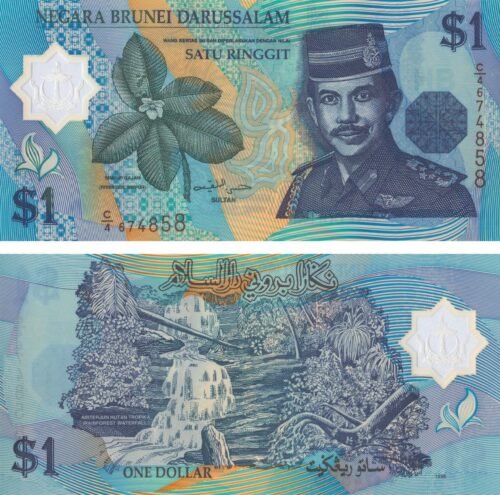
The 1989 designs brought Kampong Ayer into the reverse imagery. Polymer arrived in 1996 with the one-, five- and ten-dollar denominations, while paper remained in use for higher values. The change of material therefore occurred within the Board's existing issuing history.
In 2004, the Brunei Currency and Monetary Board succeeded the original Board. Its currency responsibilities passed to Autoriti Monetari Brunei Darussalam on 1 January 2011. That authority became Brunei Darussalam Central Bank in 2021.
Design Philosophy
Royal portraits provide a recurring reference across the Board's banknotes, but the reverse subjects distinguish successive families. The Omar Ali Saifuddin Mosque appears on the 1967 notes; later designs broaden the architectural setting to waterfront buildings and scenes associated with Kampong Ayer.
The early polymer denominations introduce rainforest vegetation and waterfalls alongside the Sultan's portrait, national arms and patterned backgrounds. Their transparent windows change how the note is viewed in transmitted light, contrasting with the portrait watermarks of earlier paper issues. Architecture, landscape and the ruler's image remain recognisable subjects across the change in substrate.
For collectors
For collectors, the 1967 family offers a distinct starting point: it portrays Omar Ali Saifuddin III and bears Government of Brunei wording, although the issuing institution was the Currency Board. Subsequent portraits of Hassanal Bolkiah should not be taken to mean that every later Brunei note belongs to this same historical authority.
Printed dates and catalogue families also need separate attention. The first rainforest one-dollar type appears with 1996, 2007 and 2008 dates. Comparing date, prefix and signature within the recorded variety is more reliable than using the institutional succession as an automatic cut-off for an established design.