
Central Bank of Cuba
The Central Bank of Cuba (Banco Central de Cuba) operates as the central monetary authority within a state-controlled system, notably defined by the coexistence of dual monetary structures and ideologically driven banknote design.
Quick Facts
Institutional Identity
The Banco Central de Cuba was formally established on 28 June 1997 under Decree-Law No. 172, assuming central banking functions from the Banco Nacional de Cuba. It serves as the issuing authority of the Cuban peso (CUP), operating within a tightly controlled financial system where monetary policy, currency design and national ideology remain closely intertwined.
Historical Evolution
A defining feature of Cuba’s monetary history was its complex dual-currency system, in which the Cuban peso (CUP) circulated alongside the convertible peso (CUC), itself preceded by Foreign Exchange Certificates (Certificados de Divisas) used to manage access to hard currency. This structure culminated in the landmark 2021 reform known as “Tarea Ordenamiento”, which unified the system by eliminating the CUC and restoring the CUP as the sole legal tender—one of the most significant monetary restructurings in Cuba’s modern history.
Design Philosophy
Banknote design is defined by strong ideological continuity and cultural symbolism. A central numismatic icon is the 3-peso banknote featuring Che Guevara, one of the few circulating three-unit denominations globally and a widely recognised cultural artifact. Production has involved international partners including De La Rue and increasingly the China Banknote Printing and Minting Corporation (CBPMC), reflecting evolving geopolitical ties. Technical features include detailed intaglio printing, watermark portraits such as José Martí, and microtext elements embedding revolutionary slogans—serving as both security features and ideological markers.
For collectors
For collectors, Cuban banknotes represent a uniquely layered field where political narrative, dual-currency mechanics and institutional reform intersect. The transition from certificates to CUC, and finally to a unified CUP under Tarea Ordenamiento, combined with iconic issues like the 3-peso Che note, creates a rich and highly distinctive collecting landscape within global numismatics.
Explore Banknotes Issued by Central Bank of Cuba
-

Cuba 3 Pesos 1991, P-FX33, UNC
2,49 € -

Cuba 5 Pesos 2019, P-116, UNC
2,49 € -

Cuba 10 Pesos 2016, P-117, UNC
2,49 € -
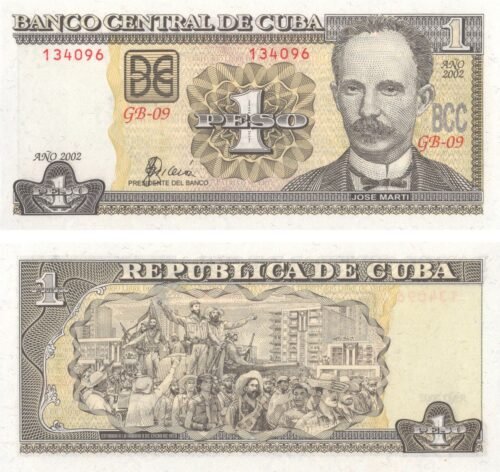
Cuba 1 Peso 2002, P-121b, UNC
2,49 € -

Cuba 3 Pesos 2005, P-127b, UNC
2,49 € -

Cuba 1 Peso 2007, P-128b, UNC
2,49 € -

Cuba 1 Peso 2009, P-128d, UNC
2,49 € -

Cuba 1 Peso 2010, P-128e, UNC
2,49 € -

Cuba 1 Peso 2011, P-128f, UNC
1,49 € -

Cuba 1 Peso 2016, P-128g, UNC
1,49 € -

Cuba 1 Peso 2017, P-128h, UNC
0,99 € -

Cuba 100 Pesos 2024, P-129, UNC
4,99 €