Central Bank of Curaçao and Sint Maarten
The Central Bank of Curaçao and Sint Maarten issues one currency for two countries. Its 2025 Caribbean guilder banknotes brought a new shared design to a monetary union established after the dissolution of the Netherlands Antilles.
Quick Facts
Country: Curacao & Sint Maarten
Currency: Caribbean Guilder
Local name: Centrale Bank van Curaçao en Sint Maarten
Institutional Identity
Known by the initials CBCS, the bank is a public-law institution with offices in Curaçao and Sint Maarten. The two countries own its equity, while its charter gives it an independent mandate within their common monetary area.
Its responsibilities extend beyond issuing notes to monetary and financial stability and the security of payments. The distinction between issuer and manufacturer remains important: CBCS commissioned the Caribbean guilder and holds the design copyright, while Crane Currency printed the banknotes. The bank’s name on the notes identifies the authority behind the currency, not the printing works.
Historical Evolution
The institution traces its history to a bank established in Curaçao on 6 February 1828 to support trade and provide credit. That long lineage should be distinguished from the present two-country organisation, which emerged from the constitutional changes of 10 October 2010.
The functions and civil-law rights and obligations of the Bank of the Netherlands Antilles passed to CBCS. Curaçao and Sint Maarten maintained their common monetary arrangements and continued using the Netherlands Antillean guilder during the years that followed.
The launch of the Caribbean guilder on 31 March 2025 completed a separate currency transition. It did not mark the foundation of the central bank itself.
Design Philosophy
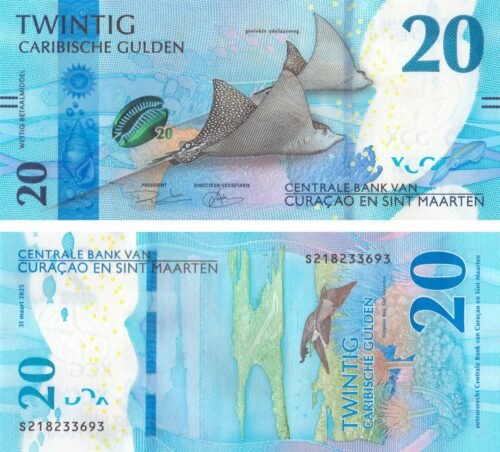
The Caribbean guilder’s underwater theme was developed as a point of connection between the two countries. Marine animals cross the horizontal fronts; island landmarks occupy the vertical reverses. The series avoids choosing one national portrait as the dominant image of the union.
CBCS worked with Crane Currency on a design that also makes authentication visible. Moving micro-optic elements, a compass watermark and raised printing accompany the marine imagery. Distinct colours and tactile marks help users distinguish denominations, joining public accessibility with the bank’s responsibility for secure cash.
For collectors
For collectors, the key distinction is between institutional succession and a new currency issue. The bank’s history reaches back to 1828, its present legal framework dates from 2010, and the Caribbean guilder entered circulation in 2025. These dates answer different questions and should not be used interchangeably.
The 2025 family belongs to a shared issuer serving both countries. Collections can place it beside earlier Netherlands Antillean notes to compare issuer wording, denomination structure and design, while retaining the separate currency identities and the issuing names actually printed on each note.