Central Bank of Djibouti
The Central Bank of Djibouti (Banque Centrale de Djibouti) operates within a fixed exchange rate framework, notably defined by long-term parity with the US dollar and strict monetary stability.
Quick Facts
Institutional Identity
The Banque Centrale de Djibouti, established in 1979, operates under a strict currency board system that pegs the Djiboutian franc to the US dollar at an exact and enduring rate of 177.721 DJF = 1 USD, maintained since 1977. This unwavering anchor defines Djibouti’s monetary identity, ensuring long-term stability and reinforcing its role as a strategic financial node along global maritime routes.
Historical Evolution
Banknote production reflects a strong legacy of French security printing influence, with issuance historically involving leading international printers, including Banque de France and other specialised facilities. This framework places Djibouti within a high-security production tradition, characterised by refined intaglio printing, complex watermark structures and durable paper substrates adapted to demanding climatic conditions.
Design Philosophy
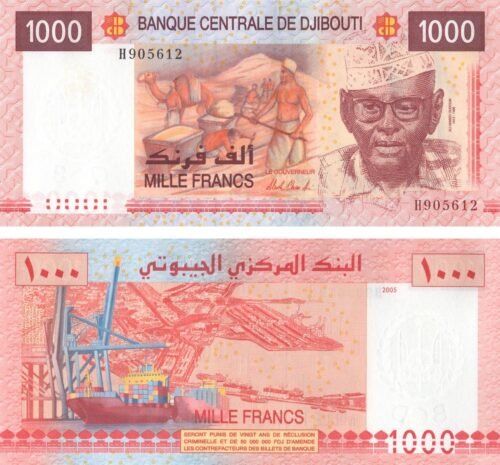
The visual identity of the series is anchored in distinctive and recognisable motifs, most notably the 10,000-franc banknote featuring the whale shark (Rhincodon typus), one of the most iconic marine representations in African numismatics. Another defining issue is the 2017 commemorative 40-franc banknote, released for the 40th anniversary of independence—an unusual denomination that stands out globally. High-value notes dominate circulation, with the 10,000-franc denomination functioning as a practical unit rather than a rarity, reflecting the country’s dollar-linked economic structure.
For collectors
For collectors, Djiboutian banknotes represent a focused and highly recognisable field defined by absolute monetary stability, international production standards and distinctive high-denomination usage. The enduring currency peg, limited series structure and standout issues such as the whale shark note and 40-franc commemorative create a compact yet compelling collecting landscape.