
Central Bank of Jordan
The Central Bank of Jordan (البنك المركزي الأردني) operates as the central monetary authority within a stable currency system, notably defined by strong exchange rate positioning and consistent monetary policy.
Quick Facts
Institutional Identity
The Central Bank of Jordan manages issuance of the dinar and maintains monetary stability through a long-standing peg to the US dollar, supporting one of the most stable and trusted currency systems in the Middle East.
Historical Evolution
Established in 1964, the bank introduced the Jordanian dinar within a framework that has preserved exceptional stability despite regional volatility. Its banknote series reflect uninterrupted Hashemite dynastic continuity, from Sharif Hussein bin Ali to King Abdullah II, creating a rare visual lineage of leadership across generations.
Design Philosophy
Jordanian banknotes are defined by royal portraiture combined with world-renowned archaeological imagery, most notably Petra’s Al-Khazneh—one of the New Seven Wonders of the World—featured on the 1 dinar note. The latest fifth series (2022–2023) introduces enhanced color vibrancy and advanced features such as SPARK Flow elements, 3D moving security threads and intricate Arabic geometric patterns, maintaining paper substrate for key denominations.
For collectors
For collectors, the Central Bank of Jordan offers a unique combination of dynastic continuity, world wonder iconography and exceptional currency strength, making Jordanian banknotes both symbolically powerful and highly desirable within Middle Eastern numismatics.
Explore Banknotes Issued by Central Bank of Jordan
-
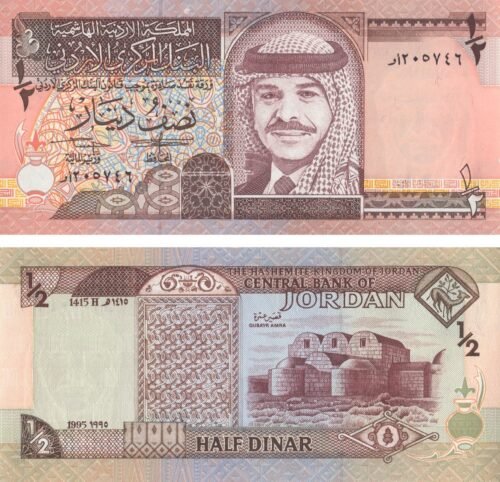
Jordan 1/2 Dinar 1995, P-28a, UNC
4,99 € -

Jordan 1 Dinar 1996, P-29b, UNC
7,99 € -

Jordan 1 Dinar 2021, P-34, UNC
3,99 € -

Jordan 1 Dinar 2022, P-39, UNC
3,99 € -
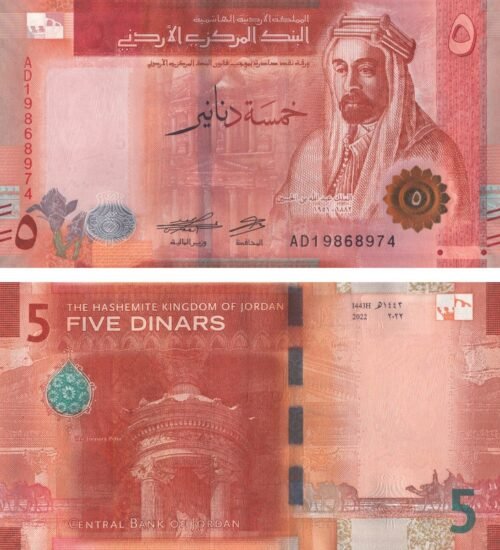
Jordan 5 Dinars 2022, P-40, UNC
14,99 € -
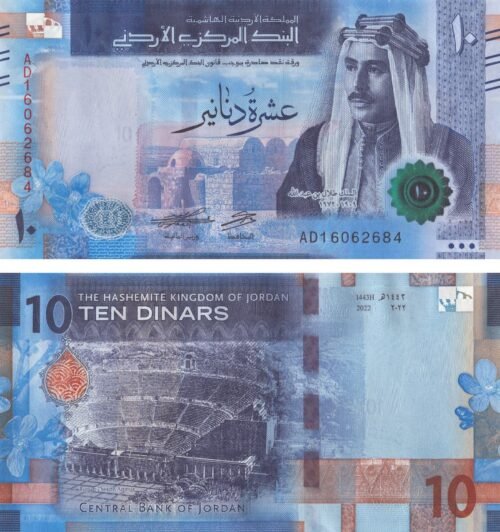
Jordan 10 Dinars 2022, P-41, UNC
30,99 €