Central Bank of The Gambia
The Central Bank of The Gambia operates as the central monetary authority overseeing a post-independence system, notably reflected in major political redesigns of national banknote series.
Quick Facts
Institutional Identity
The Central Bank of The Gambia, established in 1971, is responsible for issuing the Gambian dalasi (GMD), introduced the same year to replace the Gambian pound and establish full monetary sovereignty after independence. The Bank oversees monetary policy, financial regulation and currency issuance within a West African economy structured around the Gambia River.
Historical Evolution
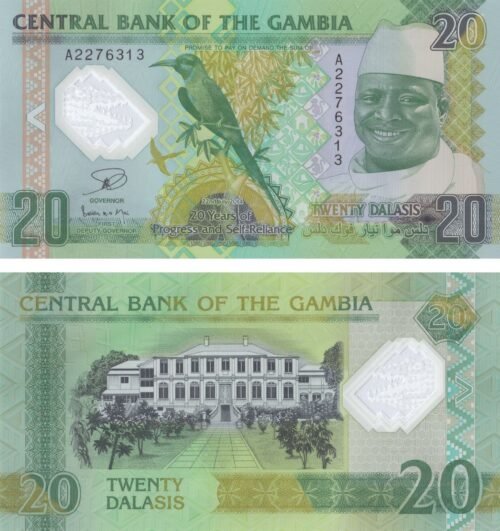
A defining numismatic shift occurred between 2015 and 2019, when banknote design reflected major political change. The 2015 series featured portraits of President Yahya Jammeh, marking a period where state authority was directly embedded into currency imagery. Following his removal from power, the 2019 series replaced political portraiture with endemic bird species, including the Giant Kingfisher and Sacred Ibis, creating a clear “pre- and post-regime” collecting structure central to Gambian numismatics.
Design Philosophy
Design governance is centrally directed with production by international security printers such as De La Rue. A key technical milestone is the 20 dalasis polymer banknote (2015), issued to commemorate the 50th anniversary of independence, representing the country’s only polymer issue. Standard issues incorporate intaglio printing, watermark systems and security threads, while reverse designs consistently reflect river-based life, including transport, fishing and agriculture along the Gambia River.
For collectors
For collectors, the Central Bank of The Gambia offers a highly dynamic and politically defined collecting field shaped by the contrast between the Jammeh portrait series and the post-2019 wildlife series, alongside the distinctive polymer 20 dalasis issue, making Gambian banknotes a compelling intersection of political history and thematic collecting.