
Central Bank of the Philippines
The Central Bank of the Philippines opened in 1949 as the country’s first formal central bank. Its notes accompanied post-war reconstruction, independence-era nation building and the development of a distinctly Filipino monetary identity before Bangko Sentral ng Pilipinas succeeded it in 1993.
Quick Facts
Institutional Identity
Republic Act No. 265, signed on 15 June 1948, created the Central Bank of the Philippines. The institution formally opened on 3 January 1949 with responsibility for monetary stability, currency issue and the supervision of the banking system.
Its English name appears prominently on early issues. Filipino-language naming became increasingly important in later series, but the institution remained the same legal central bank until the 1993 reform.
Historical Evolution
The first central-bank notes were provisional: existing Victory-series notes received CENTRAL BANK OF THE PHILIPPINES overprints on the back. Purpose-designed issues followed, gradually replacing inherited Commonwealth-era monetary imagery.
Later series reflected political and cultural change through Filipino heroes, national events, public institutions and economic scenes. Republic Act No. 7653 established Bangko Sentral ng Pilipinas, which began operating on 3 July 1993 and replaced the earlier central bank.
Design Philosophy
The bank’s notes document the movement from post-war continuity to national self-definition. Early overprints preserve the underlying American-influenced Victory designs, whereas later issues place Philippine figures and history at the centre of the visual programme.
Language, signatures and the form of the state name are useful design evidence. Even when a portrait remains unchanged, these elements can locate a note within a particular administrative and political period.
For collectors
For collectors, the distinction between an overprinted Victory note and a later purpose-designed central-bank issue is fundamental. Date, series, signatures and issuer wording should be checked together, especially in long-running denominations.
The 1993 succession is another firm boundary. Notes carrying Bangko Sentral ng Pilipinas belong to the new institution even where their denominations or national subjects continue an earlier tradition.
Explore Banknotes Issued by Central Bank of the Philippines
-

Philippines 10 Piso 1969, P-144a, UNC
2,99 € -

Philippines 50 Piso 1969, P-146b, UNC
3,99 € -
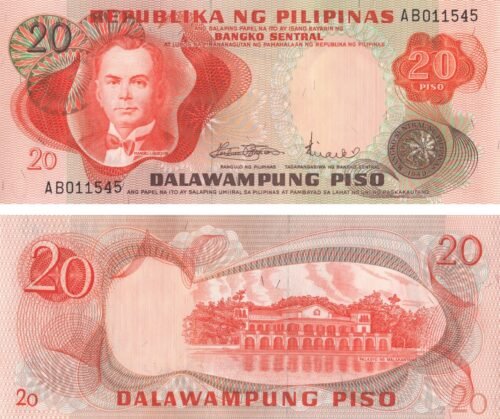
Philippines 20 Piso 1970, P-150, UNC
2,99 € -

Philippines 50 Piso 1970, P-151, UNC
3,99 € -
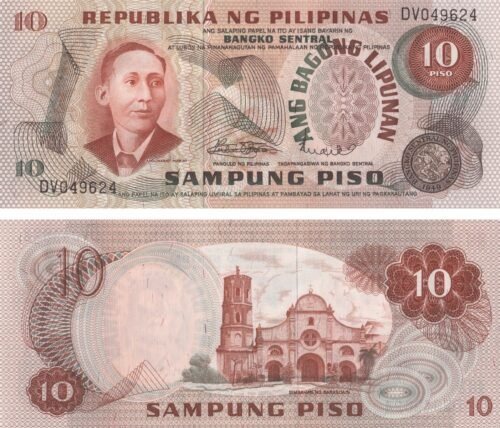
Philippines 10 Piso 1973, P-154, UNC
3,99 € -

Philippines 20 Piso 1973, P-155, UNC
3,99 € -
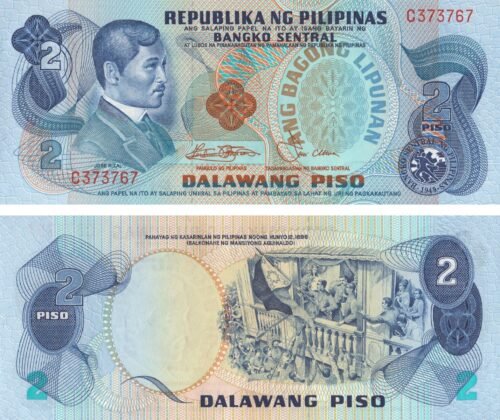
Philippines 2 Piso 1978, P-159c, UNC
2,99 € -

Philippines 5 Piso 1978, P-160a, UNC
2,99 € -

Philippines 10 Piso 1978, P-161d, UNC
2,49 € -
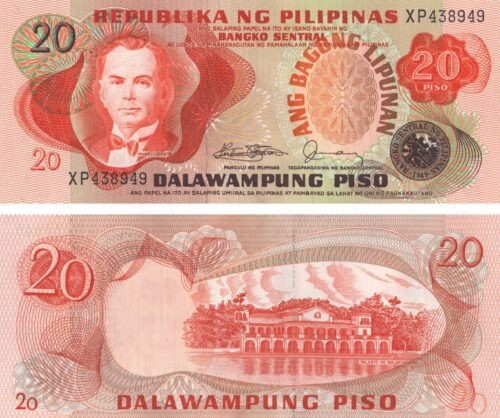
Philippines 20 Piso 1978, P-162c, UNC
2,99 € -

Philippines 50 Piso 1978, P-163b, UNC
3,99 € -

Philippines 2 Piso 1981, P-166, UNC
3,99 € -
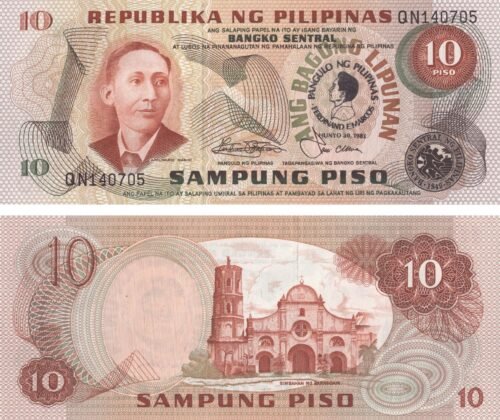
Philippines 10 Piso 1981, P-167, UNC
2,99 €