
Central Bank of Uruguay
The Central Bank of Uruguay (Banco Central del Uruguay) operates as the central monetary authority overseeing a currency system shaped by transitional overprints and recent polymer adoption.
Quick Facts
Country: Uruguay
Currency: Uruguayan Peso, Old Uruguayan Peso, Uruguayan Nuevo Peso
Local name: Banco Central del Uruguay
Institutional Identity
The Bank operates as Uruguay’s central monetary authority, managing inflation, supervising financial institutions, and issuing currency within a system shaped by repeated redenominations and long-term stabilization policies.
Historical Evolution
Established in 1967, the Bank oversaw major monetary reforms, most notably the 1993 transition to the peso uruguayo, which is particularly famous for its provisional overprinted (surcharged) notes—where older Nuevo Peso banknotes were stamped with new denominations before full replacement designs were issued.
Design Philosophy
Modern Uruguayan banknotes combine classical engraved portraiture with technological advancement, marked by the breakthrough 2017 commemorative 50 Peso polymer note—issued for the Bank’s 50th anniversary—which introduced a vertical polymer format and set the foundation for subsequent high-security issues.
For collectors
For collectors, the Central Bank of Uruguay offers a distinctive dual appeal, from the visually striking 1993 overprint notes to the elegant fusion of art and innovation in modern series, often featuring national artists such as Juan Manuel Blanes, creating a refined and highly aesthetic collecting pathway.
Explore Banknotes Issued by Central Bank of Uruguay
-

Uruguay 100 Pesos 1967, P-47a(9), UNC
4,99 € -

Uruguay 50 Nuevos Pesos 1989, P-61A(2), UNC
2,99 € -
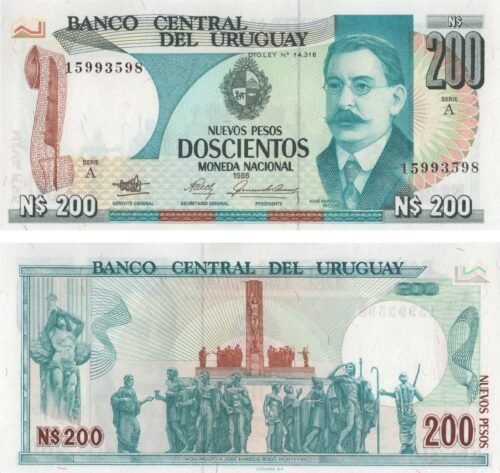
Uruguay 200 Nuevos Pesos 1986, P-66, UNC
4,99 € -
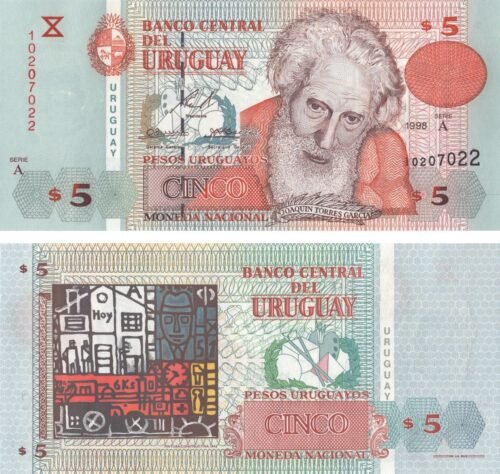
Uruguay 5 Pesos Uruguayos 1998, P-80, UNC
4,99 € -

Uruguay 50 Pesos Uruguayos 2011, P-87b, UNC
5,99 € -
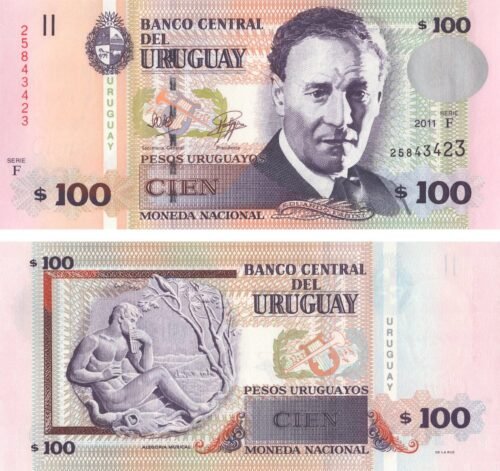
Uruguay 100 Pesos Uruguayos 2011, P-88b, UNC
10,99 € -
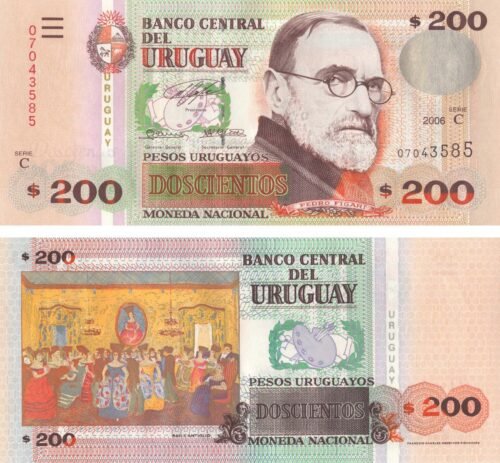
Uruguay 200 Pesos Uruguayos 2006, P-89a, UNC
22,99 € -

Uruguay 20 Pesos Uruguayos 2018, P-93, UNC
2,99 € -

Uruguay 20 Pesos Uruguayos 2020, P-101(1), UNC
2,49 € -
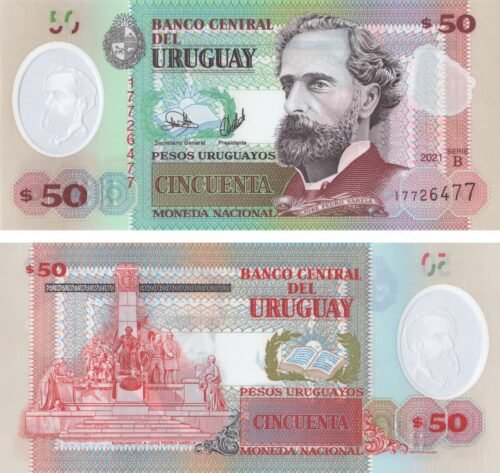
Uruguay 50 Pesos Uruguayos 2021, P-102(2), UNC
3,99 €