Companhia de Moçambique
Companhia de Moçambique issued regional paper money through its Caixa de Emissão in Beira. Company overprints, Portuguese arms and paired official signatures distinguish this Manica and Sofala sequence from Banco da Beira originals and Banco Nacional Ultramarino’s wider Mozambique issues.
Quick Facts
Institutional Identity
Companhia de Moçambique was a chartered company exercising delegated Portuguese colonial powers over Manica and Sofala. Its territorial administration operated from Beira, while its corporate headquarters were in Lisbon. Under the arrangements established in 1891, commercial enterprise and public administration occupied the same institutional framework, including powers over taxation and currency.
The company became the responsible note issuer after Banco da Beira’s privilege was terminated in 1929. Its Caixa de Emissão administered the paper money. Notes name the company and carry the signatures of the issue office’s manager and a company administrator, rather than a national central bank’s governor.
Historical Evolution
Decree 17669 of 26 November 1929 transferred responsibility for Banco da Beira’s outstanding notes to the company. The Caixa de Emissão opened on 26 May 1930, initially using earlier banknotes validated by red company overprints.
Purpose-engraved company notes followed, with centavo denominations alongside libra esterlina issues. A decree of 28 March 1933 changed redemption arrangements to metropolitan escudos at 110 escudos per libra. The printed wording and monetary promise must therefore be read in their historical setting.
The company’s territorial and issuing privileges ended on 18 July 1942, with Banco Nacional Ultramarino taking over the regional issuing function. Company notes remained redeemable until 30 April 1943, a separate endpoint from the loss of issuing authority.
Design Philosophy
Portuguese national arms, densely engraved borders and guilloche establish the appearance of the company’s notes. Bradbury Wilkinson of London printed the series. On provisional issues, the red company overprint changes the responsible issuer while much of Banco da Beira’s earlier design remains visible beneath it.
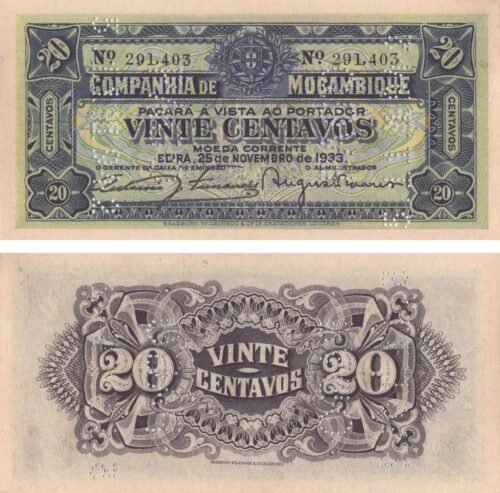
The dedicated notes instead engrave Companhia de Moçambique into the main heading. The twenty-centavo issue dated 25 November 1933 places the arms above its promise to pay, with Beira, the denomination and the two signing offices below. Blue and dark engraved work overlays a multicoloured background; the reverse concentrates on value and ornamental patterns.
For collectors
For collectors, the regional Pick R prefix and the issuer inscription are the first classification points. An original Banco da Beira note, a company-overprinted note and a purpose-engraved company issue belong to different catalogue entries, even where their engraving looks closely related.
Cancellation requires a separate check. Issued notes can have PAGO and date perforations recording payment. These are not automatically printer’s specimens. Horizontal CANCELLED perforations accompanied by serial-number ranges represent a different catalogue treatment. Inspect both serial positions, the perforation wording and any overprint before assigning a specimen status, and disclose cancellation independently of the paper’s preservation grade.