
Croatian National Bank
The Croatian National Bank (Hrvatska narodna banka) operates as the central monetary authority overseeing a system shaped by post-Yugoslav transition, notably defined by disciplined monetary policy and alignment with European standards.
Quick Facts
Institutional Identity
The Croatian National Bank (Hrvatska narodna banka) assumed full monetary authority following independence, introducing the Croatian dinar in 1991 as a transitional currency before executing a defining reform with the kuna on 30 May 1994—deliberately aligned with Statehood Day. This moment fused monetary policy with national identity, marking the restoration of a sovereign and stable currency after the collapse of the Yugoslav system.
Historical Evolution
The institutional strategy of the Bank was grounded in strict alignment with Deutsche Mark (DEM) standards, positioning the kuna within a German-influenced monetary discipline. Banknote design and production were entrusted primarily to Giesecke+Devrient (Munich), resulting in exceptional technical precision, including ultra-fine microtext, sharp intaglio engraving and highly controlled substrate quality. The design philosophy followed a consistent rule: portraiture on the obverse paired with urban and architectural compositions on the reverse, rejecting experimental or abstract motifs in favour of structured European classicism.
Design Philosophy
The kuna system was further defined by clearly structured Governor signature series, with key collecting anchors including Pero Jurković, Marko Škreb and Željko Rohatinski, whose tenure is associated with peak monetary stability. This disciplined issuance framework supported long-term exchange-rate stability against the euro, ultimately leading to Croatia’s euro adoption in 2023 and the closure of the kuna as a national currency.
For collectors
For collectors, Croatian banknotes represent a rare “closed and finite” European series defined by technical excellence and institutional clarity. The combination of German production standards, strict design doctrine and clearly segmented signature periods creates a precise and highly collectible field, positioning the kuna as one of the most refined post-independence currencies in modern numismatics.
Explore Banknotes Issued by Croatian National Bank
-

Croatia 1 Dinar 1991, P-16, UNC
0,99 € -

Croatia 5 Dinars 1991, P-17, UNC
0,99 € -

Croatia 10 Dinars 1991, P-18, UNC
0,99 € -

Croatia 50000 Dinars 1993, P-26, UNC
1,49 € -

Croatia 100000 Dinars 1993, P-27, UNC
1,49 € -
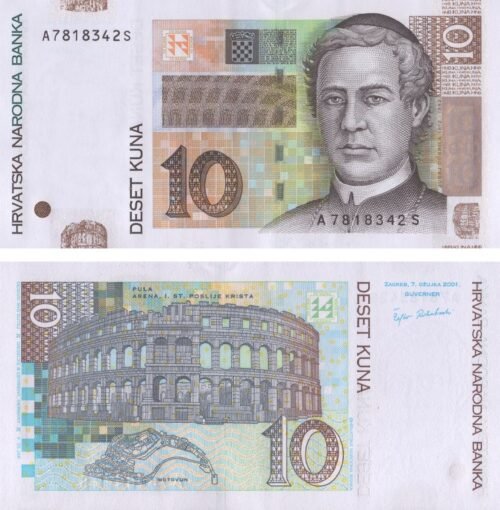
Croatia 10 Kuna 2001, P-38a, UNC
6,99 € -

Croatia 10 Kuna 2012, P-38b, UNC
6,99 € -
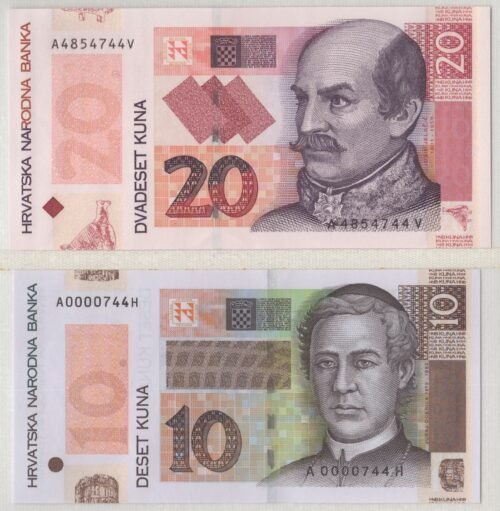
Croatia 10 & 20 Kuna Set 2004 & 2014, P-43 & P-44, UNC
36,99 €