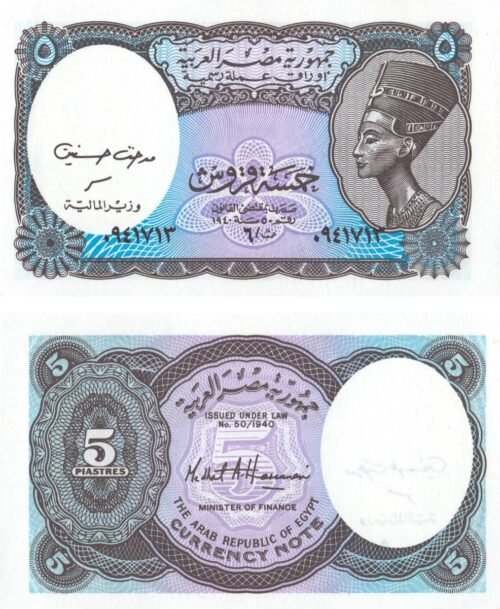
Egyptian Government
The Egyptian Government occupies a specific place in the country’s paper-money system as issuer of low-value currency notes. Its piastre issues complemented bank-issued pound notes and kept small denominations in paper form for everyday circulation.
Quick Facts
Institutional Identity
Egypt’s monetary structure historically divided responsibility by denomination. The National Bank of Egypt and later the Central Bank of Egypt issued the principal pound banknotes, while the government, through the Ministry of Finance, issued 5- and 10-piastre currency notes.
These notes were government obligations rather than central-bank banknotes. The distinction is visible in the issuer wording and explains why closely related Egyptian paper money belongs under more than one issuing authority.
Historical Evolution
Government currency notes provided practical substitutes for small coins and remained useful where metal supply, production cost or circulation needs favoured paper. Successive issues changed signatures, dates and printing arrangements while preserving the low-value function.
Production involved Egyptian state facilities, including the Survey Authority for documented series. Later examples continued alongside Central Bank of Egypt notes, showing that the institutional division persisted even after domestic central-bank printing expanded.
Design Philosophy
The small notes use compact layouts suited to low denominations. Arabic issuer text, clear value numerals and architectural or ornamental elements provide national identity without the larger scale and more complex portraiture of pound notes.
Design continuity can make dates and signatures more important than the main vignette. Paper, colour and minor typographic changes often carry the evidence needed to separate issues.
For collectors
For collectors, the first check is the authority line: a government 5- or 10-piastre note is not simply a small-denomination Central Bank of Egypt issue. Printed date, signature and printer attribution then define the exact variety.
Because the notes circulated heavily, clean examples with intact edges can be more challenging than their modest face values suggest. Arabic date reading is especially useful when organising duplicates.