Government of India
The Government of India occupies a unique place in India’s monetary system: it issues the one-rupee currency note, a legal-tender Government liability that circulates alongside Reserve Bank of India banknotes but follows a separate legal and signature tradition.
Quick Facts
Institutional Identity
In the WorldBanknotes.eu catalogue, Government of India refers to the Union Government in its narrow statutory role as issuer of the one-rupee currency note. It is not a central bank and should not be merged with the Reserve Bank of India. Under the Coinage Act, the ₹1 note is legal tender and is treated as a rupee coin for the purposes of the Reserve Bank of India Act; because rupee coin is a Government liability, the note is likewise a liability of the Government of India. The Ministry of Finance, Department of Economic Affairs, prescribes its printing, dimensions and design through statutory rules, while the Reserve Bank places the notes into circulation. This division of responsibility explains why the note bears the signature of the Finance Secretary or Secretary, Ministry of Finance rather than the RBI Governor.
Historical Evolution
Independent India’s first one-rupee note appeared in 1949 with a new national design and the Lion Capital of Ashoka. Printing of the denomination began at the new Currency Note Press location in 1962, and the Sagar Samrat design was introduced in 1981. The modern issue represented in WorldBanknotes.eu was authorised by the Printing of One Rupee Currency Notes Rules for effect from 2015, followed by separately prescribed 2016 and 2017 forms. Rajiv Mehrishi signed the 2015 issue, Ratan P. Watal the 2016 issue and Shaktikanta Das the 2017 issue. Across these changes, the Government remained the issuer, while the denomination circulated through the wider cash-distribution system administered by the Reserve Bank of India.
Design Philosophy
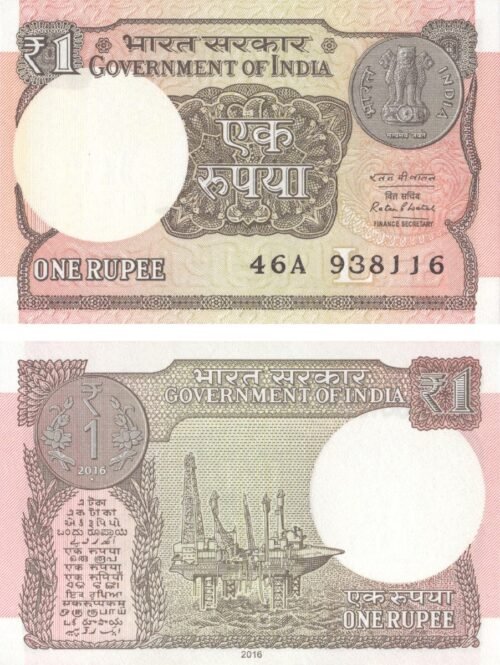
The 2015–2017 notes make their institutional status visible. The obverse carries भारत सरकार above Government of India, the bilingual signature of the Finance Secretary or Secretary, Ministry of Finance, a replica of the contemporary one-rupee coin and capital inset letter L. The reverse repeats the Government title, shows the Sagar Samrat offshore oil platform and includes a fifteen-language value panel around a coin representation dated to the issue year. Multitonal watermarks combine the Ashoka Pillar, hidden numeral 1 and vertical hidden word भारत. The compact 97 × 63 mm format and predominantly pink-green palette distinguish the series from RBI banknotes, while the 2017 form introduced numerals increasing in size from left to right after the fixed prefix.
For collectors
For collectors, issuer and signature are the first attribution points. P-117a carries Rajiv Mehrishi and the 2015 coin date; P-117b carries Ratan P. Watal and the 2016 date; P-117c carries Shaktikanta Das and the 2017 date with the revised ascending-size number panel. All three use inset letter L and the Sagar Samrat reverse, so the date, signatory and numbering treatment separate otherwise closely related forms. The Government-of-India legend and absence of an RBI Governor’s signature are not decorative details: they identify a legally distinct issuing authority. These notes should therefore be catalogued under Government of India, with Indian Rupee as the currency, rather than grouped under the Reserve Bank of India solely because RBI distributes them.