Government of the Republic of Indonesia
The Government of the Republic of Indonesia directly issued low-denomination rupiah notes under state authority, forming a distinct branch of Indonesian paper money alongside Bank Indonesia issues.
Quick Facts
Institutional Identity
The Government of the Republic of Indonesia was a direct issuing authority for certain rupiah notes, distinct from Bank Indonesia. When Bank Indonesia began issuing its own notes in 1953, its first banknote range started at 5 Rupiah, while smaller denominations continued to be represented by government-issued currency.
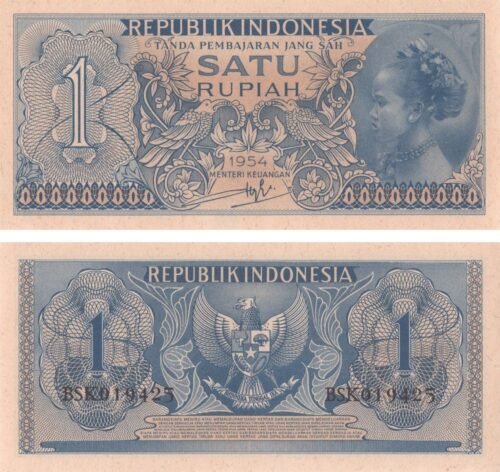
These notes were obligations of the state rather than commercial-bank or central-bank issues. Their institutional identity is visible in the REPUBLIK INDONESIA legend and in the signature of the Minister of Finance, replacing the Governor and Director signatures found on contemporary Bank Indonesia banknotes.
WorldBanknotes.eu therefore treats the Government of the Republic of Indonesia as a separate issuing authority. The distinction preserves the legal and administrative structure of the currency: government small-change notes and Bank Indonesia notes could circulate within the same rupiah system while belonging to different issuers.
Historical Evolution
Indonesia entered independence with an unusually complex monetary inheritance. Republican currency, regional issues and the notes of earlier banking institutions all formed part of the transition from colonial money to a sovereign national system. The establishment of Bank Indonesia in 1953 created a new central-bank framework, but it did not immediately make every paper denomination a Bank Indonesia issue.
Bank Indonesia’s first notes covered denominations from 5 to 1,000 Rupiah. Government paper money remained relevant below that range, and the mid-1950s 1 Rupiah and 2½ Rupiah notes provide a particularly clear example of the resulting division of issuing responsibility. Their Minister of Finance signatures and state legends identify them as government issues rather than Bank Indonesia banknotes.
The government issues represented in WorldBanknotes.eu belong to this formative stage of the rupiah, when the architecture of the young republic’s monetary system was still visibly divided between state and central-bank authority. As Indonesia’s currency framework developed, direct government paper-note issuance receded and Bank Indonesia became the dominant banknote issuer, leaving these small denominations as a finite historical branch of the national currency.
Design Philosophy
The mid-1950s government rupiah notes combine practical small-denomination purpose with a visual language of national identity. REPUBLIK INDONESIA is given clear prominence, while dense guilloche work, large denomination numerals and formal legal wording establish the notes as instruments of state authority.
The 1 Rupiah design balances this official framework with a portrait of a Javanese girl, birds and flowering ornament, while the 2½ Rupiah places an elderly Indonesian portrait against warmer engraved colour. On the reverses, Garuda Pancasila becomes the unifying image: the national emblem anchors both denominations and gives the small notes a constitutional gravity beyond their modest face value.
This contrast between intimate human portraiture and formal republican heraldry is central to the series. The designs present Indonesia not through monumental architecture or central-bank branding, but through people, ornament and the emblem of the republic itself.
For collectors
For collectors, Government of the Republic of Indonesia notes form a compact but institutionally important collecting field. They should be separated from contemporary Bank Indonesia issues even when the currency, period and circulation context overlap, because the issuing authority and signature structure are fundamentally different.
The 1 Rupiah and 2½ Rupiah notes of the mid-1950s are especially useful for studying this distinction. Date changes, Minister of Finance signatures and paired denominations allow a focused collection to show administrative change without losing the visual coherence of the government series.
Placed beside early Bank Indonesia notes, these issues reveal something larger than a denomination sequence: they preserve a moment when responsibility for Indonesian paper money was visibly shared between the republic’s government and its newly established central bank. That institutional transition gives the notes lasting historical and cataloguing significance.