
National Bank of Bosnia and Herzegovina
The National Bank of Bosnia and Herzegovina was the principal banknote-issuing authority for the Bosnia and Herzegovina dinar during the country’s wartime monetary transition of the 1990s. Its issues ranged from provisional and locally handstamped notes to regular dinar series and emergency cash coupons, before monetary functions passed to the Central Bank of Bosnia and Herzegovina in 1997.
Quick Facts
Country: Bosnia and Herzegovina
Currency: Bosnia and Herzegovina Dinar
Local name: Narodna Banka Bosne i Hercegovine
Institutional Identity
The National Bank of Bosnia and Herzegovina, locally Narodna Banka Bosne i Hercegovine, is the historical issuing authority named by The Banknote Book for Bosnia and Herzegovina’s 1990 (1992) provisional issues and for the regular, provisional and emergency dinar issues that followed through the mid-1990s. It belongs to the Bosnia and Herzegovina dinar period and must be distinguished from the later Central Bank of Bosnia and Herzegovina, issuer of the convertible mark.
The institution operated during a period in which political fragmentation, warfare and shortages of circulating cash produced several forms of paper money. Its catalogue scope therefore includes conventional banknotes as well as locally handstamped emergency notes and novčani bon cash coupons. The issuing authority is the institutional anchor that connects these otherwise visually diverse wartime issues.
The institutional boundary after the war is clear. The Central Bank of Bosnia and Herzegovina commenced operations on 11 August 1997. Contemporary CBBH records state that the former National Bank transferred the liability for Bosnian-dinar banknotes in circulation, together with equivalent foreign-exchange assets, to the new Central Bank. The older institution subsequently ceased monetary operations and was placed into liquidation.
Historical Evolution
The first Bosnia and Herzegovina dinar appeared in 1992 as the country separated from Yugoslavia. The Banknote Book records provisional issues created by handstamping Yugoslav notes, followed by emergency novčani bon issues used in areas where ordinary currency was scarce. The first Bosnian dinar was introduced in July 1992 at a rate of one Bosnia and Herzegovina dinar for ten Yugoslav dinars.
Regular 1992–1993 issues established a more coherent national series, while the continuing war generated additional provisional and emergency families. Local handstamps identified places of issue, and later note families reflected the rapid monetary adjustments of the period. A new Bosnia and Herzegovina dinar followed in 1994 as inflation and wartime conditions forced another monetary reset.
The National Bank’s monetary role ended with the post-Dayton institutional settlement. When the Central Bank of Bosnia and Herzegovina began operating in August 1997, the older National Bank no longer served as the country’s monetary authority. Its banknotes therefore form a closed historical corpus documenting the dinar era immediately before the convertible mark system.
Design Philosophy
The National Bank’s banknotes do not follow a single visual programme because many were created under emergency conditions. The earliest provisional notes reused Yugoslav designs with official handstamps, while the novčani bon issues relied on simple coupon layouts, local issue marks and repeated national or municipal symbols to make scarce paper money quickly identifiable.
The regular 1992–1993 dinar series moved toward a more unified banknote language. Guilloche patterns dominate the fronts, while the reverses alternate between the Stari Most bridge at Mostar and heraldic imagery. Latin and Cyrillic inscriptions appear together, reflecting the multilingual presentation of the issuing authority and denomination.
Later emergency and reform issues continued to place function ahead of stylistic continuity. Overprints, handstamps, revised denominations and changing security details became part of the visual record. For cataloguing, these interventions are not secondary decoration: they often identify the exact place, issue family or monetary stage to which a note belongs.
For collectors
For collectors, the National Bank of Bosnia and Herzegovina is the essential attribution for the wartime Bosnia and Herzegovina dinar issues. Notes from this period should not be assigned to the Central Bank of Bosnia and Herzegovina simply because that institution is the country’s present central bank.
Identification often depends on more than denomination and colour. Handstamp type and location, city name, signature, date, watermark, serial structure and whether a note is a regular issue, remainder or emergency coupon can determine the correct catalogue variety. The Banknote Book also warns that some purported provisional or specimen forms are not genuine official issues, making precise variety-level attribution especially important.
Viewed as a group, these notes document the transition from Yugoslav currency, through emergency wartime money and successive dinar issues, to the institutional handover that preceded the convertible mark. That sequence makes issuer, issue family and monetary stage especially useful organising principles for a Bosnia and Herzegovina collection.
Explore Banknotes Issued by National Bank of Bosnia and Herzegovina
-

Bosnia and Herzegovina 1000 Dinara 1992, P-8r, UNC
3,99 € -

Bosnia and Herzegovina 10 Dinara 1992, P-10, UNC
1,49 € -

Bosnia and Herzegovina 25 Dinara 1992, P-11, UNC
1,49 € -

Bosnia and Herzegovina 50 Dinara 1992, P-12, UNC
0,99 € -

Bosnia and Herzegovina 100 Dinara 1992, P-13, UNC
1,49 € -

Bosnia and Herzegovina 1.000 Dinara 1992, P-15, UNC
1,49 € -

Bosnia and Herzegovina 100000 Dinara 1993, P-34a, UNC
2,49 € -

Bosnia and Herzegovina 1 Dinar 1994, P-39, UNC
4,99 € -

Bosnia and Herzegovina 10000 Dinara 1993, P-53e, UNC
3,99 € -
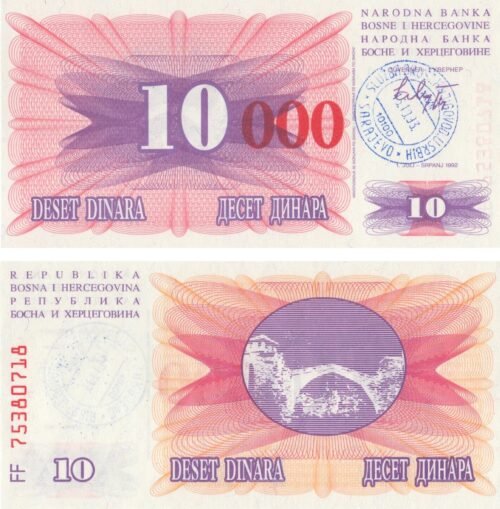
Bosnia and Herzegovina 10000 Dinara 1993, P-53f, UNC
3,99 € -

Bosnia and Herzegovina 10000 Dinara 1993, P-53g, UNC
3,99 € -

Bosnia and Herzegovina 10000 Dinara 1993, P-53h, UNC
3,99 € -

Bosnia and Herzegovina 25000 Dinara 1993, P-54a, UNC
3,99 € -

Bosnia and Herzegovina 50000 Dinara 1993, P-55h, UNC
3,99 €