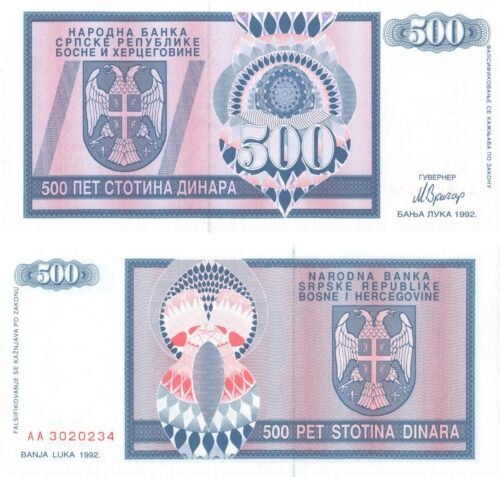
National Bank of the Serbian Republic of Bosnia and Herzegovina
The National Bank of the Serbian Republic of Bosnia and Herzegovina was the issuing authority named on the first Republika Srpska dinar banknotes of 1992–1993. Issued from Banja Luka during the Bosnian War, these notes form a distinct monetary series whose authority, inscriptions and place of issue separate them from contemporary Yugoslav, Bosnian and Serbian Krajina paper money.
Quick Facts
Country: Bosnia and Herzegovina
Currency: Republika Srpska Dinar
Local name: Narodna Banka Srpske Republike Bosne I Hercegovine
Institutional Identity
The institution appears on banknotes as Narodna Banka Srpske Republike Bosne I Hercegovine and is catalogued by The Banknote Book as the National Bank of the Serbian Republic of Bosnia and Herzegovina. Its documented numismatic role is the issue of the first Republika Srpska dinar series from Banja Luka in 1992–1993.
Reliable institutional history beyond the banknote record is limited. The Banknote Book explicitly notes that more information is sought about the institution, so its establishment date, legal succession and wider banking functions should not be inferred from the notes alone. The issuer is therefore best defined by the authority printed on the documented currency issues rather than by unsupported institutional reconstruction.
The issuer must also be separated from the later Narodna Banka Republike Srpske, which appears on subsequent 1993 issues. This distinction is visible in the banknote legends and marks a genuine catalogue boundary: the two authorities belong to successive phases of Republika Srpska’s wartime dinar system.
Historical Evolution
The first Republika Srpska dinar entered use in July 1992 in areas under Serbian control. The Banknote Book records an exchange relationship of one Republika Srpska dinar for ten Yugoslav dinars, placing the new currency on par with the contemporary Yugoslav dinar at introduction.
The 1992–1993 issues range from low denominations to rapidly escalating million-dinar values as inflation accelerated. Notes were issued from Banja Luka and carried the signatures of governors Milenko Vračar and Milan Pejić across the documented varieties. The changing denominations and prefixes provide a compact record of the monetary pressure under which the series circulated.
During 1993 the issuer name changed on later banknotes to Narodna Banka Republike Srpske. That change, followed by the 1 October 1993 redenomination of one new Republika Srpska dinar for one million old dinars, closes the first bank’s catalogue period and begins the next institutional and monetary phase.
Design Philosophy
The first Republika Srpska series uses a deliberately restrained and repetitive design system. Cyrillic Serbian text appears on the front and Latin-script text on the back, while the Serbian coat of arms is a principal identifying device. A stylised vase motif and geometric guilloches provide continuity across denominations.
The Banknote Book notes a practical front-versus-back distinction established by contemporary regulations: Cyrillic script belongs on the front, while Latin script appears on the back. The governor’s signature is on the front and the red serial number on the back, giving collectors consistent orientation cues even when both sides are visually balanced.
The notes are closely related in colour and design to contemporary Serbian Krajina issues, but the issuing text, signature and place of issue differ. Banja Luka rather than Knin is therefore an important part of the design evidence, not merely a geographic detail.
For collectors
For collectors, issuer legend and place of issue are the first safeguards against misattribution. Notes of this bank should read Narodna Banka Srpske Republike Bosne I Hercegovine and show Banja Luka; similar Serbian Krajina notes can look almost identical but belong to a different issuing system.
Within the series, denomination, governor signature, prefix, watermark and replacement prefix all matter. The Banknote Book records ZA replacement prefixes on several denominations, while specimen and unissued forms require separate treatment. Horizontal MILIONA / DINARA overprints associated with some Pick cross-references are described as unofficial and should not be treated as ordinary bank issues.
The most useful collecting boundary is institutional: keep the 1992–1993 notes of this authority separate from the later Narodna Banka Republike Srpske issues. That distinction follows the wording printed on the notes themselves and prevents the two Republika Srpska dinar phases from being collapsed into one issuer.