Pathet Lao Government
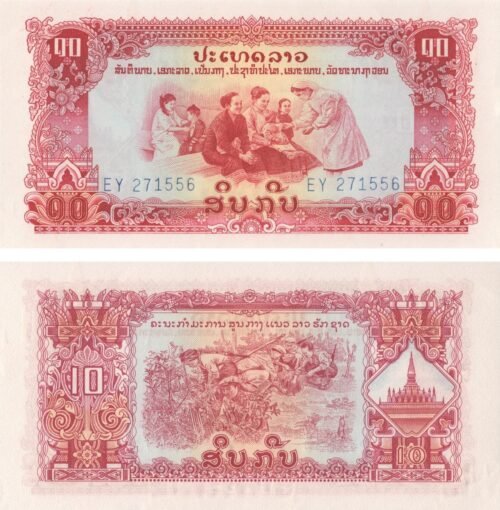
The Pathet Lao Government issued a distinct revolutionary kip series for territories under its control during the Lao Civil War. Catalogued as the 1968 issues, these notes replaced royal portraits and French text with Lao-language scenes of farming, medicine, industry and armed struggle, and later became accepted legal tender across Laos after the Pathet Lao victory in 1975.
Quick Facts
Institutional Identity
The Pathet Lao Government is the catalogue issuing authority for the 1968 revolutionary kip series circulated in Pathet Lao-controlled areas. It was not a conventional peacetime central bank. Official Bank of the Lao P.D.R. historical material describes a monetary structure built around the Central Patriotic Lao Front, which established a central treasury in the liberated zone as part of a wider effort to create an autonomous financial system.
That official history records 7 October 1968 as the date on which the standing committee of the Central Patriotic Lao Front approved the establishment of the central treasury at Viengxai in Houaphanh Province and inaugurated the printing of the liberated kip currency. The Bank of the Lao P.D.R. later adopted this date as a foundational anniversary for the Lao banking sector.
The Banknote Book separately catalogues the Pathet Lao Government’s 1968 issues from the Banque Nationale du Laos and from the later Bank of the Lao P.D.R. This distinction is essential because multiple kip currencies and issuing systems coexisted during the civil-war period.
Historical Evolution
The Banknote Book states that Pathet Lao forces began circulating the notes in April 1968 in northern and eastern areas under their control. Their exact production location remains uncertain: reports place printing either in a cave at Viengxai or in Shanghai, and the catalogue therefore lists the printer as unknown rather than assigning an unverified printer.
The series covered denominations from 1 to 500 kip and used the monetary needs of the liberated zone as its central theme. At the beginning of this period, Vientiane and Khangkhai kip currencies also circulated, illustrating the fragmented monetary landscape of wartime Laos.
After the Pathet Lao takeover in 1975, the series was accepted as legal tender throughout the country. The Banknote Book records the Royal Khangkhai kip being exchanged for the Pathet Lao Liberation kip at twenty to one. The Liberation kip was later replaced by the post-1979 Lao kip system, closing this revolutionary issue period.
Design Philosophy
The Pathet Lao notes are unusually consistent in their social and economic imagery. Instead of royal portraiture, they show workers threshing grain, medical clinics, rice distribution, blacksmiths, machine-shop workers, fishermen, textile cooperatives, farmers and transport activity. The imagery presents productive labour and public services as the visual language of the new monetary authority.
Military struggle is also explicit. Some reverses show soldiers preparing battlefield defences or engaging aircraft, while the 500-kip note combines armed farmers, agriculture and industrial imagery. Wat That Luang appears repeatedly as a national landmark and also serves as a watermark on several denominations.
Lao text is used on both sides, creating a clear contrast with many Royal Lao issues that pair Lao fronts with French reverses. Watermark varieties, especially Wat That Luang versus five-pointed-star patterns on several denominations, provide important physical subtypes within an otherwise coherent design family.
For collectors
For collectors, the Pathet Lao Government series should be treated as a separate issuing system rather than folded into Banque Nationale du Laos or later Bank of the Lao P.D.R. issues. The authority, historical circulation zone and revolutionary design programme all make it a distinct catalogue group.
Watermark is one of the most useful variety diagnostics. The 10-, 20- and 50-kip notes are recorded with both Wat That Luang and five-pointed-star watermarks, while prefixes also vary by subtype. The notes are unsigned, and the printer remains unverified, so an unknown-printer attribution is more accurate than naming a specific printing works.
The series also has a clear chronological endpoint. Its nationwide acceptance after 1975 and later replacement by the post-1979 monetary system make it a compact way to document the transition from insurgent-zone currency to national legal tender during one of the most consequential periods in modern Lao monetary history.