Reichsbank
The Reichsbank’s notes span imperial Germany, the collapse of the mark in 1923 and the subsequent Reichsmark era. Their portraits, seals and changing denominations document a central bank whose monetary responsibilities also became instruments of Nazi rearmament and financial persecution.
Quick Facts
Institutional Identity
The Reichsbank began operations in Berlin on 1 January 1876 under the banking framework created in 1875. It succeeded the Prussian Bank, issuing banknotes and operating a nationwide branch network. Earlier issues bear the Reichsbank title and reproduce the signatures of the bank’s president and governing board members.
It was distinct from the Reichsschuldenverwaltung, whose treasury and loan currency notes circulated alongside central bank money. Institutional identity also survived changes in the currency: a Reichsbanknote denominated in mark during the inflation is not automatically a Reichsmark note. Reichsmark became the currency name only with the reform of 1924.
Historical Evolution
Gold redemption was suspended at the outbreak of the First World War in 1914. The Reichsbank continued financing the state as inflation intensified. Greater autonomy in 1922 did not prevent the currency’s collapse; by 1923 the bank was issuing rapidly escalating denominations.
Stabilisation began with Rentenmark notes issued by the separate Deutsche Rentenbank in November 1923. The Reichsbank entered the Reichsmark system in 1924 under a new statutory framework. The two institutions and their currencies must therefore be distinguished when following the reform.
Under National Socialism, the Reichsbank helped finance rearmament, exploit occupied territories and dispose of confiscated Jewish property and looted gold. Its central banking operations ended in 1945. The later Bundesbank was not its legal successor.
Design Philosophy
The first Reichsbank notes used neoclassical figures, imperial crowns and eagles within elaborate ornamental frames. The hundred mark note dated 1876 places Minerva on the front and kneeling cherubs around the value on the back. Later imperial issues retain heraldic imagery while adding coloured bank seals and underprint letters.
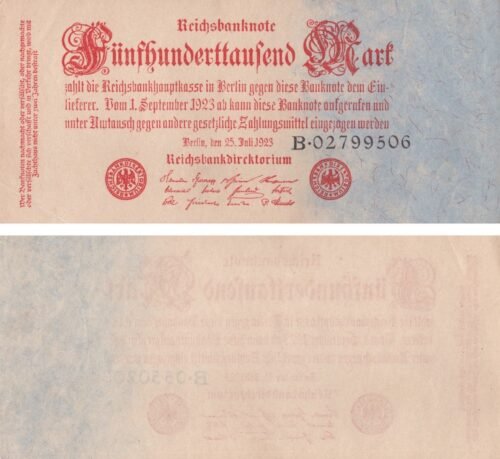
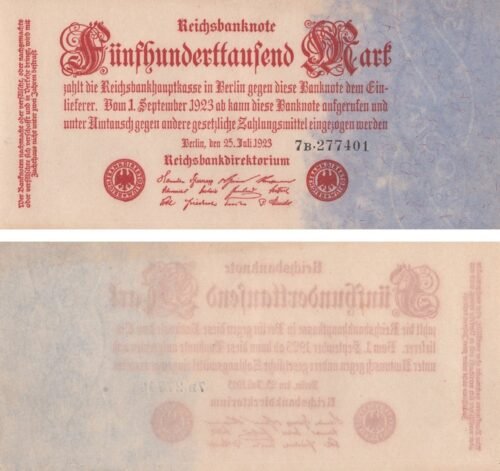
Inflation brought a wider range of layouts. Some large notes used portraits derived from old master paintings; other issues became compact sheets printed on only one side, dominated by value and legal wording. The five hundred thousand mark note dated July 1923, for example, carries two red Reichsbank seals and an unprinted reverse.
For collectors
For collectors, the issuer heading, currency unit and complete serial number belong together. The two 1923 five hundred thousand mark varieties show why: Reichsdruckerei production has a serial number of eight digits, while contracted printing has six digits. A matching date and denomination alone cannot settle the variety.
Paper can be equally decisive. The grey two hundred thousand mark note without printer codes occurs in versions with silk threads and without them. Examine the paper against light before assigning the subtype. Earlier underprint letters, seal colours and signature combinations create further distinctions within otherwise familiar banknote designs.