Republic of Croatia
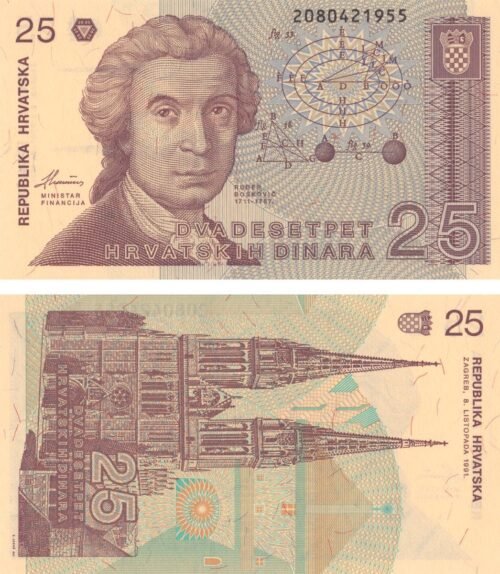
The Republic of Croatia's provisional dinar notes carry Ruđer Bošković's portrait and the Finance Minister's signature. Issued through the Ministry of Finance, they mark the interval between the replacement of Yugoslav currency in 1991 and the kuna's introduction in 1994.
Quick Facts
Institutional Identity
Republic of Croatia identifies the state named on Croatian dinar notes as Republika Hrvatska. The government's December 1991 decision assigned their issue to the Ministry of Finance. The Finance Minister determined denominations, appearance and circulation arrangements; this was not the same issuing framework as the later kuna banknotes of the national central bank.
The National Bank of Croatia nevertheless administered the exchange through banks, post offices and the payments service. Distribution and legal responsibility were therefore related but distinct. Jozo Martinović and Zoran Jašić signed the dinar issues as Finance Minister, rather than as central-bank governor.
Historical Evolution
Croatian dinars entered circulation on 23 December 1991, replacing Yugoslav dinars at parity. The first seven denominations, from one to 1,000 dinars, bear the earlier printed date of 8 October 1991. Preparation and introduction thus have separate chronological markers.
Inflation brought 2,000-, 5,000- and 10,000-dinar notes dated 15 January 1992. The 50,000- and 100,000-dinar values followed with the date 30 May 1993 and Jašić's signature in place of Martinović's. These additions retained Bošković but changed the reverse subject.
The kuna replaced the provisional dinar on 30 May 1994 at 1,000 dinars to one kuna. That reform began a different banknote family issued by the national central bank, rather than an extension of the ministry's dinar designs.
Design Philosophy
Zlatko Jakus's designs place Bošković beside geometric calculations and the Croatian coat of arms. Across the initial denominations, a horizontal portrait side contrasts with a vertical reverse showing Zagreb Cathedral. Colour and size distinguish the values within this closely related family, while the Republic inscription and ministerial title make the state authority visible.
From 2,000 dinars upward, Ivan Meštrović's sculpture History of the Croats replaces the cathedral, accompanied by a stylised stained-glass motif. The scientific portrait remains constant. Comparing the reverse therefore separates the original architectural group from the later, higher-denomination sculptural group.
For collectors
For collectors, this is the Croatian dinar's state-issued sequence, not the later kuna series or the separate Krajina dinar. Printed dates and ministerial signatures provide firm organising points: the 1991 and 1992 groups carry Martinović, while the two 1993 high values carry Jašić.
The 25-dinar note adds a paper distinction within the common design. It uses stock intended for a Swedish five-kronor note, producing a numeral 5 between waves in the watermark. Normal and reversed numeral varieties are catalogued separately. The watermark must therefore be checked independently of the printed denomination and the familiar Bošković portrait.