Republic of Slovenia
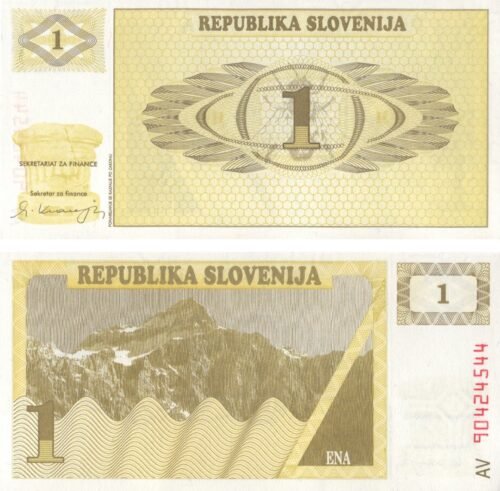
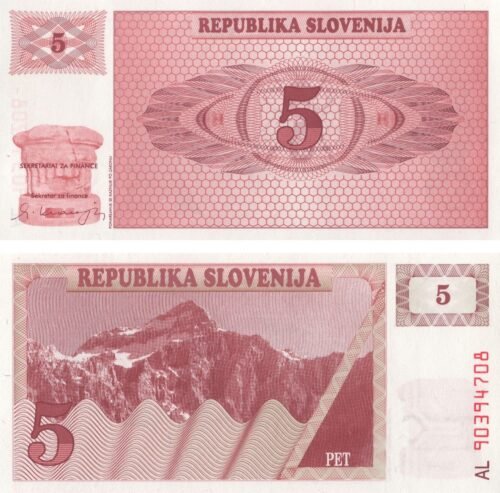
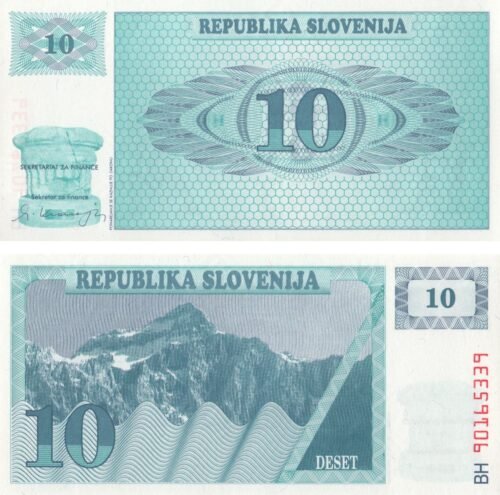
The peak of Triglav and a honey bee identify Slovenia's provisional payment notes. Bearing the Republic's name and the Secretariat for Finance inscription, these vouchers accompanied the tolar's introduction in October 1991, before the permanent portrait banknotes.
Quick Facts
Institutional Identity
The Republic of Slovenia is the state authority named on the provisional payment notes prepared for the transition to an independent currency. Their reverse identifies the Secretariat for Finance, Sekretariat za finance, and carries the facsimile signature of Marko Kranjec as Secretary for Finance.
Bank of Slovenia also had a formal issuing role. Its council adopted the October 1991 decisions defining the notes and putting them into circulation. The bank's contemporary annual report describes Republic-issued tokens operating legally in the central bank's name and on its account. Both institutional identities belong to the same monetary transition.
Historical Evolution
Preparations began in autumn 1990, before Slovenia became independent. Aero Celje, later Cetis, undertook the design and production work. Printing began that November. No currency name had yet been settled, so the designs expressed values without naming a monetary unit.
Slovenia introduced the tolar on 8 October 1991. Bank of Slovenia placed the vouchers into circulation through the Social Accounting Service. Public exchange of Yugoslav dinars began the following day at parity, providing cash while permanent banknotes were being prepared.
The first permanent tolar banknotes appeared in September 1992. The 5- and 10-tolar vouchers ceased to be legal tender on 30 June 1993. Their 1990 preparation and 1991 introduction are separate dates.
Design Philosophy
The original voucher family shares a common composition, with Triglav on the front and a bee against honeycomb on the reverse. The Prince's Stone appears beside the finance inscription and Kranjec's signature. Colours and large denomination numerals distinguish the values, while the Republic's name appears on both sides.
Unlike the later tolar banknotes, these provisional designs do not use portraits of cultural figures. Their snowflake-pattern watermark is another recognisable feature. Bank of Slovenia records that the paper came from stock originally intended for admission tickets to the Sarajevo Winter Olympics.
For collectors
For collectors, the Republic inscription establishes the catalogue grouping, but the finance title and signature explain the authority represented on each note. The 5- and 10-tolar denominations are listed as B203 and B204 in The Banknote Book, corresponding to Pick P-3 and P-4.
Serial details matter when separating printings. On these vouchers, the opening serial digits generally indicate the printing year, not the date when the tolar entered circulation. Regular notes also need to be distinguished from SPECIMEN and VZOREC overprints, which have different inscriptions and serial-number treatments.