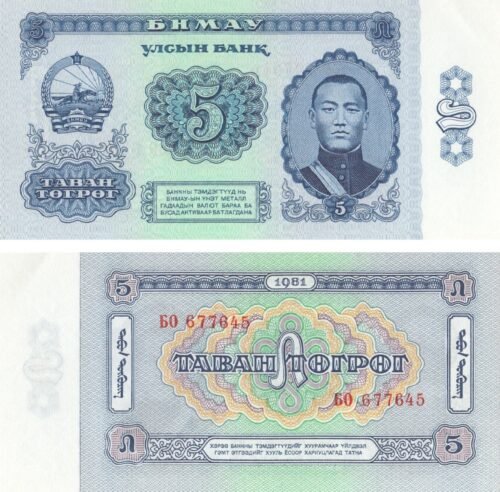
State Bank of the People’s Republic of Mongolia
The State Bank of the People’s Republic of Mongolia was created in 1954 when Mongolia’s former Trade and Industry Bank was reorganised as a fully state-owned institution. It issued the 1955 and 1966–1983 tögrög banknote families, combining socialist state symbols, Cyrillic inscriptions and the portrait of revolutionary leader Damdinii Sükhbaatar before the modern Mongolbank era.
Quick Facts
Institutional Identity
The State Bank of the People’s Republic of Mongolia was established by government order on 12 April 1954, when the Soviet Union transferred its share in the joint Mongolian Trade and Industry Bank to the People’s Republic of Mongolia and the institution was reorganised as a state bank. The Bank of Mongolia’s official history identifies this reorganisation as a major stage in the development of Mongolia’s national financial and credit system.
Under the State Bank’s regulations, its functions included issuing cash into circulation, withdrawing currency and maintaining adequate reserves of banknotes and coins. The Banknote Book catalogues the 1955 and 1966–1983 banknote issues under the State Bank, separating them from the earlier Commercial and Industrial Bank and from Mongolbank issues beginning in 1993.
The historical State Bank should therefore not be replaced by the modern Bank of Mongolia when cataloguing mid-twentieth-century notes. Although the institutions form part of a broader line of Mongolian monetary development, the issuing legend and institutional period on the banknotes are distinct.
Historical Evolution
The State Bank’s first banknotes were issued in 1955. According to the Bank of Mongolia, artists Shibu and D. Amgalan prepared the designs, and the notes were printed by Goznak in Moscow. The series introduced fully Cyrillic text, a socialist state emblem and a portrait of Damdinii Sükhbaatar, and it remained in circulation until its withdrawal in 1966.
In 1965 the Council of Ministers approved a replacement series for introduction on 1 January 1966 and ordered the State Bank to withdraw the older 1925, 1941 and 1955 notes. The Banknote Book groups the subsequent 1966–1983 issues under the same State Bank authority, showing the institution’s continued role through later printings and denominations.
Mongolia reorganised its banking system at the beginning of the 1990s, creating a two-tier structure. Modern banknotes from 1993 onward are catalogued under Mongolbank, marking the practical collecting boundary between the socialist State Bank period and the present central-bank era.
Design Philosophy
The 1955 series made political and linguistic change immediately visible. Old Mongolian script was replaced by Cyrillic, the socialist state emblem appears prominently, and Sükhbaatar became the central human figure across the series. The backs rely on guilloche engraving, while denomination colours distinguish the values.
Goznak production gave the notes a recognisably Soviet-influenced security-printing vocabulary. The 1955 paper carries the traditional Ulzii Khee good-luck knot watermark pattern, creating an important contrast between national ornamental symbolism and the series’ socialist institutional imagery.
The 1966–1983 family retained a disciplined state-symbolic approach, using the socialist arms, Cyrillic inscriptions and Sükhbaatar portraiture across much of the denomination range. For collectors, this visual continuity is useful, but issue year, denomination, watermark and serial details remain necessary for separating successive printings.
For collectors
For collectors, the State Bank is the correct issuer for Mongolia’s 1955 and 1966–1983 banknotes. Assigning these notes to the modern Bank of Mongolia obscures a real institutional boundary and makes it harder to organise Mongolia’s monetary history accurately.
The 1955 notes are especially identifiable by their Cyrillic-only inscriptions, socialist arms, Sükhbaatar portrait, Goznak printing and Ulzii Khee watermark. Denomination, suffix or prefix, replacement status and specimen markings provide further variety-level distinctions within the family.
The transition to the 1966 series and the later move to Mongolbank in the 1990s create natural collection milestones. Arranging notes by issuing authority and issue family makes the shift from the socialist State Bank to the modern central-bank system much clearer than sorting only by denomination.