
State Bank of Vietnam
The State Bank of Vietnam (Ngân hàng Nhà nước Việt Nam) operates as the central monetary authority overseeing a currency system spanning wartime monetary division and full transition to polymer banknotes.
Quick Facts
Institutional Identity
The Bank operates as Vietnam’s central monetary authority, managing inflation, supervising financial institutions, and issuing currency within a state-influenced economic system transitioning from centralized planning toward market integration.
Historical Evolution
Established in 1951, the Bank oversaw multiple parallel currencies during the Vietnam War, a period highly valued by collectors who distinguish between the socialist issues of North Vietnam and the Western-printed, visually rich banknotes of South Vietnam, before reunification in 1978 established a unified đồng.
Design Philosophy
Modern Vietnamese banknotes are defined by their complete transition to polymer from 2003 onward, making Vietnam one of the first countries to fully replace its circulating series, with Hồ Chí Minh on all obverses and reverses depicting national landmarks, executed with durable substrates and vibrant colour structures.
For collectors
For collectors, the State Bank of Vietnam offers a layered and dynamic field, from rare wartime dual-currency issues to the high-denomination 500,000 Đồng note featuring Hồ Chí Minh’s birthplace in Kim Liên, now considered the crown jewel of the modern polymer series.
Explore Banknotes Issued by State Bank of Vietnam
-

Vietnam 2 Dong 1980, P-85, UNC
1,49 € -

Vietnam 5 Dong 1985, P-92, UNC
1,49 € -

Vietnam 200 Dong 1987, P-100c(1), UNC
1,49 € -

Vietnam 200 Dong 1987, P-100c(2), UNC
1,49 € -
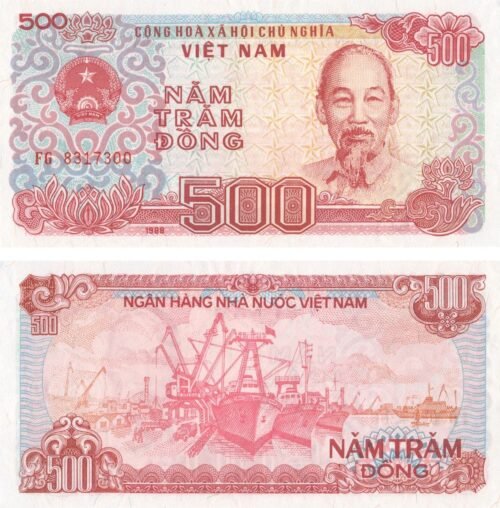
Vietnam 500 Dong 1988, P-101a(1), UNC
1,49 € -
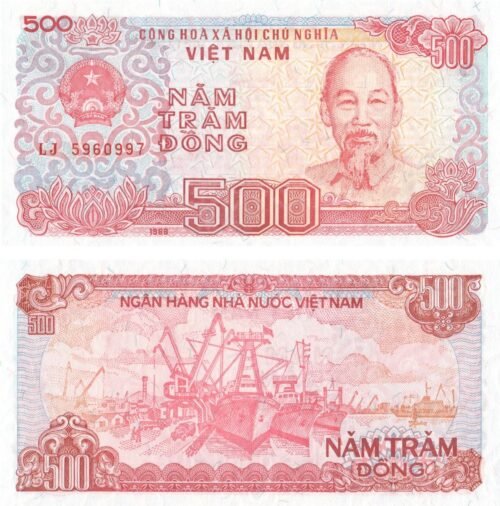
Vietnam 500 Dong 1988, P-101a(2), UNC
0,99 € -

Vietnam 100 Dong 1991, P-105a, UNC
1,49 € -

Vietnam 1000 Dong 1988, P-106a(1), UNC
0,99 € -

Vietnam 1000 Dong 1988, P-106a(2), UNC
1,49 € -

Vietnam 2000 Dong 1988, P-107a(1), UNC
0,99 € -

Vietnam 2000 Dong 1988, P-107a(2), UNC
1,49 € -

Vietnam 5000 Dong 1991, P-108, UNC
1,49 € -

Vietnam 10000 Dong 2014, P-119h, UNC
2,49 € -

Vietnam 10000 Dong 2019, P-119, UNC
2,49 € -

Vietnam 10000 Dong 2020, P-119, UNC
2,49 € -

Vietnam 10000 Dong 2023, P-119, UNC
2,49 € -

Vietnam 10000 Dong 2024, P-119, UNC
2,49 € -
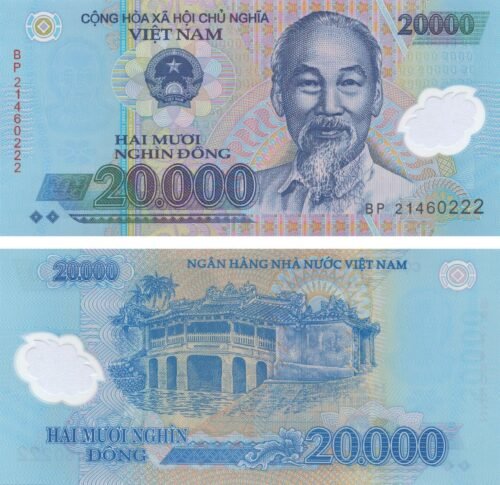
Vietnam 20000 Dong 2021, P-120, UNC
2,99 € -

Vietnam 20000 Dong 2022, P-120, UNC
2,99 € -

Vietnam 50000 Dong 2022, P-121, UNC
5,99 € -

Vietnam 100000 Dong 2021, P-122, UNC
11,99 € -

Vietnam 100 Dong 2016, P-125, UNC
9,99 €