
Trade Bank of the Democratic People’s Republic of Korea
The Trade Bank of the Democratic People’s Republic of Korea issued the colour-coded foreign exchange certificates dated 1988. The parallel series for visitors from capitalist and socialist countries are catalogued separately from the central bank’s domestic won notes.
Quick Facts
Institutional Identity
Trade Bank of the Democratic People’s Republic of Korea identifies the issuer named on the 1988 foreign exchange certificates. The Korean title is 조선민주주의인민공화국 무역은행, and international institutional records also use Foreign Trade Bank of the DPRK. These names refer to the same institution, not separate certificate issuers.
The South Korean Ministry of Unification identifies external settlement and issuing certificates for foreign visitors among the bank’s functions. For catalogue attribution it must be distinguished from the Central Bank of the DPRK, whose name appears on domestic circulation notes. Denomination in won alone does not establish the issuer.
Historical Evolution
A 2008 institutional profile published by the DPRK’s Foreign Trade Publishing House records the Foreign Trade Bank’s establishment by Cabinet decision on 2 November 1959. The account describes international settlements, foreign-currency accounts and remittances among its activities.
The certificates dated 1988 form a distinct part of its paper-money history. Catalogue series separate visitors from capitalist and socialist countries, with chon and won denominations in each group. The original capitalist-visitor chon certificates are blue and the won values green; the socialist-visitor series is red.
Later colour varieties retain the 1988 date. The printed year therefore needs to be read with the visitor group, colour and design when arranging this sequence.
Design Philosophy
The green won-denominated certificates use Chollima, the winged horse monument in Pyongyang. A man holding a book and a woman carrying grain ride above the horse, accompanied by the national arms. Large value figures and the Trade Bank’s Korean title frame the sculptural scene within the monetary layout.
The red one-won certificate for socialist visitors instead shows the International Friendship Exhibition at Mount Myohyang, with a globe-and-olive device. On the backs, enlarged denominations and interlaced ornament replace the principal front vignettes. These pictorial and colour differences distinguish the parallel visitor series without relying on the leader portraits familiar from domestic currency.
For collectors
For collectors, establish the issuer and certificate category before matching the denomination. A green one-won capitalist-visitor certificate (P-27) and a red one-won socialist-visitor certificate (P-35) share the 1988 date but belong to parallel series. Within the capitalist group, green and later purple examples must also be distinguished.
Read the unit as carefully as the numeral: one chon is not one won. Compare the colour, front vignette, bank inscription and catalogue variety together. Keep Trade Bank certificates separate from the central bank’s ordinary circulation notes and its 2003 savings bonds. Those bonds are financial instruments, not additional denominations of the 1988 visitor-certificate series.
Explore Banknotes Issued by Trade Bank of the Democratic People’s Republic of Korea
-

North Korea 1 Chon 1988, P-23(2), UNC
1,49 € -
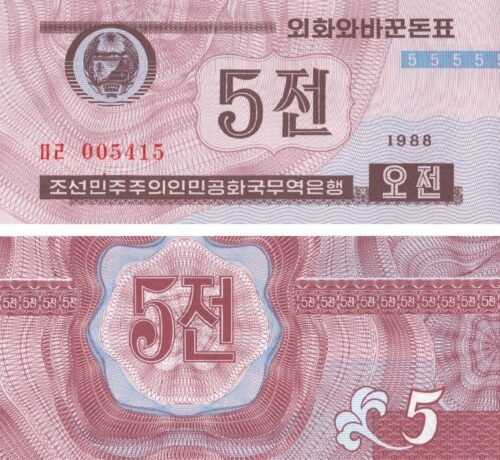
North Korea 5 Chon 1988, P-24(2), UNC
0,99 € -

North Korea 10 Chon 1988, P-25(2), UNC
1,49 € -
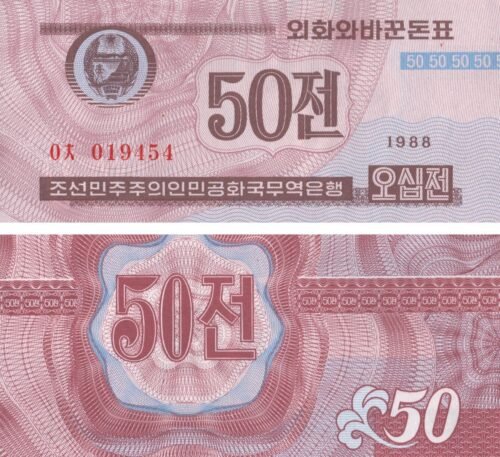
North Korea 50 Chon 1988, P-26(2), UNC
1,49 € -
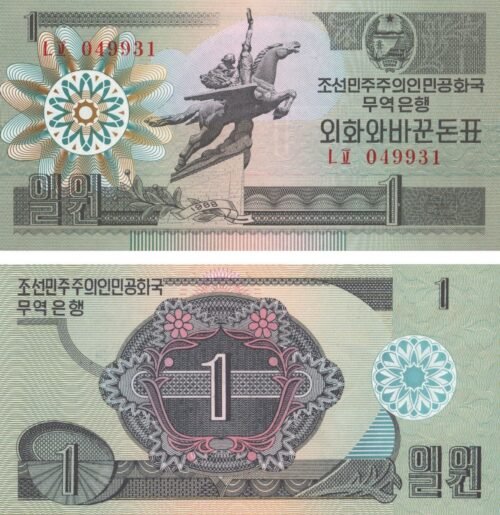
North Korea 1 Won 1988, P-27(1), UNC
1,49 € -

North Korea 50 Won 1988, P-30(1), UNC
7,99 € -

North Korea 1 Chon 1988, P-31, UNC
2,49 € -

North Korea 5 Chon 1988, P-32, UNC
1,49 € -

North Korea 10 Chon 1988, P-33, UNC
0,99 € -

North Korea 50 Chon 1988, P-34, UNC
1,49 € -
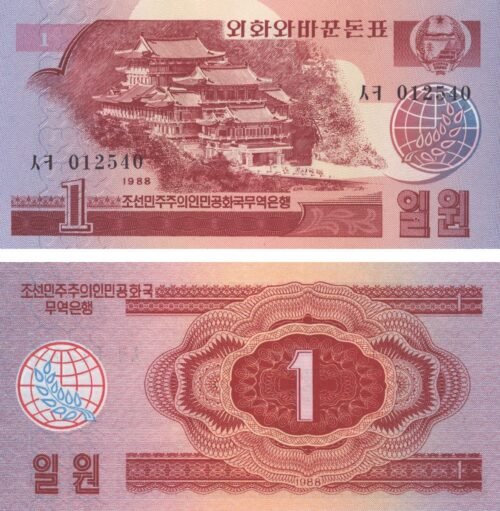
North Korea 1 Won 1988, P-35, UNC
2,49 €