
Old Paper Money for Sale
This selection brings together old paper money and world banknotes in the WorldBanknotes.eu catalogue whose recorded issue year is at least half a century in the past.
The boundary moves with time rather than being tied to a fixed historical date. Because catalogue records are organised by issue year, a banknote enters this selection when its recorded issue year is fifty or more years earlier than the current calendar year. Newly catalogued notes meeting the same rule appear here automatically.
Here, paper money is used in the traditional collecting sense: as a broad name for banknotes rather than as a strict description of substrate. Inclusion in this selection is determined by issue year, while material and production details are recorded on each individual product page.
What the Selection Contains
The selection reaches across earlier periods of modern monetary history and grows naturally as later issues cross the fifty-year threshold.
Several themes recur among these older banknotes:
- Issues from states and monetary systems that have disappeared or changed. Older banknotes can preserve political names and jurisdictions that no longer exist in the same form. Biafra issued currency during its brief existence; the Netherlands Antilles was later dissolved; and banknotes catalogued under Burma belong to an earlier chapter of the country now officially known as Myanmar. Such notes provide direct evidence of earlier monetary and political systems.
- Units superseded by later currency reforms. Currency histories such as Brazil’s transition from the cruzeiro to the cruzeiro novo and Peru’s former sol de oro show how older banknotes record monetary systems that were later replaced. What happens to banknotes when currencies are replaced is explored in the guide to currency reform.
- Changing traditions of banknote design and printing. Portrait engraving, allegorical figures, architecture, agriculture and industrial imagery appear repeatedly across older issues. As the fifty-year boundary advances, the selection will also document the gradual transition toward later security features and more modern approaches to banknote design.
Condition
Individual listings state the condition of each note, including UNC or aUNC where applicable. An older issue year does not by itself indicate wear, so the condition stated on each individual product page should be used when evaluating a note. What these grades mean in practice is explained in the guide to banknote grading.
Product pages record catalogue references and issue details such as the Pick number, issue year, signatures where relevant, printer and dimensions. Serial numbers and prefixes may differ from the reference images.
Browse the Selection
To explore the complete WorldBanknotes.eu catalogue, including more recent issues, use the country index or the currency index.
-
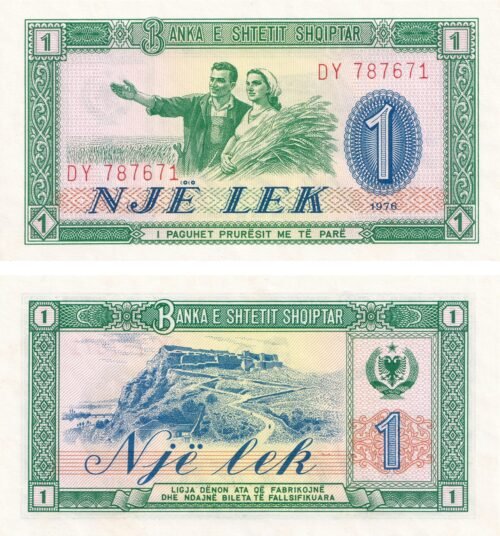
Albania 1 Lek 1976, P-40, UNC
2,49 € -

Albania 3 Leke 1976, P-41, UNC
3,99 € -

Albania 5 Leke 1976, P-42, UNC
3,99 € -

Albania 10 Leke 1976, P-43, UNC
4,99 € -

Argentina 5 Pesos 1974, P-294(2), UNC
2,49 € -

Argentina 10 Pesos 1973, P-295(1), UNC
2,99 € -

Argentina 10 Pesos 1976, P-300, UNC
2,49 € -

Bahamas 3 Dollars 1974, P-44, UNC
10,99 € -

Biafra 1 Pound 1969, P-5a, UNC
3,99 € -

Bolivia 10 Pesos Bolivianos 1962, P-154a(17), UNC
2,99 € -

Brazil 1 Cruzeiro 1955, P-150b, UNC
2,99 € -

Brazil 1 Cruzeiro 1956, P-150c, UNC
2,99 € -

Brazil 2 Cruzeiros 1958, P-151b, UNC
4,99 € -

Brazil 2 Cruzeiros 1956, P-157Ab, UNC
3,99 € -

Brazil 2 Cruzeiros 1958, P-157Ac, UNC
3,99 € -

Brazil 5 Cruzeiros 1962, P-176a, UNC
1,49 € -

Brazil 1 Centavo 1967, P-183b, UNC
2,99 € -

Bulgaria 3 Leva 1951, P-81, UNC
2,99 € -

Bulgaria 5 Leva 1951, P-82, UNC
2,99 € -

Bulgaria 10 Leva 1951, P-83, UNC
2,99 €