
American Bank Note Company

American Bank Note Company occupies a central place in the visual history of paper money. Formed in 1858 from the consolidation of leading American engraving houses, and tracing its lineage to a Philadelphia firm established in 1795, it transformed steel engraving into an international language of monetary trust. Its portraits, allegorical vignettes, borders and guilloches circulated far beyond the United States, especially across Latin America and the Caribbean. The historic banknote business no longer defines the modern company, whose lineage continues through ABCorp, but the ABN and ABNC names remain among the most recognisable printer attributions in world notaphily.
Quick Facts
Official name: American Bank Note Company
Alternative names: ABN; ABNC; American Bank Note; ABCorp corporate lineage
Country: United States
Headquarters: New York City, United States (historic operations); Boston, Massachusetts (current ABCorp)
Established: 1858; corporate lineage traced to 1795
Status: Historic banknote printer; corporate lineage continues as ABCorp
Institution type: Private security engraving and printing company
Ownership or parent: ABCorp corporate successor
Official website: abcorp.com
Institutional Identity
The American Bank Note Company was not created as a government bureau. It emerged from the private security-printing industry that served state-chartered banks, corporations and public authorities in the nineteenth-century United States. Before a unified federal paper currency existed, hundreds of banks required engraved notes whose complexity and consistency could inspire confidence across distance.
In 1858 several prominent firms merged to form the American Bank Note Company. The corporate genealogy included houses such as Rawdon, Wright, Hatch & Edson and Danforth, Perkins & Company, each bringing engraving plates, artists, clients and technical knowledge into the new organisation. ABCorp’s own historical account traces the broader lineage to Murray, Draper, Fairham & Company, founded in Philadelphia in 1795 by Robert Scot and partners.
The company’s identity was built around secure intaglio engraving and the controlled reuse of an enormous image archive. Portraits, allegories, landscapes and industrial scenes could be adapted to a client’s national or institutional narrative while remaining embedded in a recognisable grammar of fine-line security printing. This combination of art, reproducibility and protection made ABN a global contractor rather than merely an American domestic printer.
The corporate successor now trades as ABCorp and focuses on payment cards, authentication, secure manufacturing and related technologies. It presents the historic American Bank Note Company as part of a continuous lineage, but collectors should distinguish that corporate continuity from the survival of the old international banknote-printing business in its classical form.
Historical Development
The predecessor firms grew in an era when American paper money was highly decentralised. Their engraved notes relied on detailed vignettes, ornamental frames, lathe-generated patterns and skilled lettering to deter imitation. The 1858 merger consolidated much of this expertise and gave the new company a scale suited to national and international commissions.
During the early National Banking era, private contractors including American Bank Note Company designed and printed banknote material for the United States. The federal government gradually transferred these functions to the Bureau of Engraving and Printing, and by 1877 Congress had mandated federal control of national currency production. That shift reduced ABN’s role in United States circulating notes but did not diminish its international reach.
Overseas work became one of the company’s defining strengths. Governments and banks in Latin America, the Caribbean, Asia and elsewhere commissioned notes whose visual language often blended local heroes and landscapes with the company’s established engraving vocabulary. The resulting archive is a map of political transitions, monetary reforms and artistic exchange. A single stock vignette might appear in altered form on securities, stamps or notes for more than one client, while bespoke portraits and national emblems anchored each commission.
In the twentieth century, the company diversified into postage stamps, bonds, certificates, identity-related documents, payment products and other secure printing. Its history also became physically embedded in landmark New York buildings and in extensive plate and specimen archives. Later restructurings moved the business away from classical banknote manufacture. In 2008 the American Bank Note Company was acquired by American Banknote Corporation, the modern ABCorp lineage.
Role in Banknote Production
ABN’s contribution to banknote production extended from original design and engraving to plate preparation, printing, numbering and finishing. Clients could commission a complete note or draw on the firm’s established library of portraits, allegories and ornaments. The company’s imprint, when present, may appear in a lower margin in forms such as American Bank Note Company, American Bank Note Co., New York, or abbreviated variants.
Attribution is not always simple. Some notes were produced by predecessor firms later absorbed into ABN; others were printed by subsidiaries, affiliated operations or successor entities. Plates could also remain in use through institutional changes. A collector should therefore read the precise imprint, issue date and corporate chronology together rather than assigning every related American engraving style automatically to ABNC.
Security and Technology
The company’s classical security language was built on steel-plate intaglio. Engraved recesses held ink that transferred under pressure, leaving crisp tonal lines and a tactile surface. Skilled portrait engraving produced subtle modelling that was difficult to copy convincingly, while ornamental lathe work generated repeating geometries whose precision exposed crude reproduction.
ABN also developed a modular design culture. Vignettes, borders, counters, numerals and lettering could be combined in controlled ways without reducing the note to a generic product. The security value lay partly in the quality of the original engraving and partly in the disciplined custody of dies, rolls and plates. Serial numbering, signatures, overprints and paper specifications added further layers according to the client’s requirements.
The corporate history records later innovations including microprinting, machine-readable technologies and holographic features, reflecting a broader transition from engraved paper documents to modern authentication systems. For banknote attribution, however, the most characteristic evidence remains visual: finely modelled portraits, deep intaglio, elaborate counters, stock allegories and an imprint belonging to the ABN family.
For Collectors
For collectors, American Bank Note Company is both a printer and a field of study. Its output links national catalogues that might otherwise seem unrelated, revealing shared engravers, stock vignettes and design conventions across continents.
The printer imprint can define important varieties, particularly where an issuing authority changed contractors while retaining a broadly similar design. Specimens, proofs, essays, plate fragments and archival sales samples add another dimension, allowing the production process to be reconstructed beyond the issued note.
The strongest collections do not treat every ornate American-style note as ABNC by appearance alone. Exact wording, predecessor identity, date, plate characteristics and reliable catalogue evidence remain essential. The company’s vast influence makes careful attribution more important, not less.
Banknotes Printed by American Bank Note Company
-

Brazil 1 Cruzeiro 1955, P-150b, UNC
2,99 € -

Brazil 1 Cruzeiro 1956, P-150c, UNC
2,99 € -

Brazil 2 Cruzeiros 1958, P-151b, UNC
4,99 € -

Cambodia 100 Riels 1972, P-13b, UNC
2,99 € -
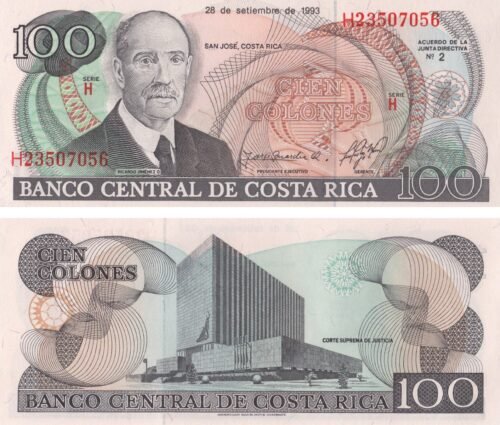
Costa Rica 100 Colones 1993, P-261, UNC
7,99 € -

Ecuador 5 Sucres 1983, P-108b(1), UNC
2,49 € -

Venezuela 10 Bolivares 1992, P-61c, UNC
2,49 € -
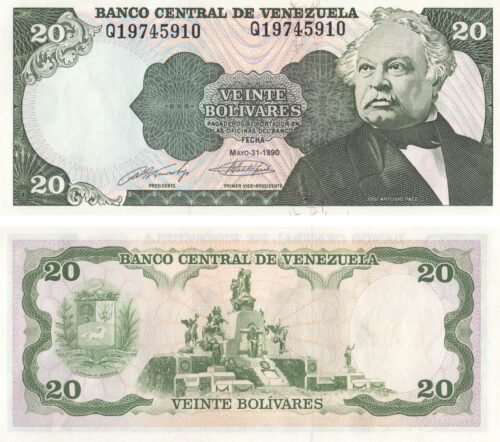
Venezuela 20 Bolivares 1990, P-63c, UNC
2,49 € -

Venezuela 20 Bolivares 1987, P-64A, UNC
3,99 €
Selected References
- ABCorp — Who We Are and Corporate History
- ABCorp — History of the American Bank Note Company
- Smithsonian Institution — American Bank Note Company Records
- Smithsonian National Postal Museum — American Bank Note Company 1879–1893
- Office of the Comptroller of the Currency — Life of a Banknote
- ABCorp — Corporate Website