
Banco Central del Ecuador

Banco Central del Ecuador stands at the meeting point of monetary authority and late-sucre banknote production. Founded in Quito in 1927 to unify Ecuador’s fragmented issuing system, the institution remained the country’s sole note-issuing authority until dollarisation ended the national banknote era. Specialist catalogues consistently identify the abbreviation BCdE as the printer of several late high-denomination sucre notes, including issues now represented in the WorldBanknotes.eu catalogue. Because the surviving public record is clearer about issuance than about the internal organisation of the printing works, this profile distinguishes documented central-bank history from qualified printer attribution.
Quick Facts
Official name: Banco Central del Ecuador
Alternative names: BCE; BCdE; Central Bank of Ecuador
Country: Ecuador
Headquarters: Quito, Ecuador
Established: 1927
Status: Active central bank; historic domestic banknote-printing attribution ended with the sucre
Institution type: Central bank and former in-house banknote printer
Ownership or parent: Autonomous public institution of Ecuador
Official website: bce.fin.ec
Institutional Identity
Banco Central del Ecuador was created as the institution responsible for stabilising and unifying Ecuador’s monetary system. Its official history records that the bank began operations on 10 August 1927 after the reforms associated with the Kemmerer Mission. The original legal framework authorised the new central bank to issue money, administer exchange arrangements and serve as fiscal agent and depository for the state and associated banks. This role replaced an earlier landscape in which private banks had circulated their own notes under government authority.
For most of the twentieth century, the BCE’s identity was that of an issuer rather than a single, permanently self-sufficient printer. Ecuadorian banknotes were produced by a succession of domestic and foreign contractors, and official museum descriptions sometimes name a separate printing house while identifying the BCE as issuer. That distinction is essential. The appearance of Banco Central del Ecuador on a note does not by itself prove that the bank physically printed it.
The late-sucre issues catalogued with the printer code BCdE form a more specific group. Specialist banknote references repeatedly use that abbreviation as a production attribution, indicating that the bank exercised an internal or directly controlled printing function for certain notes. Publicly accessible BCE material does not yet reveal a complete institutional history of that operation, its plant organisation or the exact production files for every listed date. The printer profile therefore treats BCdE as a supported but carefully bounded attribution.
Historical Development
Ecuador’s paper-money history predates the central bank. During the nineteenth and early twentieth centuries, private banks issued notes in a monetary environment marked by regional institutions, changing legal rules and periodic shortages of coin. The creation of the BCE in 1927 brought the right of issue under a national authority. Early central-bank notes and later sucre series were frequently entrusted to established security printers abroad, including firms in the United States and Great Britain, while other issues were supplied by major state printers in Latin America and Europe.
Over time, the BCE developed its own technical and administrative capacity around monetary species. The institution’s museum preserves printing plates, original designs and production-related objects that document the artistic and industrial preparation of Ecuadorian notes. These holdings demonstrate that the bank maintained deep technical involvement in banknote creation, even when the final printing contract belonged to an outside manufacturer.
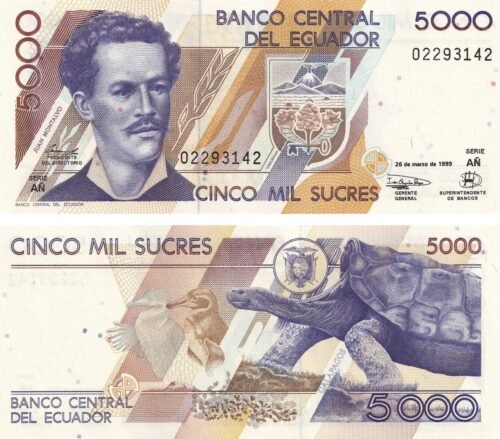
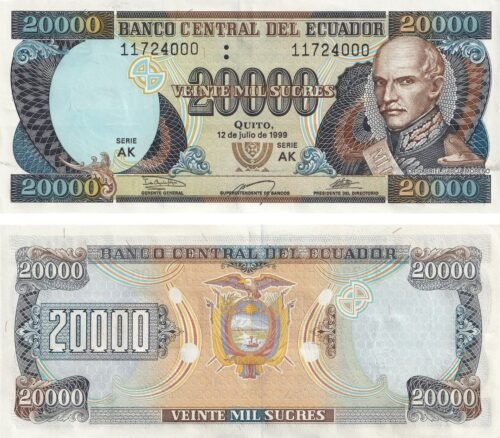
By the closing decades of the sucre, inflation drove Ecuador towards progressively higher denominations. The visual language remained rooted in historic portraits, the national arms, landscapes and natural heritage, but the production environment became increasingly urgent. Several late issues are catalogued as printed by BCdE, among them 5,000-, 10,000- and 20,000-sucre notes. These attributions distinguish them from neighbouring issues assigned to foreign printers and make the printer field a meaningful part of Ecuadorian variety study.
Dollarisation brought this chapter to an abrupt end. The BCE ceased issuing national banknotes when the United States dollar replaced the sucre as circulating currency in 2000. The bank remained active as Ecuador’s central monetary institution and later issued locally produced fractional coins for use alongside the dollar, but the late-sucre notes became the final paper witnesses of its former issuing and printing role.
Role in Banknote Production
The BCE’s role in banknote production must be read on two levels. As issuer, it commissioned, authorised and placed Ecuadorian notes into circulation. As the printer identified by BCdE, it is credited in specialist catalogues with the physical production of a defined late-sucre group. The WorldBanknotes.eu catalogue presently links this printer term to the 5,000-sucres P-128c and 20,000-sucres P-129 issues, both belonging to the final inflationary phase before dollarisation.
The attribution is strengthened by the way specialist references differentiate BCdE from named external printers within the same national sequence. It is therefore more than a generic repetition of the issuer’s name. At the same time, no publicly located BCE production ledger or official note-by-note printer table has yet been found for the exact catalogue entries reviewed. The most accurate editorial position is to preserve the recognised attribution while describing its evidential basis openly.
Collectors should also distinguish printing responsibility from design and plate preparation. A central bank may own artwork, approve engravings, retain plates or supervise quality while contracting part of the manufacturing chain elsewhere. Conversely, an in-house attribution may cover the principal printing stages without proving that paper, thread, ink or every plate was manufactured internally. This profile uses “printed by Banco Central del Ecuador” in that controlled catalogue sense.
Security and Technology
Late Ecuadorian sucre banknotes combine traditional engraved portraiture with dense guilloche structures, multicolour underprinting, watermarks, security threads and serial numbering. BCE educational material highlights tactile intaglio printing, transmitted-light features and ultraviolet examination as practical means of authentication. These features belong to an integrated security design rather than to any single visible device.
The 5,000-sucres and 20,000-sucres families are especially instructive because their familiar historical portraits sit within increasingly elaborate backgrounds. Raised intaglio detail gives authority to portraits, inscriptions and numerals; fine-line patterns complicate photographic reproduction; watermarks repeat the portrait tradition within the paper; and serial systems provide control at the individual-note level.
Public evidence does not support a detailed reconstruction of the machinery installed in the BCE’s attributed printing operation. Accordingly, this profile does not assign particular press manufacturers, production capacities or proprietary technologies to the bank. The technical discussion is confined to features observable on the notes and to processes described in BCE educational sources or established specialist catalogues.
For Collectors
For collectors, the BCdE attribution gives structure to the final sucre series. It separates notes printed under the central bank’s own name from issues supplied by better-known foreign houses and turns an apparently uniform national sequence into a study of changing production responsibility.
The late dates carry additional historical weight. They belong to the narrow interval between accelerating inflation and the extinction of the sucre as circulating paper money. Prefixes, dates, signature combinations and printer attribution can therefore be studied together as evidence of a monetary system approaching its end.
Caution is part of the appeal. Because the public institutional record remains incomplete, serious cataloguing should preserve the BCdE attribution without inventing a factory history that the sources do not yet reveal. A well-described note records both what is known and where the archival silence begins.
Banknotes Printed by Banco Central del Ecuador
Selected References
- Banco Central del Ecuador — Institutional History
- Banco Central del Ecuador — Institutional Profile
- Museo de la Moneda BCE — El Trazo
- Museo de la Moneda BCE — 50,000 Sucres Technical Record
- Banknote.ws — Banco Central del Ecuador Issues
- Banknotes.com — Ecuador 10,000 Sucres Printer Record
- BanknoteWorld — Ecuador 20,000 Sucres Printer Record