
Banco de México

Banco de México is unusual in the printer field because it is both the country’s issuing central bank and, from 1969 onward, an in-house banknote producer. After decades in which Mexican notes were printed abroad, the opening of the Banco de México banknote factory created a domestic production era that now defines most modern Mexican paper money and forms the basis of the printer attribution used across later Banco de México issues.
Quick Facts
Official name: Banco de México
Alternative names: Banxico; Fábrica de Billetes del Banco de México; Banco de México Fábrica de Billetes
Country: Mexico
Headquarters: Mexico City, Mexico; banknote factories in Mexico City and El Salto, Jalisco
Established: Banco de México founded in 1925; in-house banknote printing began in 1969; second banknote plant opened in 2018
Status: Active central-bank banknote printer
Institution type: Central-bank issuer and in-house banknote printer
Ownership or parent: Banco de México
Official website: banxico.org.mx
Institutional Identity
Banco de México is first and foremost Mexico’s central bank, created in 1925 and responsible for issuing the national currency. For printer-history purposes, however, its importance lies in the fact that it also developed its own in-house banknote-manufacturing capability. This makes it different from a simple issuer-only institution and justifies a dedicated WBN printer profile.
Official Banco de México educational material states that, although the bank was created in 1925, its first notes were printed by the American Bank Note Company in New York. That point is crucial. It means that “Banco de México” on a note does not automatically imply Banco de México as printer for the earliest decades of the institution’s paper money.
The printer identity begins in a stricter sense in 1969, when Banco de México inaugurated its own Fábrica de Billetes. From then onward, the bank moved from depending on foreign contractors to designing and producing a new generation of Mexican banknotes domestically.
In modern notaphily, the Banco de México printer attribution therefore belongs to the era of in-house production. It captures a major institutional transition in Mexican currency history: the moment the issuer also became the producer.
Historical Development
Official Banxico material gives the basic chronology very clearly. The bank was created in 1925, but the first banknotes it put into circulation were produced by the American Bank Note Company in New York. Mexico therefore spent its early central-bank decades in a model where issue authority and physical production were separated.
That changed in 1969 with the inauguration of the Banco de México banknote factory. Banxico describes this as the point at which the design and production of a new generation of Mexican banknotes began in Mexico itself. In printer history, that is the decisive turning point and the true birth of Banco de México as a printer profile rather than merely an issuing institution.
The next major expansion came in 2018, when a second banknote-manufacturing plant was inaugurated in El Salto, Jalisco. Official Banxico pages explain that the additional plant was opened to cover and guarantee banknote production. This shows that the in-house operation was no short-lived experiment but a mature and scalable national production system.
Through these changes, Banco de México moved from a central bank dependent on foreign engraving and printing expertise to one operating its own domestic banknote-production network. That development is directly visible across the families of modern Mexican notes and provides an important framework for understanding printer attributions in the WBN catalogue.
It also explains why Banco de México belongs in two WBN structures at once. It is the issuing authority for all modern Mexican notes, but only certain chronological phases belong to it as printer. A high-quality catalogue has to keep those two histories aligned rather than conflated.
Role in Banknote Production
Banco de México’s production role is comprehensive within the era of in-house manufacturing. Official Banxico material states that since 1969 the bank’s factory has been responsible for the design and production of Mexican banknotes, and current public information confirms factory activity in both Mexico City and El Salto, Jalisco.
This makes Banco de México a core WBN printer term for post-1969 Mexican notes. It is especially relevant for the user’s imported inventory, where several later twentieth-century pesos and newer issues carry Banco de México as printer. The term allows those notes to be grouped accurately under the domestic-production phase rather than under earlier foreign contractors.
Even so, one discipline remains essential: the issuer-printer distinction must be preserved for earlier periods. A pre-1969 note issued by Banco de México may still have been printed by the American Bank Note Company or another external house. The existence of a Banco de México printer page should therefore improve attribution, not encourage overgeneralisation.
Within the domestic era, the banknote factories serve more than an industrial purpose. They anchor Mexico’s monetary autonomy, support continuity of supply and allow security, substrate and denomination planning to be integrated with the central bank’s broader responsibilities. In printer terms, Banco de México is therefore both a technical producer and an institutional instrument of monetary sovereignty.
Security and Technology
Banco de México’s public educational material highlights the core technical framework of its note production. Banknotes are manufactured using security inks and either polymer substrate or cotton paper, depending on denomination and family. Banxico also states that it determines the security characteristics to be built into the substrate, including watermark, security thread, fibres, transparent window and translucent image.
Those statements are especially valuable because they connect the printer page directly to features collectors can see and test. Banxico’s public communication repeatedly encourages users to identify security elements and understand how banknotes are made, making the production process itself part of the institution’s public-facing educational work.
The factory-visit pages add another layer by confirming that visitors are shown production areas and taught about the general process of manufacturing banknotes and identifying their security features. This supports a picture of Banco de México as an integrated modern producer rather than a nominal printer label with hidden operations.
For WBN purposes, the technical takeaway is clear. Banco de México should be associated with a modern domestic production system using both paper and polymer, security-engineered substrates and central-bank-controlled design decisions. There is no need to speculate about individual machine suppliers or unpublished workflows in order to build a strong, evidence-based printer profile.
For Collectors
For collectors, Banco de México is a crucial attribution because it marks the boundary between externally printed and domestically printed central-bank notes. Knowing that the bank only began in-house production in 1969 helps prevent a very common mistake: assuming that every note bearing the Banco de México name was also printed by Banco de México.
That chronological boundary becomes especially useful when organising Mexico collections by family, substrate or printer. Notes from the 1970s onward increasingly belong to the domestic-production story, while earlier notes often sit in the histories of foreign security printers. The printer field therefore becomes a real research tool rather than a decorative extra.
Banco de México is also relevant because it links printer history to visible note evolution. As the Mexican series moved through redesigns and, later, into polymer use, the printer page helps collectors read those changes not only as design history but as production history.
For WBN cataloguing, the best practice is to assign Banco de México as printer only where the evidence supports the domestic production phase, and to keep earlier outsourced printings with their correct external printers. That simple discipline produces a much cleaner and more authoritative Mexico catalogue.
Banknotes Printed by Banco de México
-

Mexico 5 Pesos 1971, P-62b(1), UNC
4,99 € -

Mexico 10 Pesos 1972, P-63e(2), UNC
3,99 € -

Mexico 20 Pesos 1977, P-64d(2), UNC
4,99 € -

Mexico 50 Pesos 1973, P-65a, UNC
3,99 € -
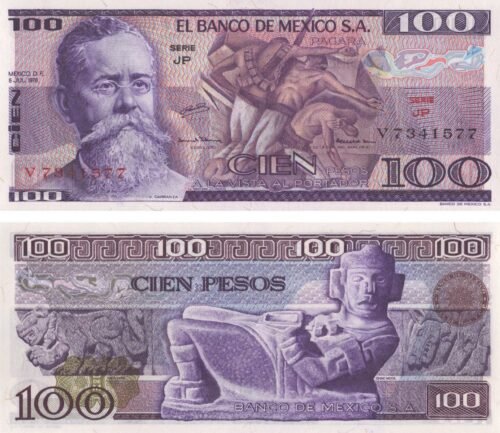
Mexico 100 Pesos 1978, P-66b, UNC
3,99 € -
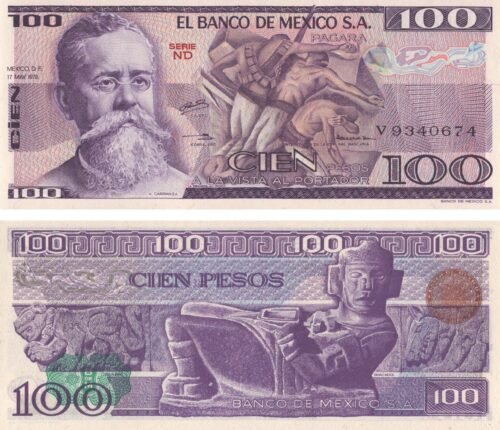
Mexico 100 Pesos 1979, P-68c, UNC
3,99 € -

Mexico 50 Pesos 1981, P-73, UNC
2,99 € -

Mexico 100 Pesos VG 1982, P-74c, UNC
3,99 € -

Mexico 500 Pesos 1981, P-75a, UNC
6,99 € -

Mexico 1000 Pesos VP 1984, P-80b, UNC
3,99 € -
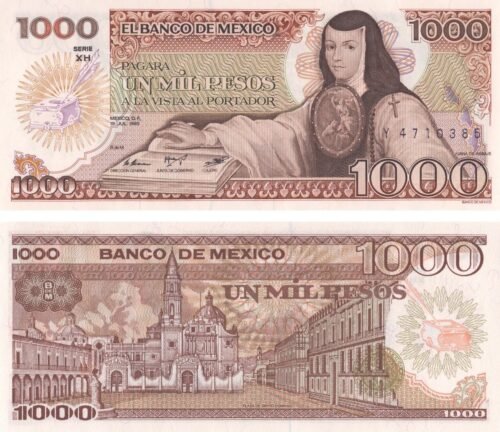
Mexico 1000 Pesos XH 1985, P-85, UNC
3,99 € -

Mexico 20 Pesos 2010, P-122n, UNC
5,99 € -

Mexico 20 Pesos 2021-10-05, P-132c(2), UNC
2,99 € -

Mexico 20 Pesos 2022-10-10, P-132g(4), UNC
3,99 € -

Mexico 20 Pesos 2023-07-10, P-132k(3), UNC
3,99 € -

Mexico 50 Pesos 2023-12-06, P-133e(5), UNC
9,99 € -

Mexico 100 Pesos 2021-05-21, P-134d(3), UNC
19,99 € -

Mexico 200 Pesos 2019-06-10, P-135c(3), UNC
30,99 € -

Mexico 500 Pesos 2022-06-06, P-136q(1), UNC
65,99 € -

Mexico 50 Pesos 2024-06-27, P-138a(2), UNC
5,99 € -

Mexico 50 Pesos 2024-06-27, P-138a(1), UNC
5,99 € -

Mexico 100 Pesos 2024-06-27, P-139a(1), UNC
11,99 €