
Hôtel des Monnaies of the Bank of Algeria

The Bank of Algeria’s Hôtel des Monnaies is the central bank’s internal production organisation for banknotes, coins and protected state documents, combining monetary manufacturing with broader security-printing work.
Quick Facts
Official name: Direction Générale de l’Hôtel des Monnaies, Banque d’Algérie
Alternative names: Hôtel des Monnaies; Bank of Algeria Printing Works; Hôtel des Monnaies of Algeria
Country: Algeria
Headquarters: Algiers, Algeria; Hôtel des Monnaies production site at 10 rue des Fusillés
Established: The Hôtel des Monnaies was already one of the Bank of Algeria’s three sites in 1962; the official public history reviewed does not state a separate founding date
Status: Active
Institution type: Integrated central-bank banknote, coin and security-document production directorate
Ownership or parent: Internal Directorate-General of the Bank of Algeria
Official website: bank-of-algeria.dz
Institutional Identity
The Direction Générale de l’Hôtel des Monnaies is the production arm within the Bank of Algeria responsible for banknotes, coins and a wider portfolio of protected documents. The official organisational structure separates banknote production, coins and medals, engineering and maintenance, and general administration. It is therefore a defined industrial directorate inside the central bank rather than an independent commercial printer.
The issuer–printer distinction remains necessary even though both functions sit within one institution. The Bank of Algeria has legal authority over the dinar and its banknotes; the Hôtel des Monnaies performs the physical production role assigned within the Bank. In a catalogue, “Bank of Algeria” may be used as the controlled printer value, but the page title identifies the actual manufacturing directorate so that it is not confused with the issuing authority page.
Official information also shows that the works is broader than a banknote plant. It produces coin denominations, medals and decorations, unpersonalised passport booklets, stamps, vignettes, diplomas, cheques and other valued documents. These activities share secure materials, controlled workflows and anti-fraud production methods, but only issue-specific evidence should be used to attach the printer to a particular banknote.
Historical Development
The Banque Centrale d’Algérie was created by Law No. 62-144 on 13 December 1962. The Bank’s own history of its sites states that in 1962 it possessed three principal locations, one of which was the Hôtel des Monnaies. That evidence proves the production site’s presence at the central bank’s foundation, but it does not give a separate construction or opening date. The profile therefore avoids repeating the commonly cited year 1964 as an unsupported founding date for the works.
The first dinar and the first national banknote series of independent Algeria entered circulation in 1964. This is a defining monetary milestone, not by itself proof that every part of that first series was manufactured at the Hôtel des Monnaies. The correct historical method separates the date of the currency, the date of the central bank, the existence of the production site and the printer attribution of each issue.
The current institutional continuity is well documented. The Bank’s 2025 organisational chart still contains the Directorate-General and its specialist production divisions. Recent regulations and public pages also describe modern banknote issues and their security characteristics, showing an active manufacturing and currency-management environment rather than a historical works preserved only in name.
Role in Banknote Production
For a banknote assigned to the Hôtel des Monnaies, the production role may include design adaptation, origination, plate preparation, background work, intaglio printing, serial numbering, inspection, cutting and secure packing. The Bank’s public organisational material confirms a dedicated Banknote Production Directorate and engineering support, although it does not publish a complete process diagram for every series.
The WorldBanknotes.eu catalogue currently links the printer term “Bank of Algeria” to four notes dated 1992, 1998 and 2011. These entries provide a practical group for collector comparison across changing denominations and security generations. They do not justify assuming that every Algerian note, commemorative issue or replacement printing used the same production line or the same suppliers.
The Bank can also commission materials or technology from outside specialists. Security paper, threads, holographic devices and machinery may therefore have separate suppliers even where the finished note was produced internally. The printer entry records physical manufacture, not exclusive authorship of every component.
Security and Technology
Official issue regulations provide unusually useful technical evidence. They describe security backgrounds formed from geometric patterns, guilloches, microprinting and numismatic graphics, together with security threads, holograms and other denomination-specific elements. These legal descriptions are stronger than generic marketing language because they define the authorised note rather than merely listing the factory’s possible capabilities.
Even so, an authorised feature list must not be confused with supplier attribution. The regulation may establish that a note contains a thread or hologram, but it does not necessarily identify who produced that component. The Hôtel des Monnaies’ role is to integrate the approved design and materials into a controlled finished note. Where a separate substrate or feature manufacturer is documented, that information should remain in its own field.
For collectors, the technical evolution is visible across official series: dense line structures, microtext, tactile intaglio, changing threads and more recent optical elements. The most reliable examination combines normal light, transmitted light and magnification, following the methods set out in the WorldBanknotes.eu guide to banknote authentication.
For Collectors
The Algerian works is especially useful for studying the relationship between a central bank and its own production directorate. The same parent institution can be the issuer, custodian of the design, regulator of the note’s legal characteristics and operator of the printing works, yet these are still distinct functions. Recording them separately keeps the catalogue analytically useful.
The four linked catalogue notes allow comparison between the early 1990s series and later high-denomination production. Collectors should examine serial formats, intaglio sharpness, security backgrounds, threads and optical devices, but should not use one familiar design feature as proof of a printer. Official regulations, reliable catalogues and direct printer evidence remain the preferred hierarchy.
The name also requires geographic discipline. Algeria and the Democratic Republic of the Congo both use institutions called Hôtel des Monnaies. They are unrelated production organisations within different central banks. Country, parent institution and exact taxonomy term must therefore accompany the name in any serious database.
Banknotes Printed by Hôtel des Monnaies of the Bank of Algeria
-
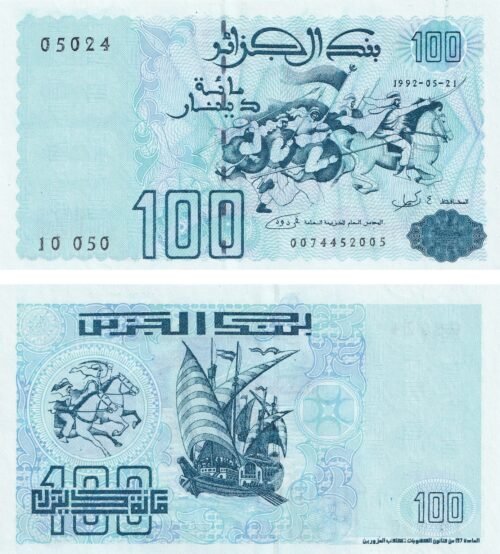
Algeria 100 Dinars 1992, P-137(1), UNC
6,99 € -
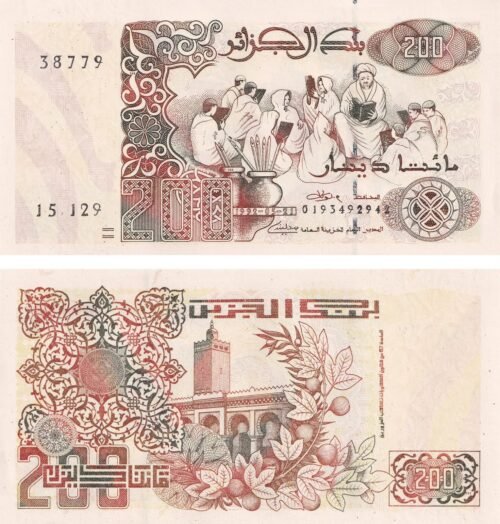
Algeria 200 Dinars 1992, P-138(3), UNC
7,99 € -
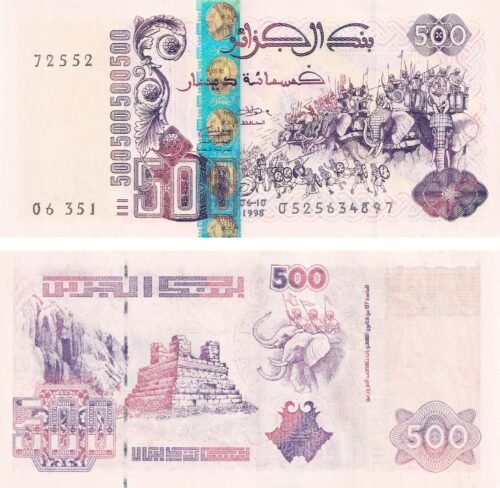
Algeria 500 Dinars 1998, P-141(3), UNC
10,99 € -
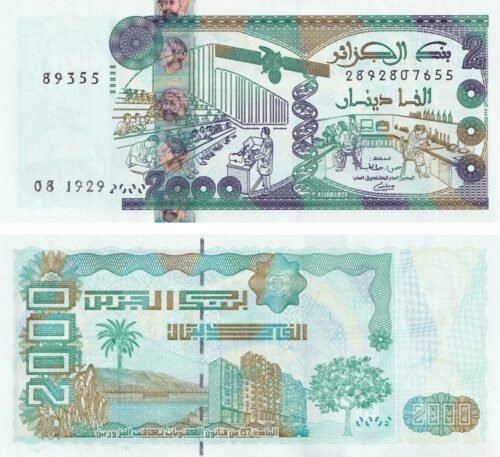
Algeria 2000 Dinars 2011, P-144(4), UNC
34,99 € -

Algeria 2000 Dinars 2011, P-144(1), UNC
30,99 € -
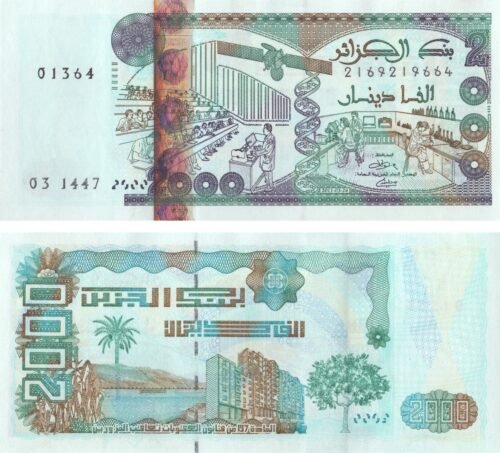
Algeria 2000 Dinars 2011, P-144(2), UNC
30,99 € -
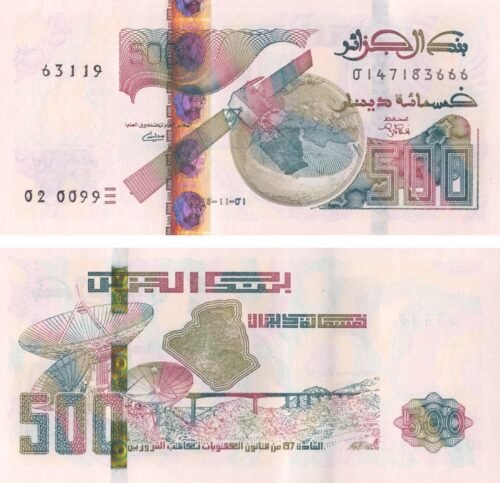
Algeria 500 Dinars 2018, P-145(2), UNC
8,99 €
Selected References
- Bank of Algeria — Directorate-General of the Hôtel des Monnaies
- Bank of Algeria — History of the Bank’s Sites
- Bank of Algeria — History of the Bank
- Bank of Algeria — Organisational Chart, 29 September 2025
- Algeria — Monetary and Banking Law No. 23-09
- Bank of Algeria — First Banknotes of Independent Algeria
- Bank of Algeria — Regulation No. 2018-05