
Bank of Italy Printing Works

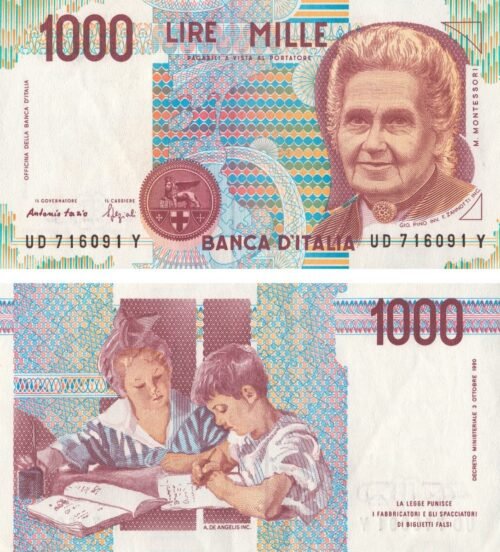
The inscription OFFICINA DELLA BANCA D’ITALIA identifies the central bank’s own printing works on Italian lire. Behind that modest credit lies a manufacturing history connecting engraved national currency, successive Roman workshops and the production of euro banknotes.
Quick Facts
Official name: Banca d’Italia — Servizio Banconote (Banknotes Directorate)
Alternative names: Officina della Banca d’Italia; Officina della Banca d'Italia; Banca d’Italia Printing Works; Servizio Banconote; Centro Guido Carli
Country: Italy
Headquarters: Via Tuscolana 417, Rome, Italy (printing works)
Established: 1894 (equipment for complete in-house production); 1968 (current Via Tuscolana plant)
Status: Active
Institution type: In-house central-bank banknote printer
Ownership or parent: Banca d’Italia
Official website: bancaditalia.it
Institutional Identity
The Bank of Italy Printing Works is the central bank’s own manufacturing operation, rather than a separate commercial printing company. Its present organisational unit is the Banknotes Directorate, or Servizio Banconote, based at the Guido Carli Centre in Rome. The historical Officina inscription identifies this production tradition on lire banknotes.
The Directorate’s responsibilities include note design, manufacture, research into security features and production processes, and custody of materials and finished notes. It supplies its output to the Bank’s Currency Circulation Management Directorate and arranges ECB deliveries where required. This is distinct from the state security printer Istituto Poligrafico e Zecca dello Stato: the two names should not be treated as alternative forms of one institution.
Historical Development
When the Bank of Italy was established in 1893, it inherited printing equipment and workshops from the Banca Nazionale nel Regno. In 1894 it acquired the mechanical and galvanoplastic equipment needed for complete banknote production and moved the works from Via dei Barbieri to Via dei Serpenti in Rome.
The plant was transferred to L’Aquila during the Second World War. Production returned to Rome in 1944, after the wartime destruction of the L’Aquila works. The existing Via Tuscolana facility opened in 1968; its designers were Pier Luigi Nervi and his son Antonio.
The building is named for Governor Guido Carli. Its purpose-built printing floors, laboratories and secure storage belong to the same institution that later adapted its production to the Eurosystem.
Role in Banknote Production
The late lire issues provide clear examples of the works’ output. The Banknote Book records OFFICINA DELLA BANCA D’ITALIA on the 1,000-lire Maria Montessori note and the 2,000-lire Guglielmo Marconi note. Both combine an identifiable printer inscription with the Bank of Italy’s name as issuer; the manufacturing and issuing roles are related but remain separate.
Not every Italian paper-money issue came from these works. The Treasury’s 500-lire Mercury and Pegasus note, for example, bears the different I.P.S. OFF. CARTE-VALORI credit. Under the euro production system, the Bank’s printing responsibilities form part of decentralised Eurosystem arrangements, with particular denominations allocated to participating production facilities rather than every printer making every denomination.
Security and Technology
Modern origination converts an artistic design into the separate elements required for offset, intaglio, screen and letterpress printing. Prototypes and production tests establish how the design works on watermarked paper before industrial manufacture. Offset supplies backgrounds and fine patterns, while intaglio produces the raised printed features perceptible to the fingertips.
The Bank obtains paper and inks from outside suppliers, then carries out its banknote production cycle at the works. Quality checks cover incoming materials, printed sheets, serial-number integrity and finished output. These current capabilities should be distinguished from the specifications of historical lire: the Montessori 1,000-lire note, for instance, has a portrait watermark with BI lettering and a solid security thread, not the holographic features of later euro issues.
For Collectors
For collectors, the Montessori 1,000-lire note offers a useful comparison within one printer’s work. The Ciampi/Speziali and Fazio/Speziali signature combinations retain the same Officina credit and the printed 3 October 1990 decree date, although they belong to different catalogue varieties. That date identifies the authorised design; it does not date every subsequent printing to 1990.
A broader group can place the Montessori and Marconi portraits beside an Italian Treasury state note. Their common currency conceals different issuing and manufacturing arrangements, visible in the institutional names and small printer inscriptions. These credits make a more precise basis for a printer collection than the country name alone, while signature and decree varieties preserve the distinctions within each design.
Banknotes Printed by Bank of Italy Printing Works

Selected References
- Banca d’Italia — Banknotes Directorate responsibilities
- Banca d’Italia — Printing plant, equipment and industrial history
- Banca d’Italia — The Guido Carli production centre
- Banca d’Italia — From artwork to banknote prototype
- Banca d’Italia — Banknote printing processes
- Banca d’Italia — Production quality checks
- Owen W. Linzmayer, The Banknote Book, Italy chapter, B323 and B465–B466, printed pp. 18 and 50; supplied PDF pp. 22 and 58.