
Bank of Thailand Note Printing Works

The Bank of Thailand Note Printing Works is the institution through which Thailand turned the memory of wartime banknote scarcity into lasting production sovereignty. Authorised in 1961 and opened in Bangkok in 1969, it gave the central bank direct control over the quantity, quality and security of the country’s notes. A larger works in Nakhon Pathom was inaugurated in 2007. Its production culture unites Thai historical imagery and ornamental design with an integrated sequence of origination, platemaking, offset, intaglio, numbering, inspection and finishing.
Quick Facts
Official name: Note Printing Works, Bank of Thailand
Alternative names: Bank of Thailand Printing Works; Note Printing Works; NPT; โรงพิมพ์ธนบัตร
Country: Thailand
Headquarters: Nakhon Chai Si District, Nakhon Pathom Province, Thailand
Established: 1969; authorised in 1961
Status: Active
Institution type: Central-bank-owned banknote printing works
Ownership or parent: Bank of Thailand
Official website: bot.or.th
Institutional Identity
The Note Printing Works is an operational arm of the Bank of Thailand rather than a separate commercial printer. Its purpose is closely tied to the central bank’s responsibility for issuing and managing banknotes. The institution was created after Thailand’s experience of dependence on foreign supply had revealed the strategic risk of importing all circulating paper money.
The Bank of Thailand’s official history explains that the Cabinet authorised the works on 5 September 1961. Funding came from earnings of the Currency Reserves of Thailand Fund under the Currency Act. The objective was economic security: domestic production would provide better control over volume and quality, reduce reliance on foreign currency for imported notes and strengthen national confidence.
The first plant stood opposite the Bank of Thailand’s head office at Tha Kasem Road in Bangkok. Construction began in 1963, and the works formally commenced operation with a royal inauguration on 24 June 1969. As demand and technical requirements increased, the central bank developed a new site in Nakhon Chai Si District, Nakhon Pathom Province, inaugurated in 2007.
Today the works sits within a wider banknote-management structure that connects design and production with issue, distribution, authentication and lifecycle control. Its identity is therefore not merely industrial. It is part of the institutional chain through which the Thai state translates monetary authority into a secure physical object.
Historical Development
Thailand’s early modern banknotes were obtained from abroad. The vulnerability of that arrangement became acute during the Second World War, when international supply was disrupted and note shortages affected economic activity. Temporary domestic solutions involved government departments, while later series again relied on overseas assistance and private security printers.
Establishing the Note Printing Works was a long-term answer to that experience. The Bangkok plant provided the machinery and guarded environment needed to bring production under central-bank control. The official series history identifies Series 11 as the point at which the works first managed the whole production process, marking a decisive transition from dependence to integrated domestic manufacture.
Growth in circulation eventually placed pressure on the original site. More floor space was needed for materials, modern security controls, production equipment and secure waste handling. The Bank of Thailand acquired a much larger site in Nakhon Pathom. The foundation stone was laid in 2004 and the new works was inaugurated in 2007, allowing production to continue within a purpose-built environment.
The institution has since supported the evolution of Thai banknotes through new portrait engravings, improved public-recognition features, commemorative issues and polymer adoption. The production works remains distinct from the issuing decision: the Bank of Thailand determines the note programme, while the works converts approved designs into finished, quality-controlled banknotes.
Role in Banknote Production
The Note Printing Works carries out an integrated process beginning with design research. Official production material describes the selection of historical information, portraits, Thai patterns and thematic imagery, balanced against technical limits, accessibility and counterfeit deterrence. Designers combine artistic drawing with digital origination.
Platemaking follows. Portraits and principal intaglio elements require specialist engraving, while complex background structures are prepared with computer-assisted systems. Printing then proceeds through successive stages. Dry offset establishes the multicolour background and accurate front-to-back register; intaglio adds raised portraiture and other tactile elements; letterpress applies serial numbers and related variable information.
Inspection and finishing are inseparable from printing. Sheets must be checked for registration, colour, ink coverage, numbering and physical defects before cutting and packaging. Secure accounting governs paper, plates, printed sheets, rejects and waste. This closed production chain is one reason the works is best understood as part of the central bank’s monetary infrastructure rather than as an ordinary commercial plant.
The WorldBanknotes.eu printer term currently has no linked products, but it is the canonical attribution for Thai notes printed by the central bank’s own works. It should not be applied retrospectively to earlier series produced by the Royal Thai Survey Department, Naval Hydrographic Department, foreign governments or private printers.
Security and Technology
Thailand’s official production description gives an unusually clear view of the technical sequence. Dry offset can print both sides of a sheet in precise relation, creating see-through register elements that complete when viewed against transmitted light. Intaglio transfers ink from engraved recesses under heavy pressure, creating the raised surface used for the royal portrait, denomination and other key details.
Security is layered across substrate, print and public interaction. Watermarks and threads belong to the paper or polymer structure; offset backgrounds create colour and registration complexity; intaglio supplies tactile recognition; serial numbering provides individual control; and optically variable features respond to movement or changing light. Later Thai notes add elements designed for easier recognition by people with visual impairments.
The new works was planned not only for printing capacity but also for surveillance, materials storage and secure waste systems. These less visible controls are fundamental. A banknote plant protects information, tools and incomplete products at every stage, preventing unauthorised material from leaving the production chain.
The move into polymer does not erase the institution’s traditional strengths. Instead, it requires the same disciplines of colour control, plate preparation, registration and inspection to be adapted to a different substrate and to transparent or optically active features.
For Collectors
For collectors, the Bank of Thailand Note Printing Works marks the point at which Thai banknotes became fully rooted in domestic central-bank production. Printer attribution therefore helps divide imported, emergency and sovereign-production phases within the national catalogue.
The strongest collecting narratives follow this transition through series, denominations and technical change. One can trace how royal portraiture, Thai ornamental forms and historical scenes were reinterpreted as the works gained control over design origination and manufacturing.
Modern notes may appear abundant, but production varieties remain meaningful. Prefixes, signatures, commemorative overprints, substrate changes and security revisions can all sit within the same broad design family. Correctly identifying the Note Printing Works provides the institutional frame in which those smaller distinctions become intelligible.
Banknotes Printed by Bank of Thailand Note Printing Works
-

Thailand 10 Baht 1980, P-87(6), UNC
2,99 € -

Thailand 20 Baht 1981, P-88(17), UNC
3,99 € -

Thailand 60 Baht 1987, P-93, UNC
9,99 € -
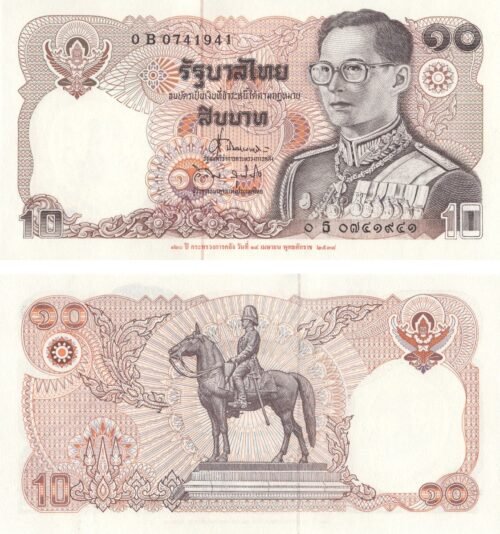
Thailand 10 Baht 1995, P-98, UNC
2,99 € -

Thailand 20 Baht 2003, P-109(9), UNC
2,99 € -

Thailand 20 Baht 2016, P-118(3), UNC
2,49 € -
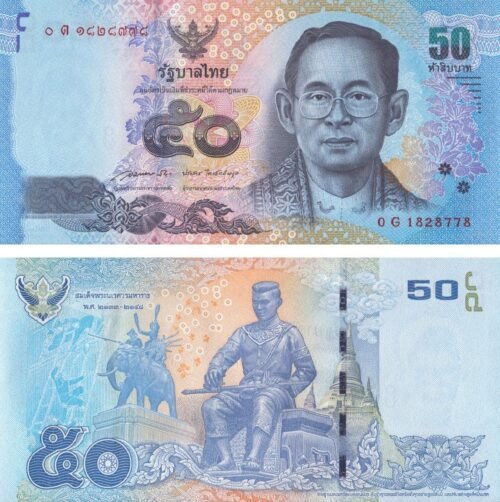
Thailand 50 Baht 2015, P-119(3), UNC
3,99 € -

Thailand 20 Baht 2018, P-135a, UNC
2,99 € -

Thailand 20 Baht 2019, P-135b(2), UNC
2,49 € -

Thailand 50 Baht 2018, P-136a, UNC
3,99 € -
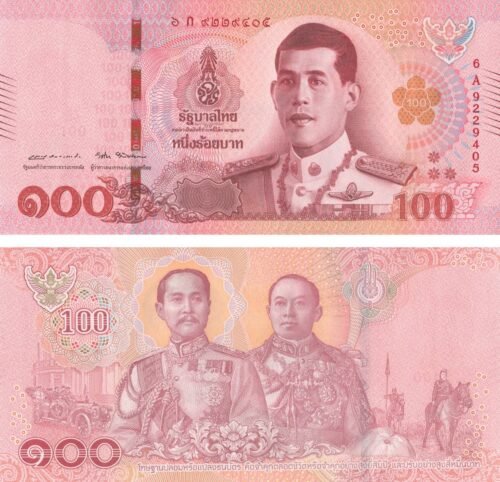
Thailand 100 Baht 2018, P-137a, UNC
7,99 € -

Thailand 100 Baht 2024, P-143, UNC
8,99 € -

Thailand 50 Baht 2025, P-146, UNC
3,99 € -

Thailand 100 Baht 2025, P-147(1), UNC
6,99 €