
Banque de France

Banque de France combines central-bank authority with one of Europe’s largest integrated banknote-manufacturing operations, linking EuropaFi paper production to high-volume printing and security research.
Quick Facts
Official name: Banque de France
Alternative names: Bank of France; Imprimerie de la Banque de France (functional name for the printing works, not a separate institution)
Country: France
Headquarters: Paris, France; banknote printing at Chamalières and banknote-paper production at Vic-le-Comte
Established: Banque de France founded in 1800; Chamalières printing works operating since 1917
Status: Active; transfer to a new Vic-le-Comte printing works is in progress
Institution type: Public central bank with integrated banknote-paper and banknote-manufacturing operations
Ownership or parent: French public institution and member of the Eurosystem; banknote paper produced through its EuropaFi subsidiary
Official website: banque-france.fr
Institutional Identity
Banque de France is France’s central bank and an active banknote manufacturer for the Eurosystem and foreign central-bank clients. These two roles must be separated. As a central bank it participates in monetary issuance and cash policy; as a manufacturer it operates a specialised printing works and provides design, paper, production and technical services under contracts for named issuers.
The manufacturing system is unusually integrated. Banknote and security paper is produced by EuropaFi at Vic-le-Comte, while finished notes have traditionally been printed at Chamalières. Banque de France describes this combination of a public paper mill and a central-bank printing works as unique among European Union central banks. EuropaFi may also supply paper to other central banks and private printers, so EuropaFi paper does not by itself prove that the finished note was printed by Banque de France.
The controlled-vocabulary term “Banque de France, France” represents this institution and its printing operation. “Imprimerie de la Banque de France” is a functional French description of the printing works, not a separate printer that requires a second WorldBanknotes.eu entity page. Keeping one canonical record prevents the institution and its factory label from being split artificially.
Historical Development
Banque de France was founded in 1800, but the relevant industrial date for the modern printer profile is 1917, when the Chamalières banknote printing works began operating. Over more than a century the site was repeatedly modernised and became a major producer of French, euro-area and export banknotes.
The transition to the euro placed the printing works inside a pooled Eurosystem production structure. Banque de France has manufactured several euro denominations while continuing to serve non-euro issuers. Its current industrial capacity is described at up to three billion notes a year, and more than half of Chamalières output may be devoted to foreign currencies for about twenty countries.
A new phase began with the Refondation project, approved by the Bank’s General Council in July 2022. The project is building a new printing works beside the EuropaFi mill at Vic-le-Comte. Official plans scheduled installation of the first production line in 2026, followed by a staged transfer of further equipment, staff and logistics. A Banque de France publication from April 2026 described the project as progressing well. The move should therefore be presented as an active transition, not as a completed closure of Chamalières.
Role in Banknote Production
Banque de France offers a complete banknote-manufacturing chain. The Chamalières works uses sheet-fed lines combining offset, intaglio, silkscreen printing, numbering and varnishing, followed by automated finishing and traceability controls. Design and prepress work connect the issuer’s approved concept to printing plates, colour separations, security-feature integration and machine-readable production requirements.
EuropaFi supplies cotton-based banknote paper and can incorporate watermarks, threads, foils, iridescent effects and other standard security elements. Some contracts may combine EuropaFi paper with Banque de France printing; others involve paper supply without finished-note printing. The issuer remains responsible for the currency and approved specification, while Banque de France or EuropaFi performs the documented manufacturing stage.
The WorldBanknotes.eu catalogue currently links Banque de France to selected notes from Azerbaijan, Comoros and Madagascar. Those records show the printer’s export reach, but attribution must remain issue-specific. A shared design language, French text or paper feature is not sufficient evidence on its own.
Security and Technology
Banque de France maintains research and production capabilities across substrates, printing techniques, anti-counterfeiting features and banknote durability. Its official portfolio includes patented technologies such as SEALGN@TURE®, TRILUMIC® and TWIN UV®, together with LongerFit® and EverFit® durability treatments. These names identify technologies developed or offered by the institution; they should not be assigned to a particular note without issue-level documentation.
At printing level, the combination of offset backgrounds, intaglio relief, silkscreen-applied effects, numbering and varnishing allows public, professional and machine-readable features to be integrated in a controlled sequence. EuropaFi’s cylinder-mould paper machine can incorporate watermarks, threads and other features during paper formation or subsequent application.
The Bank also operates a major research centre devoted to counterfeit analysis. This connects factory quality control with knowledge of how circulating notes are attacked, copied and worn. For collectors, the practical lesson is to evaluate a note as a system: paper, printing relief, optical features, serial structure and expected ultraviolet behaviour must agree with the documented issue.
For Collectors
Banque de France attribution is useful across both national and international collecting fields. Azerbaijan, Comoros and Madagascar examples in the current catalogue show how a central-bank printer can manufacture for issuers with very different languages, denominations and iconographic programmes. The printer should be recorded independently of the issuing authority and the note’s country.
Euro notes provide an additional identification tool. On Europa-series banknotes, the first letter of the horizontal serial number identifies the printing works, and the European Central Bank assigns the letter U to Banque de France. On the first euro series, the country code instead identifies the central bank that commissioned production and not necessarily the country or factory where the note was printed. Confusing those two systems can produce false printer attributions.
Collectors comparing paper, print and durability should use the guides to paper, polymer and hybrid banknotes and banknote security features. A Banco or Banque de France-related visual element, French-language inscription or EuropaFi substrate is supporting context, not a substitute for documented printer evidence.
Banknotes Printed by Banque de France
-

Azerbaijan 1 Manat 1992, P-11, UNC
5,99 € -

Azerbaijan 1 Manat 1992, P-14, UNC
3,99 € -

Azerbaijan 10 Manat 1993, P-16, UNC
5,99 € -

Comoros 500 Francs 2006, P-15b, UNC
9,99 € -

Comoros 1000 Francs 2005, P-16, UNC
10,99 € -

Comoros 2000 Francs 2005, P-17(3), UNC
17,99 € -
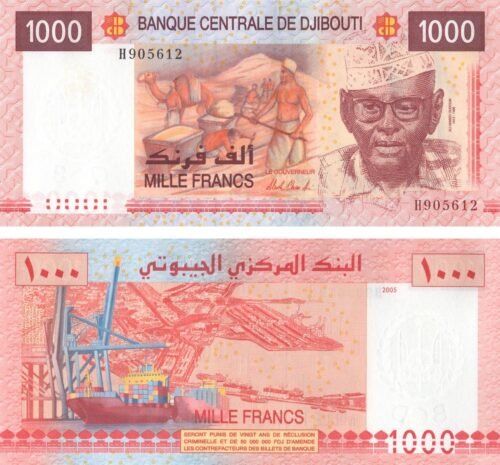
Djibouti 1000 Francs 2005, P-42a(2), UNC
12,99 € -

French Pacific Territories 500 Francs 2023, P-5(3), UNC
13,99 € -
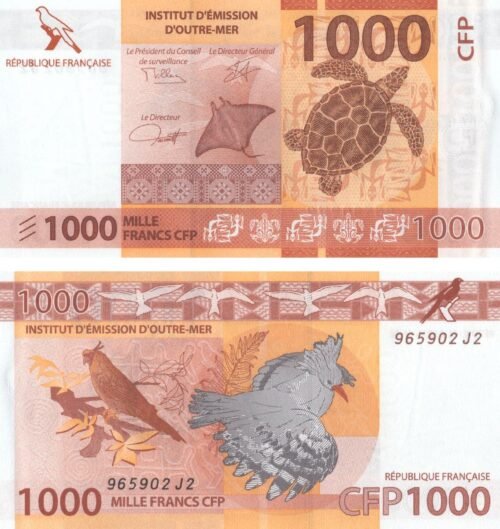
French Pacific Territories 1000 Francs 2025, P-6(4), UNC
26,99 € -

French Pacific Territories 5000 Francs 2024, P-7(2), UNC
139,99 € -

Madagascar 500 Francs 1994, P-75b, UNC
4,99 € -

Madagascar 100 Ariary (500 Francs) 2004, P-86a, UNC
1,49 € -

Madagascar 100 Ariary (500 Francs) 2004, P-86b, UNC
1,49 € -

Madagascar 100 Ariary (500 Francs) 2004, P-86c, UNC
1,49 € -

Madagascar 200 Ariary (1000 Francs) 2004, P-87b, UNC
1,49 € -

Madagascar 500 Ariary 2014, P-95a, UNC
3,99 €
Selected References
- Banque de France — Design and Manufacture of Banknote Paper and Banknotes
- Banque de France — Banknote Printing
- Banque de France — EuropaFi Banknote Security Paper
- Banque de France — Security and Innovation
- Banque de France — Behind the Bank’s Doors
- Banque de France — A Note on the Digital Banknote, April 2026
- European Central Bank — Euro Banknote Design Elements and Printing-Works Letters