
Bundesdruckerei

Bundesdruckerei is Germany’s federally owned high-security printer, linking a banknote-production tradition established in the nineteenth century with contemporary security design and industrial quality control.
Quick Facts
Official name: Bundesdruckerei GmbH
Alternative names: Bundesdruckerei; Federal Printing Office; Royal Prussian State Printing Office, Reichsdruckerei and State Printing Office (historic predecessors)
Country: Germany
Headquarters: Berlin, Germany
Established: 1763 predecessor origins; state banknote printing from 1851; Bundesdruckerei name adopted in 1951
Status: Active
Institution type: Federal high-security printer and technology company
Ownership or parent: Subsidiary of Bundesdruckerei Gruppe GmbH, which is directly and wholly owned by the German federal government
Official website: bundesdruckerei.de
Institutional Identity
Bundesdruckerei GmbH is the principal security-printing company within Bundesdruckerei Gruppe GmbH. The group is a direct, wholly owned subsidiary of the German federal government, while Bundesdruckerei GmbH performs industrial and technological work in secure printing, identity products and protected value-transfer systems.
For banknote cataloguing, Bundesdruckerei must be distinguished from the monetary authority that commissions or issues the note. It can develop a design, manufacture printing plates and inks, integrate security features and print finished notes, but it does not become the issuer of a foreign or euro-area currency. The relevant record is the documented production role for a specific issue.
The company’s identity rests on institutional continuity rather than one simple founding date. Its official history begins with a court-printing predecessor in 1763, identifies the Royal Prussian State Printing Office established in 1851 as the first state-owned works whose primary task included banknotes, and records the adoption of the Bundesdruckerei name in 1951.
Historical Development
In 1763 Frederick II granted Georg Jacob Decker the privilege to carry out court printing, creating the earliest predecessor in the Bundesdruckerei chronology. A more direct banknote milestone came in 1851, when the Royal Prussian State Printing Office was established in Berlin to print banknotes, securities and postage stamps. In 1879 it merged with the court printing office to form Reichsdruckerei.
After the destruction and political rupture of the Second World War, the organisation continued as the State Printing Office and was integrated into the Federal Republic’s administrative structure under the name Bundesdruckerei in 1951. It received post-war banknote orders in 1955, and the first 5 Deutsche Mark notes from that programme were issued in 1956.
The late twentieth-century legal history requires similar precision. Bundesdruckerei became a private-law company in 1994 with the federal government as sole owner, was sold to private investors in 2000, and returned to federal ownership in 2009. It was commissioned in 1999 to print part of Germany’s euro-banknote requirement, with euro cash entering circulation in 2002. These legal changes altered ownership and organisation without breaking the longer security-printing tradition.
Role in Banknote Production
Bundesdruckerei offers central banks and governments a banknote-production service extending from secure design and feature development to security inks, printing and sensor-supported quality control. A contract can involve a complete finished-note order or a narrower technical contribution. The exact scope must therefore be established for each issue rather than inferred from the company’s general capability.
In production, detailed offset structures can be combined with raised intaglio, specialised inks, numbering and machine inspection. Secure design is not merely decoration: line structures, portraits, value numerals, tactile elements and public-authentication features must survive both industrial printing and repeated circulation while remaining difficult to reproduce with commercial equipment.
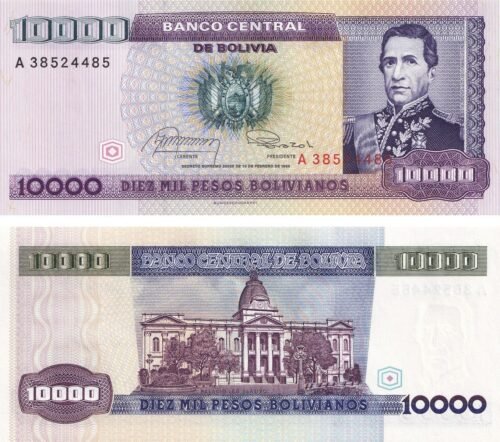
The current WorldBanknotes.eu catalogue links Bundesdruckerei to selected Bolivian and Peruvian notes of the 1980s. Those examples are useful evidence of its export work, but they do not mean every issue from those countries was produced in Berlin. Printer attribution remains tied to the individual denomination, date and catalogue variety.
Security and Technology
Bundesdruckerei describes an integrated approach covering security-feature development, security inks, sensor technology and complete design concepts. In practical terms, this allows visual features for the public to be coordinated with professional and machine-readable elements, production tolerances and inspection criteria.
Fine-line structures, microprinting, intaglio relief, colour-shifting effects, serial data and machine-detectable properties may form part of a project. The company’s contemporary concept banknotes, including STELLA presented in 2026, demonstrate research directions such as alternative formats and renewable-source polymer. They are concept and development objects, not circulating issues, and should never be used to assign those technologies retrospectively to historical Bundesdruckerei notes.
For collectors, the most useful technical evidence remains issue-specific: expected relief, serial construction, ultraviolet response, paper or polymer structure and documented security features should agree. A printer’s patent or showcase note proves capability, not automatic use on every production run.
For Collectors
Bundesdruckerei provides a clear route for studying both export banknotes and euro production. The Bolivia and Peru examples in WorldBanknotes.eu show the company operating outside Germany, while euro notes introduce a structured serial-number method for identifying the printing works.
On Europa-series euro banknotes, the first letter of the horizontal serial identifies the printing works, and the European Central Bank assigns R to Bundesdruckerei GmbH. On the first euro series, the country code identifies the central bank that commissioned printing, not necessarily the factory or country where the note was manufactured. The two systems should not be merged.
When no explicit code is available, collectors should combine catalogue data with issuer or procurement documentation and physical examination. The WorldBanknotes.eu guides to who issues banknotes and how banknotes are printed help maintain the necessary distinction between monetary authority, designer, security-feature provider and finished-note printer.
Banknotes Printed by Bundesdruckerei


Selected References
- Bundesdruckerei Group — History
- Bundesdruckerei Group — Banknotes and Postage Stamps
- Bundesdruckerei Group — Group Structure
- Bundesdruckerei — Secure Banknotes Are a Matter of Design
- Bundesdruckerei — Security Printing
- Bundesdruckerei — STELLA Concept Banknote, 13 May 2026
- European Central Bank — Euro Banknote Design Elements and Printing-Works Letters