
Casa de Moneda de Chile

Casa de Moneda de Chile developed from an eighteenth-century mint into a state security manufacturer whose modern banknote line serves Chilean and international central-bank programmes.
Quick Facts
Official name: Casa de Moneda de Chile S.A.
Alternative names: Casa de Moneda de Chile, CMCh, Chilean Mint
Country: Chile
Headquarters: Avenida Portales 3586, Estación Central, Santiago, Chile
Established: Founded as a mint in 1743; banknote printing began in 1925; current state-owned closed corporation formed on 1 June 2009
Status: Active
Institution type: State-owned mint and high-security printing company
Ownership or parent: Owned by the State of Chile and controlled through CORFO
Official website: casamoneda.cl
Institutional Identity
Casa de Moneda de Chile S.A. is Chile’s state-owned mint and security-printing company. Its work covers banknotes, coins, medals, passports, vehicle documents, licence plates and other protected products. The company operates commercially, but its ownership and public role place it within the Chilean state-enterprise system.
The institution is not the monetary issuer. Banco Central de Chile determines and issues Chilean banknotes, while Casa de Moneda manufactures notes when awarded the production contract. For foreign work, the named overseas central bank remains the issuer and Casa de Moneda acts as the security printer.
The present company must be distinguished from the broader historical institution. Casa de Moneda was founded as a mint in the colonial period, whereas the current closed corporation was formed in 2009 from the former public service. Both histories belong on the page, but they represent different legal stages.
Historical Development
The Chilean mint traces its origin to 1743, making it one of the country’s oldest institutions. Its early purpose was coinage, and the historic mint later gave its name to the presidential palace built as a monetary production site. This long minting lineage should not be mistaken for an equally early banknote-printing history.
Banknote printing began in 1925 after the creation of Banco Central de Chile. Official institutional material records the development of steel engraving, typography and offset for national notes. The banknote role expanded over the twentieth century as the works adapted from domestic production to regional security-printing contracts.
A major legal change occurred on 1 June 2009, when Casa de Moneda de Chile S.A. was constituted as a state-owned closed corporation. From 2013, a modern banknote-production line increased its capacity for Chilean and international work. Current financial and organisational documents confirm that the company remains active as a state security manufacturer.
Role in Banknote Production
Casa de Moneda’s published process includes simultaneous offset printing, screen printing where required, intaglio printing, numbering, inspection, cutting and packing. The exact sequence and feature package depend on the customer’s approved specification.
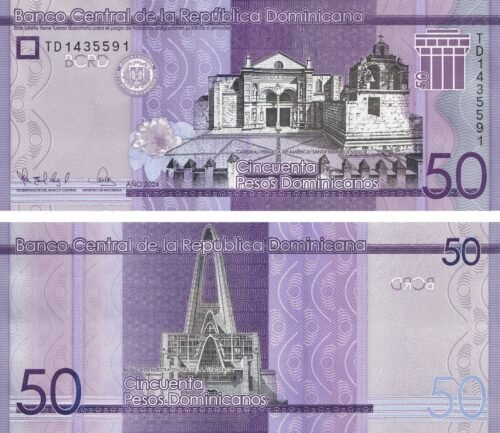
WorldBanknotes.eu currently links the printer to the Dominican Republic 50 pesos dated 2024. The attribution is retained as catalogue-supported. Banco Central de la República Dominicana procurement records show Casa de Moneda participating in recent Dominican banknote programmes, but the public sources reviewed do not provide a denomination-specific award document for this exact catalogue entry.
That distinction is important. Participation in a tender or contract family is supporting evidence, but it is not automatically proof for every denomination and date. The public profile therefore names the catalogue example while disclosing the evidence limit instead of turning a plausible connection into an absolute issuer-confirmed statement.
Security and Technology
The modern banknote line combines industrial control with established security-printing methods. Offset creates the multicolour foundation, screen processes can apply specialised effects, intaglio produces tactile relief, and numbering and inspection establish individual control over finished sheets and notes.
Casa de Moneda also publishes certification and security-management information, including ISO 14298 for security-printing processes and ISO 27001 for information security. Such certification supports institutional control but does not identify the features of a particular banknote.
The company has demonstrated paper and polymer capability through development work and house notes. Collectors should not infer substrate from the printer name alone. A Casa de Moneda contract can involve paper or polymer, and the substrate supplier may be a separate entity.
For Collectors
Casa de Moneda de Chile is useful for studying the movement of state printers beyond their home markets. A note from the Dominican Republic can carry a Chilean printer attribution while remaining entirely a liability and design programme of Banco Central de la República Dominicana.
The 2024 50-peso example should be examined for its serial structure, print registration, tactile elements, security thread and optical features, but none of those elements independently proves the printer. The strongest record combines catalogue evidence with procurement or issuer documentation.
Collectors should also separate the printer from the historic Palacio de La Moneda. The palace is an important part of Chile’s minting history, but the current production company operates elsewhere and under a modern corporate structure. This distinction prevents architectural heritage from being confused with the location of contemporary banknote manufacture.
Banknotes Printed by Casa de Moneda de Chile

Selected References
- Casa de Moneda de Chile — History
- Casa de Moneda de Chile — Who We Are
- Casa de Moneda de Chile — 2023 Financial Statements
- Casa de Moneda de Chile — Security Banknote Printing
- Casa de Moneda de Chile — Regional Banknote Production Capability
- Casa de Moneda de Chile — Sustainability Report 2022
- Casa de Moneda de Chile — Security in Valuable-Asset Operations
- Banco Central de la República Dominicana — 2024 Banknote Procurement Invitation