
Casa de Moneda Argentina

Casa de Moneda Argentina links the country’s monetary history to a state security-printing operation whose work has ranged from coinage and fiscal printing to complete domestic banknote production.
Quick Facts
Official name: Casa de Moneda S.A.U.
Alternative names: Casa de Moneda Argentina; Casa de Moneda de la Nación (historic); Sociedad del Estado Casa de Moneda (former legal form)
Country: Argentina
Headquarters: Buenos Aires, Argentina; Retiro headquarters and industrial facilities in Retiro and Don Torcuato
Established: Created on 29 September 1875; operations began in 1881; public banknote-printing mandate from 1897; transformed into Casa de Moneda S.A.U. in December 2024
Status: Active; undergoing state-directed structural and operational reconfiguration
Institution type: State-owned security printer and mint
Ownership or parent: Wholly owned by the Argentine State and dependent on the Ministry of Economy
Official website: argentina.gob.ar
Institutional Identity
Casa de Moneda S.A.U. is Argentina’s state-owned mint and security printer. Its institutional history reaches back to the nineteenth century, while its present legal form dates from the conversion of the former Sociedad del Estado into a single-shareholder public company. The organisation remains under the Ministry of Economy and retains a statutory object centred on circulating money, valued documents and other protected products required by the State.
The monetary roles must be kept separate. The Central Bank of the Argentine Republic is the issuing authority responsible for monetary policy, denominations and the release of banknotes. Casa de Moneda is the industrial manufacturer when a production assignment or contract places the work in its plants. A note’s Argentine origin, design or central-bank issue does not by itself prove that Casa de Moneda printed that particular production run.
The company operates from Buenos Aires, with the historic Retiro complex and the Don Torcuato plant forming the core of its security-production capacity. Official institutional material describes certified processes for banknotes, coins, passports, vehicle plates and other valued documents. This broader portfolio is important: Casa de Moneda is not merely a banknote workshop, but a state security-manufacturing organisation whose printing, minting, personalisation and controlled-destruction functions share the same protected industrial environment.
Historical Development
Casa de Moneda de la Nación was created by Law No. 733 on 29 September 1875 and began operating in 1881, initially as a mint. Security printing expanded gradually: state paper and fiscal stamps entered the portfolio in 1886, and legislation in 1897 designated the institution as the public body responsible for printing banknotes. The first Peso Moneda Nacional line followed in 1899. These dates describe distinct stages and should not be compressed into a single founding claim.
The twentieth century brought the technical transition from partial production to an integrated banknote works. Intaglio machinery arrived in 1942, the current Retiro building opened in 1944, and foreign specialists trained local staff in design and production. Casa de Moneda printed its first internally designed banknote in 1950 and completed an entire note from design through printing for the first time in 1952. That milestone, rather than the earlier use of imported plates or materials, marks the emergence of a fully domestic production chain.
In 1977 the institution became a Sociedad del Estado, giving its industrial and commercial functions a separate corporate framework. The Don Torcuato plant was incorporated in 2012 and continued banknote work alongside secure-document production. A further legal transition began in late 2024: an extraordinary meeting approved conversion into Casa de Moneda S.A.U., and the national executive ratified the change in 2025. Official measures also record a reconfiguration of business units after the partial termination of central-bank production contracts. The correct current description is therefore active but restructuring, not dissolved and not automatically the sole printer of every new Argentine issue.
Role in Banknote Production
Where Casa de Moneda holds the manufacturing assignment, its role can extend across design adaptation, engraving, plate preparation, background printing, intaglio printing, numbering, inspection, cutting, packing and controlled handling of spoilage. The exact division of work varies by series. Imported paper, external technology or a design approved by the central bank may all be present without changing the identity of the finished-note printer.
The WorldBanknotes.eu catalogue currently links Casa de Moneda de la Nación to 21 published Argentine notes dated from the early 1980s to 2020. They cross several monetary regimes, including the peso argentino, austral and present peso, and therefore provide a compact record of institutional continuity through redenomination and redesign. The group is catalogue evidence for the listed issues; it should not be expanded into a claim that every Argentine note of the same period or design family was manufactured domestically.
Issuer and manufacturer should also be distinguished from the substrate and feature supply chain. A watermark, security thread or optically variable element may originate with a specialist supplier, while Casa de Moneda performs the printing and finishing. Conversely, a note designed or finished by Casa de Moneda may contain imported paper or devices. Accurate attribution records the organisation responsible for the finished production only where the evidence supports that conclusion.
Security and Technology
Casa de Moneda’s official history documents a long sequence of security-printing upgrades: steel-engraved intaglio, dry intaglio, mechanically generated guilloché patterns, automated finishing, note sorting and numbering. These developments matter because they show how the institution moved from printing with externally prepared material to controlling more of the design-to-finished-note process.
The current institutional profile reports ISO 9001:2015 certification across major product lines and ISO 14298:2021 security-process certification at Central Bank Level for banknote production in both plants. Certification confirms a managed production system; it does not identify the printer of an individual note. For that, collectors still need an imprint, central-bank record, contract history or dependable catalogue attribution.
Security features must be assessed issue by issue. Intaglio relief, microtext, serial numbering, watermarks, threads and optical devices may appear across Argentine series, but their presence alone cannot identify Casa de Moneda. The reliable method is to combine the physical note with documentary evidence and the chronology of the relevant series, following the principles in the WorldBanknotes.eu guides to banknote printing and security features.
For Collectors
Casa de Moneda is particularly valuable as a collecting theme because its output can be studied across profound monetary change. Notes from the peso argentino and austral periods can be compared with later peso families to trace changes in engraving, background structure, numbering, security paper and production finish. The printer relationship adds an industrial chronology to the familiar catalogue sequence of denomination and date.
Collectors should read the note’s date, legal text and issuing authority separately from the printer attribution. A date may identify an authorisation or series rather than the exact manufacturing year, while a shared design can contain printings from different sources. Printer evidence should therefore be recorded at the individual catalogue variety or documented production group, not inherited automatically from a neighbouring entry.
The legal transition to Casa de Moneda S.A.U. and the current restructuring make precise wording more important. Historical notes may properly be attributed to Casa de Moneda de la Nación or the former Sociedad del Estado, while the present organisation uses Casa de Moneda S.A.U. The canonical WorldBanknotes.eu page brings those names into one institutional line without pretending that the legal form, production mandate and factory allocation remained unchanged throughout its history.
Banknotes Printed by Casa de Moneda Argentina
-
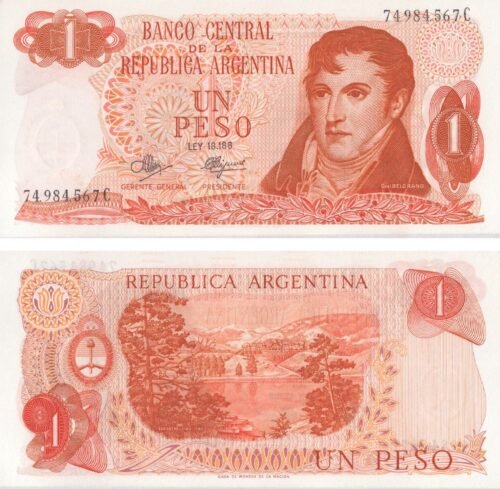
Argentina 1 Peso 1972, P-287(3), UNC
2,49 € -

Argentina 5 Pesos 1974, P-294(2), UNC
2,49 € -

Argentina 10 Pesos 1973, P-295(1), UNC
2,99 € -

Argentina 50 Pesos 1975, P-296(2), UNC
2,99 € -

Argentina 10 Pesos 1976, P-300, UNC
2,49 € -

Argentina 50 Pesos 1977, P-301a(2), UNC
2,49 € -

Argentina 500 Pesos 1982, P-303c, UNC
1,99 € -

Argentina 500 Pesos 1982, P-303cr, UNC
3,49 € -

Argentina 1000 Pesos 1982, P-304d(1), UNC
2,49 € -

Argentina 1 Pesos Argentinos 1983, P-311a(1), UNC
1,99 € -

Argentina 1 Pesos Argentinos 1984, P-311a(2), UNC
1,99 € -

Argentina 5 Pesos Argentinos 1984, P-312a(2), UNC
2,49 € -

Argentina 10 Pesos Argentinos 1984, P-313a(2), UNC
2,49 € -

Argentina 50 Pesos Argentinos 1985, P-314a(2), UNC
2,49 € -

Argentina 100 Pesos Argentinos 1983, P-315a(1), UNC
2,99 € -

Argentina 500 Pesos Argentinos 1984, P-316, UNC
2,99 € -

Argentina 1 Austral 1988-1989, P-323b(2), UNC
2,49 € -

Argentina 5 Australes 1987-1989, P-324b, UNC
2,49 € -

Argentina 10 Australes 1987-1989, P-325b, UNC
2,49 € -

Argentina 100 Australes 1989-1990, P-327c, UNC
2,49 € -

Argentina 500 Australes 1990, P-328b, UNC
1,49 € -

Argentina 1000 Australes 1990, P-329(5), UNC
1,49 € -

Argentina 2 Pesos 2013, P-352(7), UNC
2,49 € -

Argentina 20 Pesos 2014, P-355a(5), UNC
5,99 €