
Central Engraving and Printing Plant

The Central Engraving and Printing Plant is Taiwan’s principal state security printer and the manufacturer of New Taiwan dollar banknotes. Directly supervised by the Central Bank of the Republic of China (Taiwan), it combines a complex institutional lineage with a modern division of labour between secured production sites. Equipment and specialist staff transferred from the Shanghai printing organisation helped establish a Taipei factory in 1949, while the Ankang works became the dedicated centre of banknote manufacture in the early 1970s. CEPP also produces passports, identity documents, stamps and other protected products.
Quick Facts
Official name: Central Engraving and Printing Plant
Alternative names: CEPP; Central Printing Plant; 中央印製廠
Country: Taiwan
Headquarters: Xindian District, New Taipei City, Taiwan
Established: 1949 in Taiwan; present Ankang banknote works established in 1972
Status: Active
Institution type: Central-bank-supervised security printing plant
Ownership or parent: Central Bank of the Republic of China (Taiwan)
Official website: cepp.gov.tw
Institutional Identity
CEPP is a public security printer under the direct supervision of Taiwan’s central bank. It does not issue currency in its own name. The Central Bank determines the note programme and monetary requirements, while CEPP converts approved designs and specifications into finished banknotes and other secure documents.
The institution’s history cannot be reduced to a single foundation date. A local Bank of Taiwan factory began producing Old Taiwan dollar notes in Wanhwa in 1947. In 1949, printing equipment and more than one hundred technical employees from the Shanghai factory were transferred to Taiwan, creating a Taipei factory with a different institutional lineage. Subsequent reorganisations and relocations gradually formed the present CEPP.
The current structure includes the Ankang and Chingtan working sites. Official CEPP history identifies Ankang as the site established for advanced banknote production, while Chingtan’s former banknote lines were closed in 1976 and the site continued with other secure printing functions. This division shows that CEPP is a multi-product organisation rather than a single press hall.
Its public identity extends beyond currency. The plant lists banknotes, passports, identity cards, postage stamps, certificates, cheques and protected labels among its products. The common thread is controlled design, anti-forgery technology and secure production under state supervision.
Historical Development
Taiwan’s post-war monetary environment required rapid local production. In 1947, the Bank of Taiwan was authorised to establish a factory in Wanhwa for Old Taiwan dollar notes. The severe inflation of that period and the introduction of the New Taiwan dollar made secure domestic capacity strategically important.
In 1949, the transfer of machinery and specialist personnel from the Shanghai factory created a Taipei operation. This movement carried engraving and security-printing knowledge into Taiwan at a moment of political and institutional rupture. The factory later moved and was renamed Sanchung Factory in 1954, continuing to print New Taiwan dollar notes as well as stamps and other documents.
Expansion produced a more complex site structure. The Chingtan works supported banknote and security-document production, but the need for newer machinery and stronger protection led to the development of Ankang. Construction plans were approved in the 1960s, buildings were completed in 1971, two new banknote lines were installed, and the Ankang works was formally established in July 1972.
From November 1976, Chingtan ceased banknote production. The Ankang site became the central banknote works, while CEPP retained a broader secure-document mission across its facilities. This institutional evolution explains why notes from different periods may be associated with changing factory names even though they belong to the lineage now represented by CEPP.
Modern New Taiwan dollar series display the plant’s development from traditional engraved notes to complex multi-feature designs. Portraits of historical figures, education, science, sport, ecology and public life are combined with dense background structures and modern optical security. CEPP also preserves official records of earlier notes, allowing the history of banknote design and production to be traced through the institution’s own archive.
Role in Banknote Production
CEPP manufactures banknotes for Taiwan’s central bank. Its work encompasses security design, pre-press preparation, engraving, plate manufacture, printing, numbering, inspection, cutting and packing. The plant’s official structure includes specialist units for production, quality, technology, information security and administration.
Banknote production is centred at the Ankang works. The plant must control substrate, printing plates, inks, serial data, partially completed sheets, rejects and finished notes. These materials pass through secured zones and accounting systems designed to prevent unauthorised removal or substitution.
The precise relationship between issuer and printer changed historically. Earlier Old Taiwan dollar notes were associated with Bank of Taiwan production arrangements, while current New Taiwan dollar notes are issued by the Central Bank and physically produced by CEPP. A catalogue should therefore follow the printer named or documented for the specific series rather than retroactively applying CEPP to every Taiwanese note.
The WorldBanknotes.eu term currently has no linked products. Establishing the profile now creates the correct canonical destination for future Taiwan inventory and prevents fragmentation among Taipei Factory, Sanchung Factory, Ankang Works and CEPP names without erasing their historical differences.
Security and Technology
CEPP’s public security material presents banknote protection as a layered system. New Taiwan dollar notes combine watermarks, security threads, intaglio printing, microprinting, latent images, see-through register, optically variable ink and ultraviolet-responsive elements. The exact feature set varies by denomination.
Intaglio creates raised areas on portraits, numerals and selected inscriptions. Fine engraved lines provide tonal depth and a tactile signal that ordinary digital printing cannot reproduce. Offset backgrounds add colour and intricate structures, while accurate front-to-back register creates images that complete when viewed against transmitted light.
Optical features respond to movement or changing angle. Colour-shifting ink on higher denominations changes appearance as the note is tilted, while latent images and microtext reward closer inspection. Ultraviolet features provide a second-level check for trained users and machines.
The plant’s security is also organisational. CEPP highlights specialised staff, advanced equipment, protected working sites and professional certifications. These controls matter because counterfeit resistance depends on consistent execution and secure custody, not simply on the presence of a list of features.
Collectors should avoid assuming that every technology appeared simultaneously. Earlier notes belong to different production eras, and later printings may incorporate modified threads, inks or machine-readable responses while retaining the same principal design. Exact attribution requires the denomination, series and issue information.
For Collectors
For collectors, CEPP provides a coherent framework for modern Taiwan banknotes. Its factory history connects the emergency monetary conditions of the late 1940s with the technically sophisticated New Taiwan dollar notes of the present era.
Printer study can reveal institutional transitions hidden by continuity of currency name. Wanhwa, Taipei, Sanchung, Chingtan and Ankang are not merely geographical labels; they mark changes in equipment, organisation and responsibility within Taiwan’s secure-printing system.
Modern notes can be studied through issue date, prefix, signature, denomination and security revision. The same visual family may contain meaningful manufacturing changes. A CEPP attribution gives those varieties an industrial context without claiming that every difference identifies a separate factory.
The plant’s unusually detailed public history is valuable. It allows collectors to move beyond a generic “state printer” label and understand how people, machinery and production sites were reorganised across political and technological change.
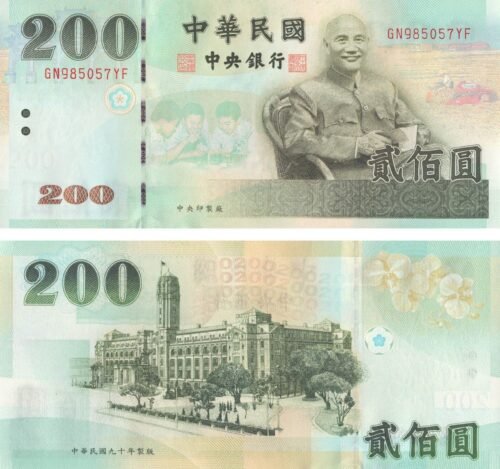
Banknotes Printed by Central Engraving and Printing Plant

Selected References
- Central Engraving and Printing Plant — Official Website
- CEPP — About the Plant and Structure
- CEPP — Taipei Factory and the 1949 Transfer
- CEPP — Wanhwa Factory and Early Taiwan Production
- CEPP — Sanchung Factory
- CEPP — Ankang Works
- CEPP — Chingtan Works
- CEPP — Security Features of Products
- CEPP — New Taiwan Dollar Security Features