
CETIS d.d.

CETIS is a Slovenian security printer whose place in banknote history rests above all on the provisional payment notes that carried the newly independent republic into the tolar era.
Quick Facts
Official name: CETIS, Graphic and Documentation Services, d.d.
Alternative names: CETIS d.d.; Cetis, grafične in dokumentacijske storitve, d.d.
Country: Slovenia
Headquarters: Čopova 24, 3000 Celje, Slovenia
Established: Modern company structure with more than 200 years of institutional printing experience claimed in official company material
Status: Active
Institution type: Private security printer and secure identity-management provider
Ownership or parent: CETIS Group; also part of the privately owned MSIN Group
Official website: cetis.si
Institutional Identity
CETIS, Graphic and Documentation Services, d.d. is a security-printing and identity-solutions company based in Celje. Its modern business is centred on passports, identity and travel documents, secure cards, fiscal and administrative products, personalisation and complete document-issuance systems. The company is part of CETIS Group and the wider MSIN Group.
CETIS is not Slovenia’s issuing authority. Banka Slovenije issued the tolar and controlled the country’s currency programme; CETIS supplied printed matter within that wider state project. This separation is especially important because the firm’s documented connection is strongest for the provisional payment notes, while the first permanent Slovenian tolar banknotes were printed by Thomas De La Rue on paper made in Slovenia.
Official company material speaks of more than two centuries of printing experience. That statement describes institutional know-how and continuity rather than a simple, unbroken banknote-printer identity under the present corporate name. The profile therefore preserves the long lineage without projecting today’s legal form backwards across every historical predecessor.
Historical Development
The decisive monetary episode came during Slovenia’s transition to independence. Banka Slovenije placed provisional payment notes into circulation on 8 October 1991, using denominations from 1 to 1,000 tolars; a 5,000-tolar note followed in 1992. They served as temporary currency while the permanent portrait series was being prepared.
Specialist catalogues attribute these provisional notes to CETIS in Celje. Their design was deliberately functional and nationally legible: Mount Triglav, the Prince’s Stone and a bee on honeycomb carried a compact vocabulary of landscape, history and work. The notes were withdrawn denomination by denomination as permanent banknotes and coins entered circulation, yet Banka Slovenije continues to exchange them without a time limit.
CETIS subsequently developed into a broad international security and identity business serving governments across several continents. The institutional path moved far beyond emergency currency, but the provisional tolar notes remain a concise record of the moment when secure printing supported the practical birth of an independent monetary system.
Role in Banknote Production
The WorldBanknotes.eu catalogue links CETIS to the Slovenian 1-tolar provisional payment note. It belongs to the temporary series dated 1990 and introduced in 1991, rather than to the later permanent banknote family. That classification should remain explicit in titles, series data and historical text: a payment note used as temporary national currency is not merely an early printing of the permanent tolar design.
Banka Slovenije’s official history confirms the issue dates, denominations and temporary role of the payment notes, but does not name the printer on the page reviewed. The CETIS attribution is supplied by specialist numismatic cataloguing. Because the issuer’s account and the catalogue attribution answer different questions, both are retained: the central bank establishes monetary status, while the specialist source identifies the manufacturing institution.
CETIS’s modern portfolio demonstrates a production culture built around secure document origination, controlled printing, personalisation and protected data workflows. It would nevertheless be inaccurate to infer that every present capability was used on the early payment notes. The notes themselves must remain the primary evidence for their paper, line work, numbering and security characteristics.
Security and Technology
CETIS currently lists ISO 14298 certification at Central Bank level for the management of security-printing processes, alongside ISO 9001, ISO 14001 and ISO 27001 systems. Intergraf’s current certified-company register gives the scope as security printed matter, passports, identity documents, smart cards and personalisation. These certifications describe the management environment of the modern company; they do not retroactively define the specifications of the provisional tolar series.
The 1-tolar payment note is a restrained object compared with a mature high-denomination banknote. Its security is carried by controlled paper, fine-line printing, serial application, repeated graphic structures and the integrity of the complete printed sheet. Collectors should avoid inventing an intaglio process or a particular watermark unless these are confirmed on the exact denomination and variety.
A useful examination compares the provisional notes across denominations: alignment of common motifs, density of line screens, serial typography, paper response and cutting tolerances can reveal the logic of a rapidly delivered national series. The exercise also shows why security printing is not synonymous with visual complexity. Controlled consistency can be as informative as an elaborate optical feature.
For Collectors
CETIS matters to collectors because its most important monetary object is inseparable from Slovenia’s state formation. The provisional payment notes were not a decorative prelude to the tolar; they were the working currency of the transition, carrying economic life while the permanent system was prepared.
The 1-tolar note offers an accessible entry into the full denomination set. Collectors can follow serial structures, date conventions and shared design elements across the series, then compare the temporary notes with the later De La Rue-printed portrait banknotes. That comparison makes the issuer–printer relationship unusually clear: one central bank, two distinct production phases and different technical ambitions.
Catalogue descriptions should retain the wording ‘provisional payment note’ and should not generalise CETIS as the printer of all Slovenian tolars. The value of the attribution lies precisely in its narrowness. Accurate boundaries turn a modest note into a reliable document of monetary history.
Banknotes Printed by CETIS d.d.
-

Bosnia and Herzegovina 10 Dinara 1992, P-10, UNC
1,49 € -

Bosnia and Herzegovina 25 Dinara 1992, P-11, UNC
1,49 € -

Bosnia and Herzegovina 50 Dinara 1992, P-12, UNC
0,99 € -

Bosnia and Herzegovina 100 Dinara 1992, P-13, UNC
1,49 € -

Bosnia and Herzegovina 1.000 Dinara 1992, P-15, UNC
1,49 € -

Bosnia and Herzegovina 100000 Dinara 1993, P-34a, UNC
2,49 € -

Bosnia and Herzegovina 10000 Dinara 1993, P-53e, UNC
3,99 € -
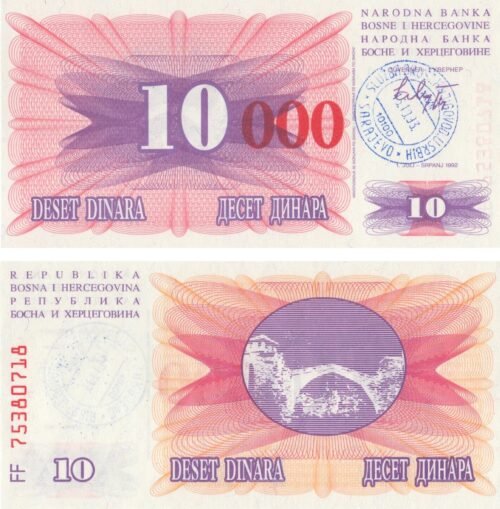
Bosnia and Herzegovina 10000 Dinara 1993, P-53f, UNC
3,99 € -

Bosnia and Herzegovina 10000 Dinara 1993, P-53g, UNC
3,99 € -

Bosnia and Herzegovina 10000 Dinara 1993, P-53h, UNC
3,99 € -

Bosnia and Herzegovina 25000 Dinara 1993, P-54a, UNC
3,99 € -

Bosnia and Herzegovina 50000 Dinara 1993, P-55h, UNC
3,99 € -
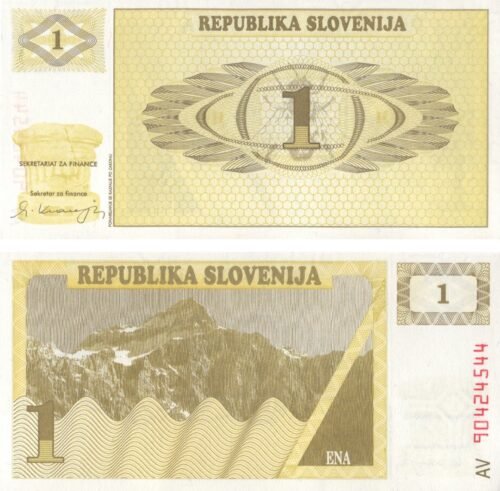
Slovenia 1 Tolar 1990, P-1, UNC
1,49 € -
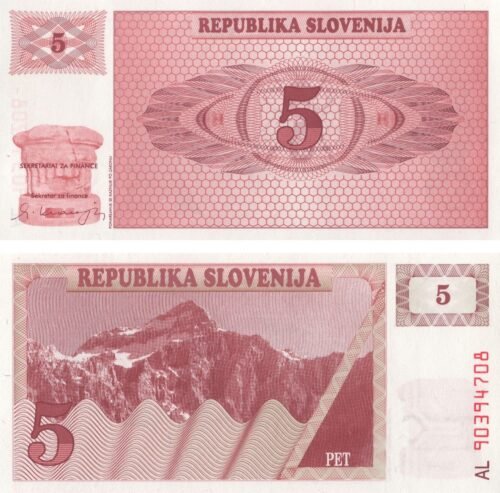
Slovenia 5 Tolarjev 1990, P-3, UNC
2,99 € -
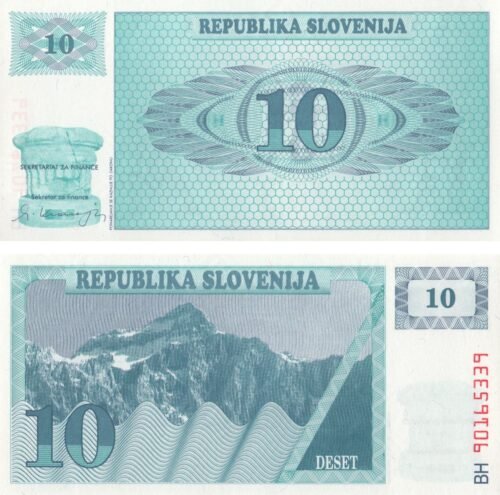
Slovenia 10 Tolarjev 1990, P-4, UNC
3,99 €