
China Banknote Printing and Minting Corporation

China Banknote Printing and Minting Corporation is the industrial system behind the renminbi, integrating design, printing, paper, inks, security threads, minting equipment and cash-lifecycle technology under the People’s Bank of China.
Quick Facts
Official name: China Banknote Printing and Minting Group Co., Ltd.
Alternative names: China Banknote Printing and Minting Corporation; CBPM; China Banknote Printing and Minting Group
Country: China
Headquarters: Kaixuan Building, 143 Xizhimenwai Street, Xicheng District, Beijing, China
Established: The present group’s public English materials do not state one legal founding date; a core predecessor, Beijing Banknote Printing, dates to 1908
Status: Active
Institution type: State-owned integrated currency-design, banknote-printing, minting and cash-technology group
Ownership or parent: Directly under and funded by the People’s Bank of China
Official website: cbpm.cn
Institutional Identity
China Banknote Printing and Minting Corporation, generally abbreviated CBPM in its English material, is the state-owned currency-manufacturing group directly under the People’s Bank of China. The current Chinese legal name is China Banknote Printing and Minting Group Co., Ltd., while the English-facing corporate identity continues to use “Corporation”. The distinction is editorially important: the group is not the monetary issuer. The People’s Bank of China authorises and issues the renminbi; CBPM designs, develops and manufactures currency and related products within that mandate.
CBPM is better understood as an integrated industrial network than as one printing house. Its official structure brings together banknote-printing companies, mints, banknote-paper manufacturers, security-ink and thread specialists, equipment producers and cash-service organisations. That breadth allows the group to control or coordinate much of the currency-production chain, but it also creates an attribution problem for collectors. A note may be printed by one affiliated plant, use paper from another CBPM company and incorporate ink or a thread from a third. “CBPM” can therefore identify the group without naming the exact physical works.
The group’s current mission extends beyond new-note manufacture. Official material describes design, research and development, printing and minting, security printing, equipment production and cash-lifecycle management. This institutional scope places CBPM among the world’s most vertically integrated public currency manufacturers, but each claim about a particular foreign issue still requires note-level evidence.
Historical Development
CBPM’s public English website emphasises the present group and does not provide a single incorporation date that can safely be used as the beginning of the entire institution. One central predecessor is documented more clearly: a Chinese government feature identifies Beijing Banknote Printing as established in 1908. That date belongs to an affiliated printing lineage, not automatically to the current legal group, and the Quick Facts field therefore preserves the distinction instead of presenting 1908 as an unqualified corporate birthday.
During the development of the modern Chinese currency system, specialised printing, paper, minting and technical organisations were assembled into a national production network serving the People’s Bank of China. The present structure reflects that accumulated industrial depth. Banknote paper is manufactured by affiliated companies in Baoding, Kunshan and Chengdu; dedicated subsidiaries produce security inks and threads; and related equipment companies cover machinery required across the banknote-production process.
The group’s more recent development has focused on full cash-lifecycle capability and international technical services. Official pages refer not only to printing and minting but also to financial equipment, currency culture, security printing and paper supplied to overseas customers. These activities establish international reach, although they do not prove that every foreign note printed on Chinese paper was physically printed by a CBPM banknote works.
Role in Banknote Production
Within an authorised programme, CBPM can contribute to concept development, graphic and security design, origination, plate preparation, background printing, intaglio printing, numbering, inspection, finishing and secure delivery. The official banknote-printing description also places research and development at the centre of the organisation’s role. This matters because a modern banknote is not simply an image transferred to paper: it is an engineered system in which artwork, machine-readable features, substrate and industrial tolerances must operate together.
The WorldBanknotes.eu catalogue currently links CBPM to four Albanian notes dated 1976. These entries demonstrate the international dimension represented in the collection, but they remain issue-level catalogue attributions. They should not be expanded into a claim that CBPM printed every Albanian series, nor should the use of Chinese paper, ink or security technology be treated as equivalent to finished-note printing.
For renminbi, the group identity may be sufficient in a general institutional profile, but advanced cataloguing can require the individual affiliated printer. Where a plant mark, official production statement or specialist catalogue identifies the actual works, that narrower attribution is preferable. The group page should function as the top-level institutional reference rather than erase the production geography beneath it.
Security and Technology
CBPM’s strongest documented characteristic is vertical integration. Its official paper page identifies three affiliated banknote-paper manufacturers and describes capability in banknote and high-security paper. The ink subsidiary, China Banknote Ink Co., was founded in Shanghai in 2001 and produces offset, intaglio and letterpress inks, coatings and specialised varnishes. Zhongchao Special Security Technology, founded in 2003, develops optical and machine-readable security threads for currency and related applications.
The equipment division adds another layer. Official material states that affiliated manufacturers can supply machinery for the whole banknote-printing process. This does not mean every CBPM note uses the same configuration; different plants, generations and contracts may use different workflows. It does mean that design, consumables, machinery and final manufacturing can be developed within one state industrial system.
Collectors should resist converting this capability list into automatic feature attribution. A watermark, colour-shifting ink or thread on a foreign note may have been supplied by a CBPM affiliate without the finished note being printed by CBPM. Conversely, a CBPM-printed note can contain components sourced elsewhere. The correct record separates the finished-note printer from paper, ink, thread and equipment suppliers.
For Collectors
CBPM offers collectors two different fields of study. The first is the renminbi itself, where changes in printing, security threads, inks and note-processing requirements can be read across successive series. The second is international production, where a Chinese state group appears behind notes issued by other monetary authorities. In both cases the issuer remains separate from the manufacturer.
The four 1976 Albanian notes in WorldBanknotes.eu form a coherent catalogue group for examining one documented foreign assignment. Their shared date and design family make them useful for comparative study, but the collector should still inspect each denomination independently for printing characteristics, paper, serial structure and any identifying marks. A series relationship is supporting evidence, not a substitute for attribution.
The most reliable workflow combines the printer record with the physical banknote-production process and the guide to security features. Record the issuing authority, the exact note or series, the named printing entity and any separately documented component supplier. That method preserves CBPM’s genuine technological importance without collapsing a complex group into a single unexplained printer label.
Banknotes Printed by China Banknote Printing and Minting Corporation
-
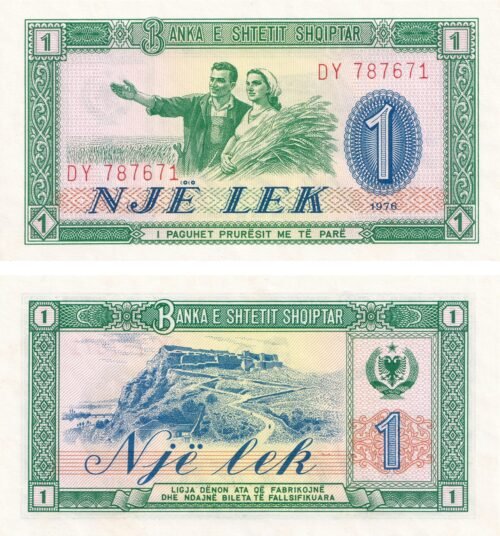
Albania 1 Lek 1976, P-40, UNC
2,49 € -
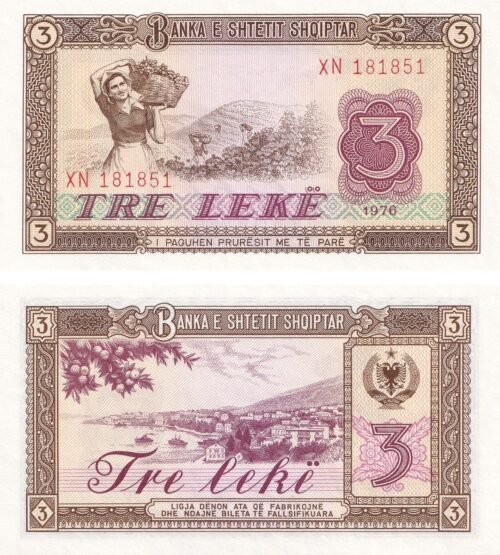
Albania 3 Leke 1976, P-41, UNC
3,99 € -
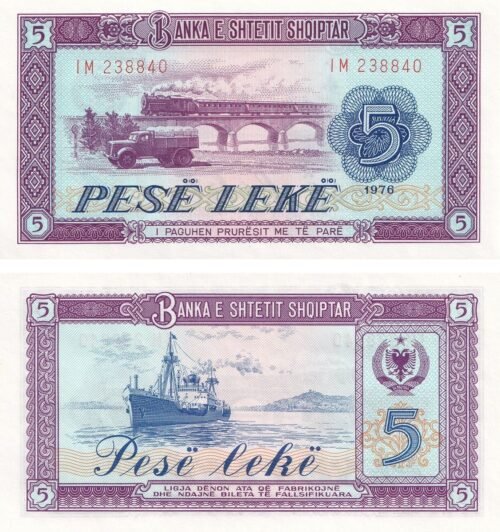
Albania 5 Leke 1976, P-42, UNC
3,99 € -
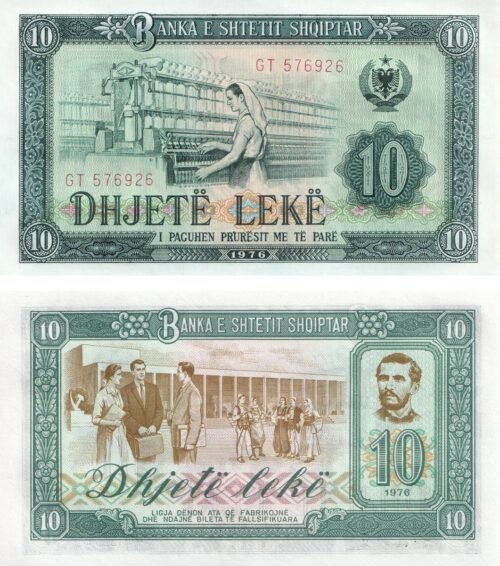
Albania 10 Leke 1976, P-43, UNC
4,99 € -

Argentina 20000 Pesos 2024, P-370, UNC
46,99 €