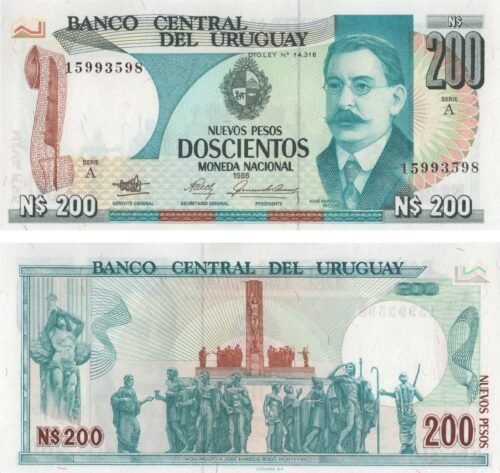
Ciccone S.A.

Ciccone S.A. is the printer credited on selected South American banknotes, including Uruguay’s 200-nuevos-pesos issue of 1986. The name belongs to Argentina’s private security-printing history, but surviving sources require care when linking it to later Ciccone corporate forms.
Quick Facts
Official name: Ciccone S.A.
Alternative names: Ciccone; Ciccone y Lima; Ciccone S.A., Argentina
Country: Argentina
Headquarters: Buenos Aires, Argentina
Established: Exact legal founding date for the entity named in the catalogue attribution was not confirmed
Status: Historical printer name; current independent status not established
Institution type: Commercial security printer
Ownership or parent: Not stated; this catalogue term is kept distinct from Ciccone Calcográfica unless an issue source explicitly connects them
Institutional Identity
The printer operated in Buenos Aires and appears under related names including Ciccone y Lima and Ciccone S.A. Catalogue attribution establishes the producer named for an issue, not the complete legal history of every company that later used the Ciccone name.
WBN retains a separate taxonomy entry from Ciccone Calcográfica. The pages should be merged only if primary corporate documentation proves that the catalogue labels refer to the same legal producer for the relevant period.
Argentina’s Ciccone name appears across several business forms and periods, a common source of database over-merging. A catalogue entry reading CICCONE S.A. is direct evidence for that label on the issue; it is not, by itself, a legal opinion about every predecessor, affiliate or successor carrying the family name.
This evidence-led separation is particularly important because WBN already has a Ciccone Calcográfica term. Distinct profiles preserve the source wording until corporate documents demonstrate when the identities coincide. They can later be consolidated with redirects if stronger evidence emerges.
Historical Development
Private Argentine security printers served both domestic and regional clients. Ciccone’s documented Uruguayan contract belongs to this cross-border market and shows that smaller national issues could be placed with specialist firms in neighbouring countries.
Public descriptions of the Ciccone businesses vary in naming and continuity. Rather than turn those inconsistencies into a speculative narrative, this profile confines the history to the verified printer credit.
Buenos Aires supported a mature printing industry with the skills needed for banknotes, stamps and fiscal documents. Regional proximity made Argentine firms practical contractors for Uruguay, whose central bank used several domestic and foreign production partners across different series.
The 1986 contract belongs to the nuevo-peso period, only a few years before another redenomination. Its historical relevance lies both in the printer relationship and in the accelerated monetary change visible in Uruguay’s rising denominations.
Role in Banknote Production
The Banknote Book credits CICCONE S.A. on Uruguay’s 1986 200-nuevos-pesos note, and Uruguayan numismatic documentation also identifies Buenos Aires production by the Ciccone concern. That agreement supports the WBN printer assignment.
The attribution should not be extended automatically to other Argentine or Uruguayan notes. Each issue needs its own catalogue or documentary printer evidence.
Two types of evidence align for the 200-nuevos-pesos issue: specialist catalogue attribution and Uruguayan numismatic documentation. Agreement between them is more reliable than visual resemblance or a modern company biography disconnected from the note.
The printer credit should be copied exactly at research stage and then mapped to the approved taxonomy term. If another Ciccone spelling appears on a different issue, it must be checked rather than automatically folded into this page.
Security and Technology
The attributed note uses commercial security-printing methods suited to circulating currency, including fine-line backgrounds, controlled numbering and denomination-specific design work. Exact plant machinery and proprietary processes were not established in the reviewed sources.
Technical description therefore remains note-specific. Visual similarity with another Ciccone product does not prove a contract or corporate identity.
The note’s fine-line ornament, multicolour structure and serial control are consistent with professional currency production. Those visible characteristics help authentication and condition assessment, but they do not disclose which stages were performed at Ciccone or supplied by another specialist.
No verified technical manual or plant archive was found for the relevant contract. Naming specific presses, proprietary inks or paper suppliers would therefore exceed the evidence and has been avoided.
For Collectors
For collectors, Ciccone S.A. attribution is a useful way to distinguish the 1986 Uruguayan issue from notes supplied by other printers. The printer should be recorded with denomination, year and catalogue variety.
The separate Ciccone S.A. and Ciccone Calcográfica taxonomy terms reflect evidence discipline, not a claim that the businesses were unrelated in every respect. Until the legal link is documented for the issue, preserving the catalogue name is the safer approach.
Printer attribution can separate production contracts within a national series, but it should not be presented as an automatic rarity factor. Market availability depends on issue quantity, release and survival, none of which follows from the Ciccone name alone.
A high-quality record keeps the Uruguayan issuing authority, nuevo-peso currency and Argentine printer in separate linked fields. That structure preserves the cross-border character of the object without confusing institutional roles.