
Dar As-Sikkah

Dar As-Sikkah is Morocco’s integrated banknote printing, coin minting and secure-document complex. Inaugurated in 1987 by King Hassan II, it brought the physical production of the dirham under Bank Al-Maghrib’s direct institutional control. From a secured site near Rabat–Salé, the works designs and manufactures Moroccan banknotes and coins while also producing passports, protected documents and selected export work. Its identity is inseparable from the modernisation of Moroccan currency: national imagery, Arabic calligraphy and royal portraiture are carried through a production system that unites design, tooling, printing, quality assurance and secure custody.
Quick Facts
Official name: Dar As-Sikkah
Alternative names: Dar As-Sikkah; دار السكة; Bank Al-Maghrib Printing and Minting Works
Country: Morocco
Headquarters: Salé, Morocco
Established: 1987
Status: Active
Institution type: Central-bank banknote printing, minting and secure-document works
Ownership or parent: Bank Al-Maghrib
Official website: bkam.ma
Institutional Identity
Dar As-Sikkah is a specialised directorate of Bank Al-Maghrib rather than an independent commercial printer. The central bank entrusts it with manufacturing banknotes and coins and with producing other highly protected documents. The same institution therefore controls monetary issuance, industrial production and the lifecycle management of Moroccan cash.
The name evokes the historic Islamic mint tradition, yet the present organisation is a modern industrial complex. Official Bank Al-Maghrib material states that Morocco established its national printing and minting works in 1987 and that the facility was inaugurated on 5 March of that year.
The site lies in Salé on the road to Meknès, near Rabat–Salé airport. Bank Al-Maghrib describes a secured area of approximately twenty hectares protected by internal security services, perimeter control by the Royal Gendarmerie and continuous electronic surveillance.
Dar As-Sikkah’s remit is broader than cash. It produces biometric passports and other security documents, allowing expertise in engraving, personalisation, substrate control and anti-forgery design to circulate across product families. This breadth strengthens the plant’s technical base without changing the fact that Moroccan banknotes remain its most visible monetary work.
Historical Development
Before Dar As-Sikkah, Moroccan banknotes were printed abroad. Bank Al-Maghrib’s iconographic history records the use of foreign printers during the twentieth century, even as the notes developed an increasingly distinct national language of royal portraiture, architecture, agriculture, industry and landscape.
The creation of the works in 1987 marked a change from national issuance with foreign manufacture to domestic production under the central bank. The first series associated with the new plant belongs to the same year, making the institution and its early banknotes part of one deliberate programme of monetary modernisation.
Dar As-Sikkah expanded beyond conventional paper money. It developed coin minting, passport production and security-document capability, while its banknote department adopted computer-assisted design, modern plate preparation and multi-process printing. The integration of design and manufacture allowed Moroccan themes to be developed within the same institution that controlled technical feasibility and quality.
The plant’s twenty-fifth anniversary was marked by a commemorative banknote that demonstrated experimental substrate technology and the symbolic importance of the works itself. Later dirham series continued to introduce stronger public security features, updated portraiture and imagery associated with infrastructure, heritage and economic development.
Official annual reports also refer to export-oriented foreign banknote and secure-document activity. These references confirm that Dar As-Sikkah’s competence is not confined to domestic orders, although individual export clients should only be named where primary or reliable specialist evidence supports the attribution.
Role in Banknote Production
Dar As-Sikkah designs and manufactures Moroccan banknotes for Bank Al-Maghrib. Its official process begins with specialised computer-assisted design, where portraits, calligraphy, numerals, ornamental structures and security elements are coordinated as one technical composition.
Pre-press work converts approved designs into printing tools. The production sequence can include offset backgrounds, intaglio relief, screen-applied optically active features, numbering and finishing. Quality control follows each major stage, not merely the completed sheet.
Bank Al-Maghrib remains the issuing authority and determines the denominations and circulation programme. Dar As-Sikkah is the manufacturing arm. This distinction matters when cataloguing older Moroccan notes printed abroad: the presence of Bank Al-Maghrib’s name identifies the issuer, whereas the production date and documented printer determine whether Dar As-Sikkah was responsible for manufacture.
The WorldBanknotes.eu term currently has no linked products, but the profile will become central as modern Moroccan inventory expands. It provides the canonical attribution for domestically produced dirham notes and avoids splitting one institution into “Bank Al-Maghrib printer”, “Moroccan mint” and Dar As-Sikkah variants.
Security and Technology
Dar As-Sikkah’s banknote production combines visual art with industrial security. Fine-line backgrounds, calligraphy, engraved portraits and denomination structures must function aesthetically while supporting machine readability and resistance to reproduction.
Public descriptions of the production process refer to specialised banknote-design software and the preparation of printing forms for multiple processes. Offset creates detailed colour fields; intaglio gives the royal portrait, principal numerals and selected inscriptions a raised surface; screen printing can apply optically variable features; serial numbering individualises the note.
Moroccan notes employ layered features including watermarks, security threads, see-through registers, microtext, iridescent or colour-shifting elements, ultraviolet responses and tactile marks. The precise package changes by series and denomination, and no single description should be imposed on every note produced by the works.
Site security is part of the technical system. Bank Al-Maghrib identifies guarded perimeter protection, electronic detection and continuous surveillance. Materials, printing tools, unfinished sheets and waste must remain under controlled accounting throughout production.
Quality assurance extends from the design file to finished bundles. Colour consistency, register, intaglio relief, serial accuracy, cutting and substrate condition are checked against approved standards. A secure feature is effective only when it is reproduced consistently across an entire issue.
For Collectors
For collectors, Dar As-Sikkah marks the transition to sovereign domestic manufacture. Moroccan banknotes before and after 1987 may share royal and national imagery, but they belong to different industrial histories.
Printer attribution can help separate series or varieties that appear visually related. It also provides context for the growing technical confidence of later dirham notes, whose optical and tactile features reflect the capabilities of a mature integrated works.
Anniversary and commemorative notes are especially revealing because they often make the institution itself part of the subject. They show how a printer can become a symbol of monetary independence rather than remaining invisible behind the issuing bank.
Collectors should still verify each note. Dar As-Sikkah’s existence does not mean that all modern Moroccan notes or every printing date were necessarily manufactured there without exception. Series documentation and reliable printer attribution remain the proper basis.
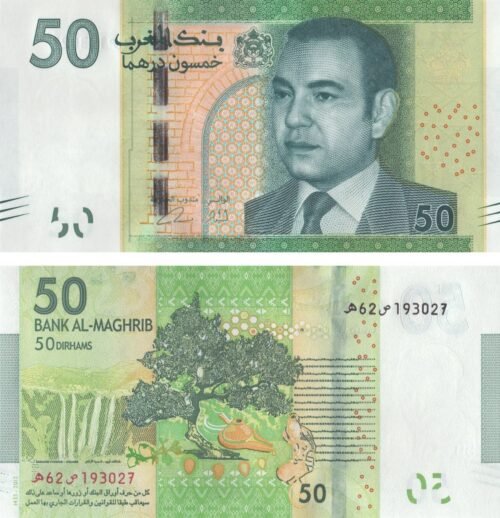
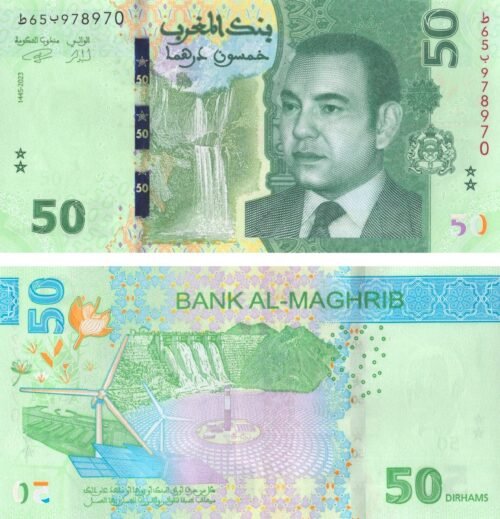
Banknotes Printed by Dar As-Sikkah


Selected References
- Bank Al-Maghrib — Dar As-Sikkah History
- Bank Al-Maghrib — Production of Banknotes
- Bank Al-Maghrib — Currency Production and Issuance
- Bank Al-Maghrib — Dar As-Sikkah Site Security
- Bank Al-Maghrib — Dar As-Sikkah Contact and Location
- Bank Al-Maghrib — Commemorative Banknotes and Coins
- Bank Al-Maghrib — Dar As-Sikkah Educational Booklet