
De La Rue

De La Rue occupies a central place in commercial banknote production, joining two centuries of printing history with contemporary paper, polymer, design and security-feature expertise.
Quick Facts
Official name: De La Rue Limited
Alternative names: Thomas De La Rue & Co., De La Rue plc (former listed name)
Country: Great Britain
Headquarters: Basingstoke, Hampshire, United Kingdom
Established: 1813; banknote printing since 1860
Status: Active
Institution type: Private commercial security printer
Ownership or parent: Owned by Atlas Holdings since 2025
Official website: delarue.com
Institutional Identity
De La Rue is a British commercial currency specialist whose work sits between monetary authority, design studio, materials supplier and industrial printer. It does not issue currency in its own right. Instead, it works for central banks, issuing authorities and state printing works, supplying combinations of fully finished banknotes, secure paper, polymer substrate, security features, design services and launch support.
This distinction matters. A note carrying De La Rue’s imprint or attributed to one of its production sites remains the liability of the issuing authority named on the note. De La Rue’s role concerns the physical and technical realisation of that monetary instrument: translating an approved concept into a document that can circulate securely, withstand handling and be authenticated by the public, cash professionals and machines.
The company’s modern currency offer is deliberately integrated. Design is developed alongside substrate, windows, threads, optical devices and public-facing security features rather than treated as a decorative layer added after the technical specification. That integrated approach makes De La Rue relevant not only as a printer, but also as an important participant in the broader architecture of contemporary banknote production.
Historical Development
The company traces its origins to Thomas de la Rue, who established a printing business in 1813. De La Rue entered banknote production in the nineteenth century and records 1860 as the beginning of its banknote-printing activity. From that point, the firm expanded from a British printing house into an international supplier of currency and other high-security products.
Its history reflects the changing structure of the banknote industry. Earlier private printers were often responsible for engraving, plate preparation and complete note production. In the modern era, the same company may contribute only part of a more distributed chain: design, substrate, a security feature, technical support or final printing. De La Rue has operated across these layers, which explains why its name appears in catalogues for notes from many regions and periods even when the visible design language differs greatly.
The group also evolved through corporate restructuring. Its former listed-company identity, De La Rue plc, gave way to private ownership when the acquisition by Atlas Holdings became effective in July 2025. The change did not erase the historic name or its currency specialism; it placed the business within a new ownership structure while the company continued to present itself as a provider of banknote, substrate and security solutions.
For catalogue purposes, historical references should therefore preserve the name appropriate to the period and source. A note printed by an earlier De La Rue entity should not automatically be relabelled with the current legal name, while the modern Printer page can serve as the canonical institutional hub linking those historical forms.
Role in Banknote Production
De La Rue’s banknote role can begin before a finished design exists. Its design teams develop visual concepts, integrate security elements and prepare artwork for industrial production. The company describes a “feature-first” approach in which threads, windows, optical devices and other security components are planned as structural parts of the composition. This reduces the divide between image and authentication: a feature can contribute simultaneously to visual identity, public recognition and counterfeit resistance.
The company also supplies paper and SAFEGUARD® polymer substrate, security features and fully finished banknotes. In other projects it supports a central bank or state printing works rather than completing every production stage itself. The exact role must therefore be established note by note. “Printed by De La Rue” is not interchangeable with “designed by De La Rue”, “substrate supplied by De La Rue” or “printed with De La Rue technology”.
Production attribution can also involve different sites or partnerships within the wider De La Rue network. A catalogue should preserve the strongest supported level of identification: the company, a named facility, or a local production partnership where official documentation makes that distinction. Where the evidence reaches only the company level, greater specificity should not be invented.
Security and Technology
De La Rue’s contemporary portfolio covers security elements for both paper and polymer notes. Its public materials describe ultraviolet features such as GEMINI™, optical platforms such as OPTILIGHT™, embedded and applied devices, windows and the SAFEGUARD® polymer substrate. These names are useful for understanding the company’s technical range, but they should not be assigned to an individual banknote unless the feature is documented for that issue.
Its design philosophy also illustrates how modern banknotes are authenticated at several levels. Public features must be recognisable without equipment; professional features support cash handlers and machines; restricted features remain within central-bank and law-enforcement systems. A printer page should describe this layered capability without revealing or speculating about non-public security information.
Durability and lifecycle management form a second strand of the technology. Substrate selection, protective coatings, resistance to soiling and folding, machine readability and eventual recycling all affect the cost and performance of a note. De La Rue’s work with both paper and polymer makes it particularly relevant when comparing how the same monetary system adopts different substrate generations.
For Collectors
For collectors, De La Rue offers one of the broadest institutional threads through modern world paper money. Its presence across countries, currencies and political periods makes the printer useful for thematic collecting, but also easy to oversimplify. The company name alone does not prove that two notes belong to the same series, share the same substrate or were produced at the same facility.
Printer attribution may appear as a full imprint, an abbreviation, a discreet line of text or only in catalogue and central-bank documentation. The absence of a visible printer mark does not establish that De La Rue was uninvolved, while a security feature developed by the company does not by itself prove that De La Rue printed the finished note. Collector records should separate printer, designer, substrate supplier and feature provider whenever reliable evidence permits.
A change to or from De La Rue can create a catalogue variety, but it does not automatically create a new design series. The most useful comparison combines printer attribution with date, signature, substrate, dimensions, security-thread type, visible imprint and documented production history. In this way, De La Rue becomes not merely a famous name, but a precise analytical link between design, manufacture and circulation.
Banknotes Printed by De La Rue
-
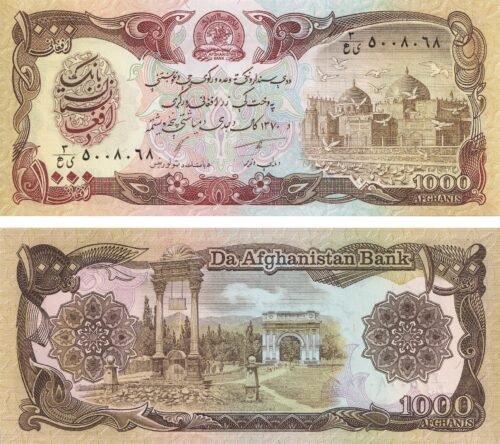
Afghanistan 1000 Afghanis 1991, P-61c, UNC
1,49 € -
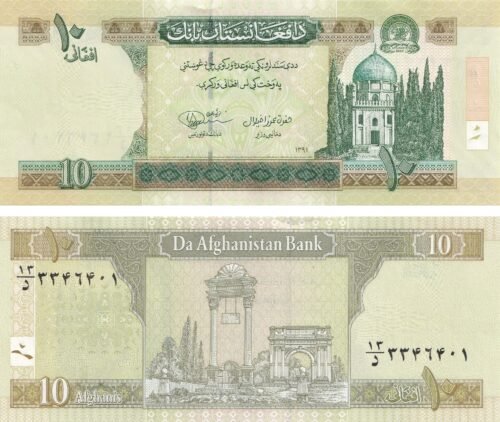
Afghanistan 10 Afghanis 2012, P-67Ab, UNC
1,99 € -
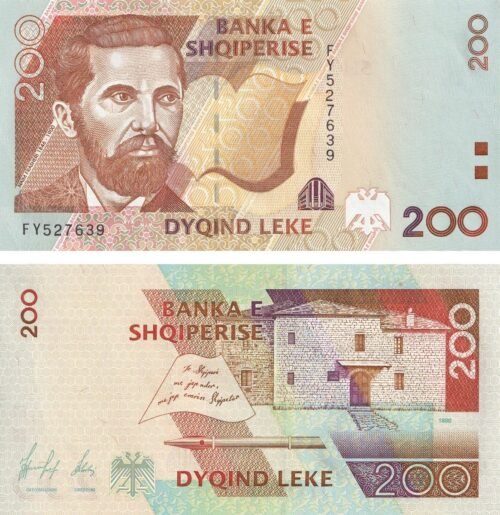
Albania 200 Leke 1996, P-63, UNC
10,99 € -

Albania 500 Leke 2015, P-72b, UNC
12,99 € -

Albania 500 Leke 2020, P-77, UNC
13,99 € -

Angola 500000 Kwanzas 1991, P-134, UNC
5,99 € -

Armenia 50 Dram 1998, P-41, UNC
2,99 € -

Armenia 100 Dram 1998, P-42, UNC
3,99 € -

Azerbaijan 250 Manat 1992, P-13b, UNC
2,99 € -

Azerbaijan 50 Manat 1999, P-17b, UNC
4,99 € -

Azerbaijan 100 Manat 1993, P-18b, UNC
2,99 € -

Azerbaijan 500 Manat 1999, P-19b, UNC
3,99 € -

Azerbaijan 1000 Manat 2001, P-23, UNC
3,99 € -

Bahamas 3 Dollars 1974, P-44, UNC
10,99 € -

Bahamas 1 Dollar 2015, P-71A, UNC
3,99 € -

Bahamas 5 Dollars 2013, P-72A, UNC
12,99 € -

Bahamas 10 Dollars 2016, P-79, UNC
27,99 €