
Fábrica Nacional de Moneda y Timbre

Fábrica Nacional de Moneda y Timbre joined Spain’s minting and stamp traditions in 1893, became the country’s principal peseta-banknote manufacturer in 1940 and now operates beside IMBISA within a more specialised euro-era production structure.
Quick Facts
Official name: Fábrica Nacional de Moneda y Timbre – Real Casa de la Moneda, E.P.E., M.P.
Alternative names: FNMT-RCM, FNMT, Spanish Royal Mint, Real Casa de la Moneda
Country: Spain
Headquarters: Madrid, Spain; industrial production in Madrid and at the Burgos paper mill
Established: Created in 1893 by merging the Madrid Mint and Stamp Factory; banknote production began in 1940; IMBISA assumed Spain’s euro-banknote production role from 2015
Status: Active public security manufacturer; routine euro-banknote production is carried out by IMBISA
Institution type: State public-business entity producing coins, security paper, non-euro banknotes, identity products and digital trust services
Ownership or parent: Public business entity under Spain’s Ministry of Finance; 20% shareholder in IMBISA
Official website: fnmt.es
Institutional Identity
The Fábrica Nacional de Moneda y Timbre – Real Casa de la Moneda is Spain’s state security-manufacturing institution. Its activities span coins, security paper, banknotes outside the euro production quota, passports, identity documents, stamps, lottery products, smart cards and digital certification. It is a public business entity under the Ministry of Finance, not the issuing authority for Spanish currency.
The issuer–printer distinction changed shape across the peseta and euro eras. Banco de España authorised and issued peseta banknotes, while FNMT manufactured them. In the Eurosystem, Banco de España remains the national central bank responsible for Spain’s cash requirements, but euro-banknote production is assigned to Imprenta de Billetes, S.A. (IMBISA), established in 2015 and owned 80% by Banco de España and 20% by FNMT.
That transition did not erase FNMT’s banknote expertise. Official material preserves its capacity to manufacture non-euro banknotes, produce security paper and provide ancillary services to IMBISA. The correct modern description is therefore neither “Spain’s current euro printer” nor “a former banknote printer”, but an active integrated security manufacturer whose direct role in circulating banknotes depends on the currency and contract.
Historical Development
FNMT was created in 1893 by merging two established institutions, the Madrid Mint and the Stamp Factory. The organisation’s banknote history began later. Wartime supply difficulties led the Spanish state to authorise FNMT to print banknotes in 1940, and the first issue manufactured there carried the date 21 October 1940. From 1941, FNMT held the preferred position in the manufacture of Spanish paper currency.
Security-paper production followed in 1952, reducing dependence on foreign suppliers. The modern Madrid premises opened in 1964, while the Burgos paper mill became central to the integrated peseta-banknote system. This combination of paper, engraving, printing and finishing produced the long sequence of post-war Spanish notes represented in official Banco de España catalogues.
FNMT also participated in the initial euro programme and produced part of Spain’s first euro-banknote stock. A legal and governance change followed the Eurosystem’s procurement rules: IMBISA was incorporated on 2 November 2015 for euro-banknote production. Later development moved IMBISA into its own new Madrid works, while FNMT retained a broader security-production portfolio and the legal capacity to manufacture non-euro notes.
Role in Banknote Production
During the peseta era, FNMT could integrate design interpretation, original engraving, plate preparation, lithographic or offset backgrounds, intaglio printing, numbering, inspection and finishing. Its Burgos mill supplied banknote paper for many issues, allowing paper manufacture and finished-note printing to be recorded separately even when both belonged to the same institution.
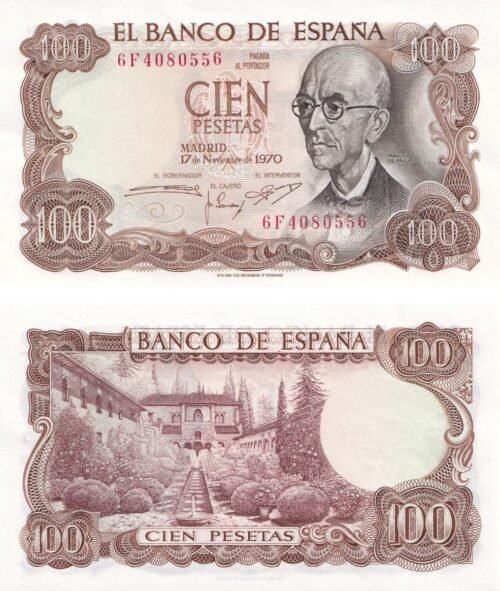
The WorldBanknotes.eu catalogue currently links FNMT to the Spanish 100 pesetas dated 17 November 1970. Banco de España’s official banknote reference confirms that FNMT printed the note and that its paper came from the FNMT mill in Burgos. The same source identifies the Manuel de Falla portrait, the Generalife reverse, the named designers and engravers, and the combined intaglio and lithographic process.
In current cataloguing, FNMT and IMBISA must not be treated as interchangeable terms. A peseta note or non-euro export contract may correctly belong to FNMT, while Spain’s present euro quota belongs to IMBISA. The page therefore records institutional continuity without collapsing two legally and operationally distinct printer identities.
Security and Technology
FNMT’s banknote expertise rests on the integration of paper, print and laboratory control. Its security paper is based on cotton linters treated for circulation durability. The laboratory can test paper and polymeric substrates, inks and applied features, and can produce proofs using offset, intaglio, screen printing, typography and foil application.
The 1970 100-peseta note provides a clear historical example. Its security structure combines engraved portrait work, a Manuel de Falla watermark, lithographic colour layers, intaglio detail and complex ornamental line structures. These features should be described as properties of the documented issue, not as a universal FNMT template.
Modern FNMT activity also includes digital identity and electronic certification. Those services belong to the same institutional security culture but should not be presented as banknote technologies. The most useful collector record preserves the boundary between physical currency manufacture, security-paper supply, protected documents and digital trust.
For Collectors
FNMT is one of the clearest case studies in how a national printer changes when a country moves from a sovereign paper currency into a monetary union. Peseta notes show direct FNMT authorship, often paired with paper from Burgos. Euro notes require a separate IMBISA attribution and the wider Eurosystem production framework.
The catalogue’s 100-peseta note is particularly suitable for close study because official documentation identifies the complete production chain. Collectors can compare the intaglio portrait, lithographic colour, watermark, plate signatures and paper characteristics against the formal Banco de España description rather than relying on a generic printer assumption.
When cataloguing later Spanish issues, record the issuing authority, printer and paper mill independently. The guide to how banknotes are printed helps separate each manufacturing stage, while the printer field should always reflect the entity responsible for the finished note.
Banknotes Printed by Fábrica Nacional de Moneda y Timbre
Selected References
- FNMT-RCM — Institutional Information
- FNMT-RCM — Banknotes
- Banco de España — Exchangeable Peseta Banknotes
- Banco de España — History of the Peseta
- FNMT-RCM — Security Paper
- FNMT-RCM — Laboratory
- Banco de España — IMBISA Incorporated to Produce Euro Banknotes
- Banco de España — IMBISA and Cash Production in Spain